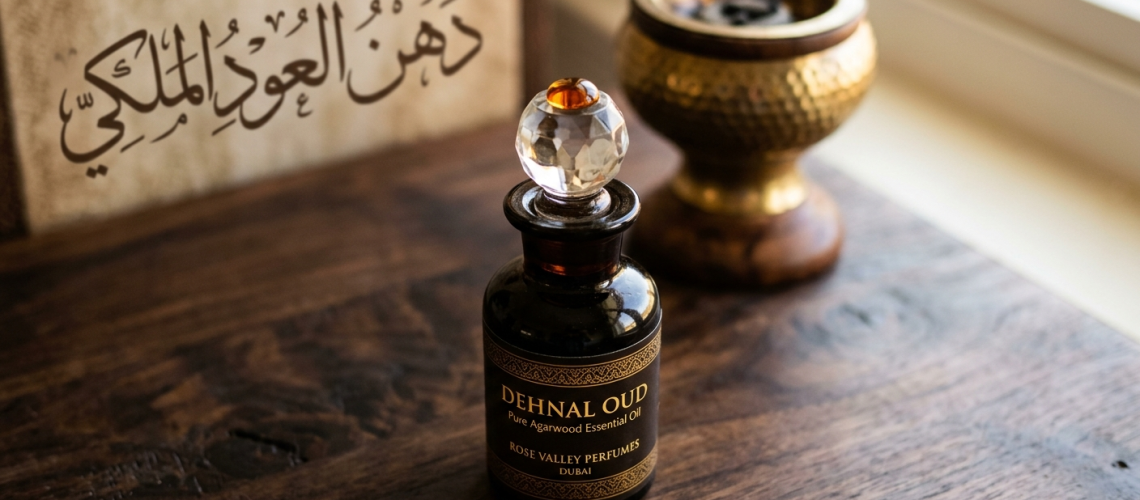
Dehnal Oud (or Dehn Al Oudh) is an Arabic phrase meaning “fat of the wood”. It refers to the pure, highly concentrated essential oil extracted from the resinous heartwood of the rare Aquilaria (Agarwood) tree. It is entirely free of alcohol and is prized for its deeply woody, earthy, and long-lasting aroma.
What Is Dehnal Oud?
Dehnal Oud – also written as Dehn Al Oud or Dehn Al Oudh – is the pure, undiluted essential oil extracted from the resin-saturated heartwood of the Agarwood tree (Aquilaria genus). It is the world’s most precious and expensive perfume oil, universally known as “liquid gold” across Arabian fragrance culture.
Here are the essential facts about what is Dehnal Oud at a glance:
| Fact | Detail |
| What it is | 100% pure Agarwood essential oil – no alcohol, no carrier, no dilution |
| Where it comes from | South and Southeast Asia – India, Cambodia, Vietnam, Malaysia, Indonesia |
| How it forms | Inside a living Aquilaria tree after natural fungal infection |
| Formation time | 10 to 40+ years inside a living tree |
| Concentration | The most concentrated fragrance substance on earth |
| Longevity on skin | 12 to 24+ hours from a single application |
| Price | High-grade wild oil can exceed $1,000 per gram |
| Traditional use | Applied to pulse points as a non-alcoholic attar |
| Cultural history | Referenced in the Vedas, the Bible, and Hadith – 3,000+ years of use |
Before Perfume Bottles Existed, There Was Dehnal Oud
Close your eyes and picture this for a moment.
A merchant travelling along the ancient Silk Road, somewhere between the forests of Assam and the spice markets of Oman, opens a small clay vessel. A single dark, viscous drop catches the firelight. He touches it to his wrist – and the entire room shifts. The air thickens with woodsmoke, warm leather, damp earth, and something deeply sweet, all arriving at once and slowly dissolving into each other across hours. Every person in that room remembers the scent for the rest of their lives.
That oil was Dehnal Oud.
Long before Chanel designed a bottle, before a perfumer sat at a laboratory bench working with synthetic molecules, before fragrance became a commodity sold at department store counters – Dehnal Oud existed. It was:
- Worn by the Prophet Muhammad (PBUH) as his personal fragrance of choice.
- Burned in the courts of Mughal emperors across the Indian subcontinent.
- Treasured by Japanese samurai as prizes of war and refinement.
- Traded along ancient Silk Road routes at prices that rivaled gold itself.
Not because of clever branding or marketing. But because it is genuinely, verifiably, and irreplaceably extraordinary.
Today, the global fragrance industry is worth hundreds of billions of dollars. It is filled with synthetic accords, engineered molecules, and mass-produced sprays built to appeal to as many people as possible. And sitting at the very top of that entire world – untouched, unreplicated, uncompromised – is a small, dark bottle of pure Dehnal Oud.
In this complete guide, you will discover:
- Exactly what Dehnal Oud is and what makes it truly different from every other fragrance.
- Why its price reflects honest biology and production reality – not luxury inflation.
- Which varieties exist, where they come from, and how they differ in character.
- How Dehnal Oud has shaped human civilisation across 3,000 years of recorded history.
- How to apply it correctly to maximise longevity and experience.
- How to identify genuine Dehnal Oud and protect yourself from fakes.
What Is Dehnal Oud? The Full Definition
The Meaning Behind the Name
The name itself is the most accurate description in all of perfumery.
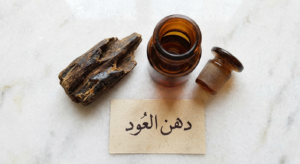
- “Dehn” (دهن) in Arabic means fat, oil, or concentrated essence – the extracted soul drawn from a substance.
- “Oud” (عود) simply means wood.
- Together: “the oil of the wood” – or more precisely, “the fat extracted from wood.”
It is an ancient name and a perfectly accurate one. Centuries before essential oil science had a vocabulary, Arabic traders named this substance with complete precision.
You will encounter this oil spelled many ways depending on the culture and market. All of these refer to exactly the same substance:
- Dehnal Oud – most common in Gulf Arabic transliteration.
- Dehn Al Oud – used widely across UAE and Saudi markets.
- Dehn Al Oudh – common in Omani and South Asian contexts.
- Dahn Al Oud / Dhan Al Oud – regional variations across the Indian subcontinent.
The spelling variation exists because Arabic transliteration into English has never been fully standardised – not because the products themselves are different. When you are searching for this oil and see different spellings, you are always looking for the same thing: pure Agarwood essential oil.
What Dehnal Oud Actually Is – And What It Is Not
Dehnal Oud is a 100% pure essential oil. Full stop.
Understanding what it is not is just as important:
- It is not a fragrance blend.
- It is not a diluted attar mixed with carrier oil.
- It is not an oud-scented spray in alcohol.
- It is not an “oud accord” made from synthetic molecules in a laboratory.
- It is the raw, undiluted oil distilled from resin-saturated Agarwood heartwood – nothing added and nothing removed.
To understand why this matters, look at where Dehnal Oud sits in the fragrance concentration scale:
| Fragrance Format | Aromatic Concentration | Comparison to Dehnal Oud |
| Dehnal Oud – Pure Oil | 100% | The benchmark |
| Perfume / Extrait de Parfum | 20 – 40% | 2.5× to 5× weaker |
| Eau de Parfum (EDP) | 15 – 20% | 5× to 7× weaker |
| Eau de Toilette (EDT) | 5 – 15% | 7× to 20× weaker |
| Eau de Cologne (EDC) | 2 – 5% | 20× to 50× weaker |
Dehnal Oud is five to fifty times more concentrated than any spray perfume on the market. That is not a marketing claim – it is basic chemistry.
Three direct consequences of that concentration:
- It is applied in drops, not sprayed – a tiny amount delivers full presence.
- A small bottle lasts months or even years – even with daily use.
- A single morning application remains with you well past midnight – sometimes for a full 24 hours.
The most important distinction any buyer must understand:
When a luxury brand releases an “oud fragrance spray,” they typically use a tiny percentage of oud oil – or in most cases, a synthetic oud accord – blended into an alcohol-based composition. The result may smell pleasant. But it is not Dehnal Oud. Calling an oud-scented spray “Dehnal Oud” is like calling a glass of orange-flavoured water freshly squeezed orange juice. The names share territory. The substances do not.
What Does Dehnal Oud Actually Smell Like?
This is the question that language struggles to fully answer.
Dehnal Oud does not smell like one thing. It smells like a journey – one that evolves and changes across hours on your skin, shifting character as it responds to your body temperature, your personal chemistry, and the gradual release of hundreds of different aromatic compounds over time. Fragrance experts call this “development,” and almost nothing in the world of perfumery develops the way genuine Dehnal Oud does.
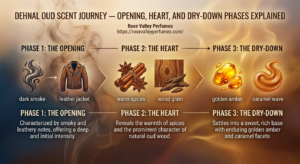
Here is what that journey typically looks like across a full day of wear:
Phase 1 – The Opening (First 15 Minutes)
- The wood arrives first – dark, dense, with a suggestion of smoke.
- A thread of warm leather and damp earth sits underneath.
- In some varieties, a subtle medicinal quality appears briefly.
- The opening is bold and direct – the full, unapologetic weight of what Dehnal Oud is.
- First-time wearers are often surprised by the intensity; those familiar with synthetic oud accords will immediately notice the difference in depth and authenticity.
Phase 2 – The Heart (15 Minutes to 2 Hours)
- The initial smoke softens and becomes warmer.
- A depth develops somewhere between warm spice and sacred incense.
- Depending on origin, you may notice a floral thread, a fruity undercurrent, or a deepening leathery richness.
- Hundreds of individual aromatic compounds are unfolding simultaneously – each at their own pace, interacting with your unique skin chemistry.
- This is where Dehnal Oud separates completely from everything synthetic.
Phase 3 – The Dry-Down (2 Hours to 12+ Hours)
- By the time most spray perfumes have completely evaporated, Dehnal Oud is entering its most beautiful phase.
- The base becomes warm, balsamic, and almost caramel-sweet.
- The woodiness softens to something skin-close and deeply personal.
- The scent does not fade – it transforms. This transformation across a full day of wear is one of the most compelling experiences in all of fragrance.
Important note on origin and scent: The scent profile varies significantly by where the oil comes from. Hindi Agarwood oil from India opens with a darker, more animalic intensity. Cambodian oil is sweeter and immediately approachable. Vietnamese Agarwood carries a silky, honeyed elegance that connoisseurs describe as unmistakably royal. Understanding these differences is part of what makes the world of pure Dehnal Oud a genuine art form to explore.
How Dehnal Oud Is Created: Nature’s Most Unlikely Luxury
Most precious things in this world become precious because of human effort – skilled hands, rare materials, and years of craft. Dehnal Oud is fundamentally different. Its preciousness begins with biology. With a tree. With an infection. And with time measured not in weeks, but in decades.
The Aquilaria Tree – Before the Magic Happens
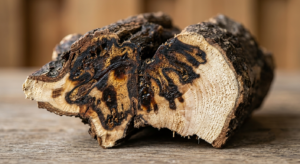
Aquilaria is a genus of approximately 21 recognised species of large tropical trees, native to the rainforests of South and Southeast Asia. In its healthy, uninfected state, the Aquilaria tree is completely unremarkable:
- Its wood is pale, almost white in colour.
- It is lightweight – far lighter than the infected material.
- It is entirely without fragrance. A healthy Aquilaria tree carries no aroma whatsoever.
- It holds no commercial value for perfumery in its uninfected state.
These trees grow across a wide natural range that includes:
- Northeastern India and Bangladesh – home to Aquilaria agallocha, the source of prized Hindi Oud.
- Cambodia and Vietnam – home to Aquilaria crassna, producing Cambodian and Vietnamese varieties.
- Malaysia and Indonesia – home to Aquilaria malaccensis, now protected under international conservation law.
- Sri Lanka – producing a distinctive spicy, rich variety of growing international recognition.
- Papua New Guinea – a newer origin producing cleaner, sweeter oil for accessible entry-level purchases.
- Southern China – home to Aquilaria sinensis, dominant in the Chinese Agarwood market.
The geography of where each tree grows – the soil composition, altitude, rainfall patterns, and surrounding forest biodiversity – directly shapes the aromatic character of any oil eventually produced from it. The tree does not just produce the oil. In a meaningful sense, the tree is the oil.
The Infection That Births Agarwood
Here is where the story becomes genuinely extraordinary.
When an Aquilaria tree is wounded or attacked – most commonly through infection by specific mould-like fungi including species related to Phialophora parasitica and Fusarium solani – something remarkable happens inside the heartwood. The tree does not simply succumb. It fights back.
Here is how the process unfolds inside the living tree:
- The fungal attack begins – the tree is wounded or infected, triggering its biological defence response.
- The tree produces oleoresin – a dark, dense, intensely aromatic resin deep within the heartwood, designed as a biochemical fortress against the invader.
- The resin saturates the wood fibres – gradually, over years and then decades, transforming pale, odourless timber into dark, heavy, intensely fragrant Agarwood.
- The resin deepens with time – the longer the infection continues, the more saturated and aromatic the wood becomes.
- Decades later, the Agarwood is ready – only now does the heartwood hold the fragrant material from which Dehnal Oud can be distilled.
Key facts about this natural biological process:
- The minimum formation time is 10 years in managed plantation conditions.
- In wild trees, the finest resin development can unfold over 30 to 40 years or more.
- Fewer than one in ten wild Aquilaria trees ever naturally develop Agarwood – the majority live and die without producing the resin that makes them valuable.
- Even in trees that do become infected, quality varies enormously – shaped by the specific fungi, the tree’s individual stress response, soil microbiome, and decades of accumulated ecological interaction.
- No factory can replicate this process. Nature retains ultimate control, regardless of how advanced farming technology becomes.
Wild Agarwood vs. Plantation Agarwood: What Every Buyer Should Know
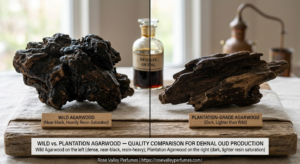
The Agarwood market today contains two fundamentally different categories of raw material. Understanding this distinction is essential for anyone investing in genuine Dehnal Oud.
| Criteria | Wild Agarwood | Plantation Agarwood |
| Source | Naturally infected trees in old-growth forest | Deliberately inoculated trees in managed cultivation |
| Resin development | 15 to 40+ years | 5 to 15 years |
| Scent complexity | Highest – shaped by decades of genuine forest ecology | Good to excellent – more uniform, slightly less layered |
| Legal status | CITES-regulated; requires documentation for international trade | Permitted with certification – more straightforward |
| Availability | Critically limited and declining | Growing, more consistent supply |
| Price | Commands the highest market premiums | More varied and accessible pricing |
Additional facts about Wild Agarwood:
- Most Aquilaria species are now listed under CITES (Convention on International Trade in Endangered Species).
- Aquilaria malaccensis is specifically listed under CITES Appendix II due to severe overharvesting pressure.
- Genuine wild-sourced Dehnal Oud from legally compliant operations carries the highest scent complexity in the market.
Additional facts about Plantation Agarwood:
- Produced using fungal inoculation techniques that trigger the tree’s natural resin response.
- Allows more consistent supply and supports the long-term sustainability of Agarwood production.
- Delivers excellent quality oil, particularly from well-managed operations with longer cultivation periods.
From Forest to Flask: How Dehnal Oud Oil Is Extracted
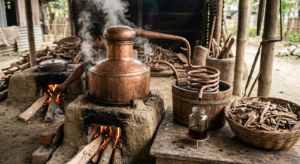
Understanding how Dehnal Oud is made is the fastest way to truly understand why it costs what it does. Every single stage of the production process is slow, highly skilled, and dependent on variables that absolutely cannot be rushed.
Step 1 – Harvesting the Resinous Heartwood
Once an Aquilaria tree is identified as having developed sufficient Agarwood, skilled harvesters begin the careful separation process.
What harvesters look and feel for:
- Colour – infected portions are dark brown to near-black; uninfected wood is pale and worthless for perfumery.
- Weight – resin-saturated Agarwood is noticeably heavier than the surrounding uninfected wood in the same tree.
- Smell – a trained harvester can detect the faint aroma of Agarwood even before any distillation begins.
- Touch – resin-saturated wood feels denser and harder than the pale surrounding material.
Yield reality at the harvesting stage:
- A single Aquilaria tree may yield only 1 to 3 kilograms of usable resinous heartwood after all uninfected material has been removed.
- For wild-sourced trees with particularly heavy infection, the yield may be somewhat higher – but these trees represent the rarest end of an already rare supply chain.
Step 2 – Soaking and Preparation
The harvested wood is chipped or coarsely ground, then submerged in clean water.
Key details about the soaking process:
- Soaking duration ranges from two weeks to six months, depending on the distiller’s tradition and wood density.
- The soak softens the wood fibres and begins releasing aromatic compounds into solution.
- Soaking duration, water temperature, and water quality are closely guarded craft variables – each master distiller has their own tradition developed over generations.
- This pre-distillation stage directly influences the final character of the oil – it is not a mechanical step but a skilled craft decision.
Step 3 – Hydro-Distillation: The Traditional Method
This is the heart of Dehnal Oud production – and the stage that most clearly explains its price.
The full distillation process, step by step:
- Soaked, prepared Agarwood chips are loaded into copper or steel distillation vessels.
- Water is added and the vessel is sealed tightly.
- Low, controlled heat is applied slowly – never rushed, never high.
- Steam passes through the wood, vaporising the volatile aromatic compounds embedded in the resin.
- The vapour travels through a condensing coil cooled by cold water, returning it to liquid form.
- The condensed liquid separates naturally – the essential oil floats on the surface of the water.
- The oil is carefully collected using a Florentine flask or by hand – drop by drop.
The extraordinary yield numbers:
- Producing 12 ml of premium Dehnal Oud requires between 20 and 80 kilograms of high-quality infected Agarwood heartwood.
- For the finest grades from wild-sourced Hindi or Vietnamese material, the ratio is sometimes even more extreme.
- A full distillation run takes 10 to 30 days from start to finish – not hours. Most essential oils distil in hours. Dehnal Oud demands weeks.
Step 4 – Why Slow Distillation Defines Quality
Speed is the single greatest enemy of quality in Dehnal Oud production. Here is why:
The consequences of fast, high-heat distillation:
- Destroys the most delicate aromatic molecules before they can be captured.
- Results in an oil that smells harsh, one-dimensional, and what experienced distillers describe as “barnyard.”
- Loses the sweetness, complexity, and elegant dry-down that define premium Dehnal Oud.
The benefits of slow, low-heat distillation:
- Preserves the full spectrum of aromatic molecules in their natural proportions.
- Captures the lighter, more volatile top-note compounds without destroying them.
- Gives heavier base compounds the time they need to fully release.
- Produces an oil with layered depth, sustained sweetness, and extraordinary longevity.
The fundamental truth of Dehnal Oud pricing: The cost is partly the cost of exceptional raw material. But it is also, fundamentally, the cost of time itself. Every day of a thirty-day distillation run is a day of skilled labour, energy, and dedicated equipment that cannot be used for anything else.
Step 5 – Aging the Oil After Distillation
The finest Dehnal Oud does not go straight from the distillation vessel to the bottle. Like exceptional whisky or fine wine, premium oil is aged in glass or specific wood vessels after distillation is complete.
What aging does to Dehnal Oud:
- Mellows the sharper, more aggressive top notes.
- Deepens the balsamic and sweet qualities of the base.
- Creates greater overall smoothness, roundness, and complexity.
- Increases the value of the oil – properly aged Dehnal Oud commands a significant premium.
Aged Dehnal Oud facts:
- Oil aged for 5 to 10 years post-distillation carries noticeably greater refinement than freshly distilled oil.
- 20-year-aged Dehnal Oud is treated by collectors as an appreciating asset – its value only increases over time.
- This is the absolute pinnacle of the Dehnal Oud market – combining the scarcity of the original production with the irreplaceable quality that only time creates.
The World’s Major Varieties of What Is Dehnal Oud – Where Origin Defines Character
Wine lovers speak of terroir – the idea that the land permanently shapes what grows in it. The soil, the climate, the altitude, and the surrounding ecosystem all leave their signature in every glass. Dehnal Oud works on exactly the same principle.
Where an Aquilaria tree grew, what species it belongs to, what fungi infected it, how long the resin developed – all of this becomes encoded in the final oil. A trained nose can distinguish Hindi Dehnal Oud from Cambodian in a single encounter, just as a skilled sommelier immediately identifies a Burgundy from a Bordeaux.
1. Hindi Dehnal Oud – India
Origin: Primarily the Assam region of northeastern India, from Aquilaria agallocha trees growing in some of the most biodiverse forest ecosystems in the world.
Scent character breakdown:
- Opening: Deep, assertive, animalic – dark, smoky, and leathery with a bold earthiness.
- Heart: Warmth and spice emerge from beneath the smoke, becoming progressively richer.
- Dry-down: A richness and depth that no other variety matches – complex, long-lasting, and commanding.
Key facts:
- The most revered Dehnal Oud variety in traditional Arab Gulf fragrance culture.
- Wild-sourced Hindi Agarwood commands prices of $32,000 to $40,000 per kilogram for the finest grades.
- The most intense Dehnal Oud available – not the most accessible for first-time wearers, but considered the ultimate expression by experienced collectors.
- Best for: Gulf buyers, experienced oud collectors, and anyone who appreciates bold, assertive, deep fragrance.
2. Cambodian Dehnal Oud (Cambodi)
Origin: Cambodia, primarily from Aquilaria crassna trees.
Scent character breakdown:
- Opening: Sweeter and fruitier than Hindi – the animalic intensity is replaced by a gentle warmth.
- Heart: A light spice develops; clean and approachable without losing depth.
- Dry-down: Beautiful, warm, rich, and deeply satisfying – an excellent dry-down.
Key facts:
- The most accessible entry point for first-time wearers of pure Dehnal Oud globally.
- Cambodian variety has introduced more international buyers to pure oud oil than any other origin.
- Delivers genuine complexity and a rewarding dry-down without the challenging boldness of Hindi varieties.
- Best for: First-time Dehnal Oud buyers, Western wearers, and anyone who prefers a sweeter, more approachable character.
3. Vietnamese Dehnal Oud (Nha Trang / Kyara)
Origin: Vietnam, particularly the Nha Trang region, from Aquilaria crassna trees.
Scent character breakdown:
- Opening: Silky and refined – lighter than Hindi, warmer than Cambodian.
- Heart: A honeyed sweetness develops with an almost floral, royal elegance.
- Dry-down: Described by connoisseurs as “transcendent” – smooth, complex, and extraordinarily long-lasting.
Key facts:
- Japanese connoisseurs have revered the finest Vietnamese Agarwood as Kyara – the absolute highest grade – for centuries.
- Kyara-grade Vietnamese Agarwood costs more per gram than gold on the Japanese market.
- The most expensive and sought-after Dehnal Oud variety in the world.
- Best for: Connoisseurs, collectors, and buyers seeking the ultimate refinement in pure Dehnal Oud.
4. Malaysian Dehnal Oud
Origin: Malaysia, from Aquilaria malaccensis trees – now protected under CITES Appendix II.
Scent character breakdown:
- Opening: Earthy, cool, and quietly complex – a deep forest quality.
- Heart: A subtle medicinal edge develops, associated with long, old-growth resin development.
- Dry-down: Meditative, woody, and deeply calming – a scent that rewards patient attention.
Key facts:
- The variety most closely associated with Japan’s formal Kōdō incense ceremony tradition.
- Aquilaria malaccensis is CITES Appendix II protected – legally sourced supply is increasingly limited.
- The Malaysian Muri Super represents this extraordinary origin at its finest.
- Best for: Buyers who appreciate meditative, complex fragrance – and those interested in the Japanese oud appreciation tradition.
5. Sri Lankan Dehnal Oud
Origin: Sri Lanka, from Aquilaria trees native to the island’s tropical forests.
Scent character breakdown:
- Opening: Noticeably spicier and warmer than both Hindi and Cambodian.
- Heart: A richness develops that reads almost like a natural blend of Indian and Cambodian character.
- Dry-down: Deep, warm amber with a long, satisfying base.
Key facts:
- One of the rarer varieties on the global market – growing in international collector recognition.
- Sri Lankan Agarwood is increasingly prized as supply constraints tighten on other origins.
- Distinctive, spicy-rich profile makes it a highly memorable fragrance experience.
- Best for: Collectors seeking something genuinely uncommon with a distinctive spice-forward character.
6. Indonesian and Brunei Dehnal Oud
Origin: Indonesia and Brunei, from Aquilaria malaccensis and related species across the archipelago.
Scent character breakdown:
- Opening: Rich and layered – sitting comfortably between the boldness of Hindi and the sweetness of Cambodian.
- Heart: A full-bodied warmth develops with excellent projection.
- Dry-down: Long-lasting and deeply satisfying – highly regarded for daily wear in Gulf culture.
Key facts:
- Highly regarded by Gulf buyers for its full-bodied, long-lasting character.
- Indonesian and Brunei Agarwood varieties represent some of the most accessible high-quality Dehnal Oud available.
- A reliable daily-wear choice for those who have outgrown Cambodian varieties but find full Hindi intensity overwhelming.
- Best for: Experienced oud wearers seeking exceptional depth with greater approachability than pure Hindi varieties.
A note on building your Dehnal Oud preference:
Understanding these varieties is the first step to finding the oil that truly resonates with you personally. Consider this typical collector journey:
- Start with Cambodian – the sweetest, most approachable entry point.
- Progress to Sri Lankan or Indonesian – greater depth, distinctive character, more complexity.
- Explore Vietnamese – the pinnacle of refinement and silky elegance.
- Arrive at Hindi – the most intense, most revered, and most deeply traditional expression of Dehnal Oud.
This journey can take years, and for most collectors, it genuinely never fully ends.
Six Reasons Dehnal Oud Is the Most Precious Perfume Oil in the World
The preciousness of Dehnal Oud is not a position manufactured by clever marketing. It is the direct product of verifiable biology, documented production economics, irreproducible chemical complexity, and cultural history that no other fragrance substance in the world comes close to matching.
Each of the following six reasons stands completely on its own. Together, they are overwhelming.
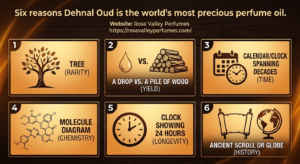
Reason 1 – Its Rarity Is Biological, Not Manufactured
Most precious things are scarce because of geography:
- Diamonds – because gem-quality stones form only in specific geological conditions.
- Gold – because the earth contains a finite, measurable quantity of it.
Dehnal Oud’s rarity is entirely different in nature. It is created by a biological event – a fungal infection inside a living tree – that unfolds over decades and cannot be:
- Reliably predicted in advance.
- Artificially accelerated without destroying quality.
- Meaningfully replicated in any factory, anywhere on earth.
Even on the world’s most sophisticated Agarwood plantation, with perfectly controlled conditions and deliberately triggered infection, the tree retains ultimate authority over quality. Nature decided what Dehnal Oud would be. Nature still decides how much of it exists.
Reason 2 – The Yield Is Almost Impossibly Small
Consider these production numbers carefully:
- Up to 80 kilograms of infected Agarwood heartwood may be required to produce a single 12 ml bottle of premium Dehnal Oud oil.
- Decades of biological formation + kilograms of carefully harvested wood + weeks of skilled distillation = an amount of oil that fits in the palm of your hand.
- For wild-sourced material from the finest origins, the ratio is sometimes even more extreme.
There is almost no other natural product in existence with such a disproportionate relationship between input and output. The numbers justify the price independently of everything else.
Reason 3 – The Time Investment Is Generational
Think about what this production timeline actually means:
- A tree planted today on a commercial plantation may not yield quality Agarwood until 2035 or 2040.
- For wild-sourced material of the highest grade, that tree may have been developing its resin since the 1980s or earlier.
- The person who planted the tree and the person who distils its oil may be two full generations apart.
The resin inside a bottle of premium Dehnal Oud began forming before many of its buyers were born. There is almost nothing else in the luxury goods world where the production timeline spans decades like this.
Reason 4 – The Chemistry Cannot Be Replicated
What is inside genuine Dehnal Oud at the molecular level:
- Hundreds of individual aromatic compounds in a naturally occurring ratio.
- Sesquiterpenes – including agarospirol, jinkohol, and kusunol – responsible for the deep, complex woody character.
- Chromone derivatives – responsible for the sweet, balsamic base notes that define the dry-down.
- The specific ratio of these compounds is shaped by one individual tree, in one specific forest, over one specific span of decades. No two batches are chemically identical.
Why synthetic alternatives fall short:
- Perfumery chemists have spent decades attempting to replicate the Agarwood aroma.
- The best synthetic oud accords come close in isolation – but are immediately recognisable as inferior to any experienced nose.
- Dehnal Oud contains more individual aromatic compounds than rose absolute or jasmine absolute – two of the most chemically complex natural fragrances in existence.
- Natural Agarwood oil still commands over 77% of the global agarwood essential oil market in 2025 despite synthetic alternatives being dramatically cheaper to produce. The market has voted clearly.
Reason 5 – Longevity That Defies All Comparison
A direct comparison of how spray perfumes and Dehnal Oud behave on skin:
| Stage | Spray Perfume (EDP) | Genuine Dehnal Oud |
| 0–15 minutes | Top notes strong and fresh | Opening: bold, dark, assertive |
| 15–60 minutes | Top notes begin to fade | Heart: spice, warmth developing |
| 2–4 hours | Heart notes fading | Dry-down: balsamic, sweet, deep |
| 6 hours | Light base note trace only | Still fully and clearly present |
| 12 hours | Essentially gone | Often still clearly detectable |
| 24+ hours | Nothing detectable | Premium varieties still present on fabric |
Why Dehnal Oud lasts so much longer:
- No alcohol to evaporate and carry fragrance away.
- 100% pure aromatic molecules – many with high molecular weights that bind to skin and fabric.
- The oil does not disappear. It transforms. The dry-down is not a faded version of the opening – it is a completely different and equally beautiful phase of the same fragrance.
Reason 6 – Three Thousand Years of Unbroken Human Reverence
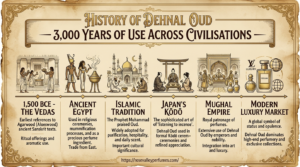
No other fragrance substance has been continuously revered across as many civilisations, over as long a period, as Dehnal Oud. A timeline of the most significant moments:
| Period | Civilisation | How Dehnal Oud Was Used |
| ~1,500 BCE | Ancient India | Documented in the Sanskrit Vedas as aguru – sacred ritual and royal tribute |
| ~3,000 years ago | Ancient Egypt | Used in temple ritual and burial rites – confirmed in archaeological analysis |
| ~950 BCE | Hebrew tradition | Referenced in Numbers 24:6, Psalms 45, and the Gospel of John as “aloes” |
| ~600 CE | Islamic world | Praised by the Prophet Muhammad (PBUH) in multiple authentic Hadith |
| 595 CE | Japan | First Agarwood arrives; Kōdō ceremony tradition eventually develops around it |
| 14th–19th century | Mughal Empire | Central to imperial perfumery; shaped the Kannauj attar tradition of India |
| 2000s–present | Global | Western luxury houses begin incorporating oud into mainstream fragrance |
The accumulated weight of 3,000+ years of recorded human reverence is part of what you carry when you apply Dehnal Oud. No synthetic molecule can give you that.
3,000 Years of Dehnal Oud: A History Worn by Prophets, Emperors, and Kings
To genuinely understand why Dehnal Oud commands the reverence it does today, you need to understand the full depth of its history. This is not a substance that became fashionable. It is a substance that humanity has treasured continuously for longer than most modern nations have existed.
Ancient Egypt, India, and the Hebrew Bible
Ancient Egypt (~3,000 years ago):
- Agarwood incense incorporated into Egyptian funeral rites and temple ritual.
- Confirmed through scientific analysis of aromatic material recovered from burial sites.
- In Egyptian religion, where afterlife preparation was of supreme importance, the inclusion of Agarwood was a profound statement of sacred value.
Ancient India (~1,500–1,000 BCE):
- Documented as a precious fragrant substance in the Sanskrit Vedas – among the oldest written records in human history.
- Referenced multiple times in the Mahabharata, describing royal courts and sacred spaces perfumed with its smoke.
- Known as Aguru – listed among the eight most precious fragrant gifts of the natural world.
The Hebrew Bible:
- Referenced as “aloes” or “lign aloes” in multiple texts:
- Numbers 24:6 – Balaam uses Agarwood as a metaphor for divine blessing in his vision.
- Psalms 45 – The king’s robes described as fragrant with myrrh, aloes, and cassia.
- Gospel of John (19:39) – Nicodemus brings seventy-five pounds of aloes and myrrh for the burial of Jesus.
- The quantity mentioned in John – seventy-five pounds – powerfully underlines how precious and significant this substance was considered in that culture.
The Islamic Tradition: A Scent Praised by the Prophet
In Islamic culture, the relationship between Dehnal Oud and faith is not merely cultural – it is documented and specific in authentic religious texts.
Key Islamic references to Agarwood:
- In Sahih al-Bukhari, the Prophet Muhammad (PBUH) described Paradise as a place where Agarwood would burn in censers.
- In separate narrations, Aisha recorded that oud was “the best type of perfume the Prophet loved.”
- The Prophet specifically recommended Agarwood for certain medical treatments in additional narrations.
- Agarwood is also mentioned in the Quran indirectly through references to aloe wood as one of the fragrant trees of Paradise.
The result of this prophetic tradition:
- For 1,400 years, across every corner of the Islamic world, Dehnal Oud has carried the weight of prophetic endorsement.
- For hundreds of millions of Muslims, wearing Dehnal Oud is an act of cultural and spiritual continuity – connecting the present to an unbroken chain of tradition.
- It is not simply a luxury preference. It is part of a living tradition with the deepest possible grounding.
The Arab Gulf Tradition: When Oud Is Simply Daily Life
In Saudi Arabia, the UAE, Kuwait, Oman, and Qatar, Dehnal Oud is not an occasion luxury. It is woven into the fabric of daily life in a way that continually surprises visitors from other cultures.
How Dehnal Oud is used daily in Gulf culture:
- Men apply it before Friday prayers – as part of spiritual preparation and respect.
- It is worn before important business meetings – a statement of personal distinction and cultural identity.
- Applied at weddings, celebrations, and family gatherings – marking significant moments of life.
- Used in daily personal grooming as a standard practice – not as a special occasion choice.
- Women wear lighter varieties as their personal signature scent throughout the day.
Bakhoor – the companion ritual to Dehnal Oud:
Burning bakhoor – Agarwood chips heated on charcoal in a mabkhara incense burner – to perfume the home and welcome guests is an act of Gulf hospitality as significant as serving Arabic coffee. The practice communicates:
- Welcome – the home is perfumed in honour of the guest.
- Status – the quality of the bakhoor reflects the host’s taste and generosity.
- Cultural continuity – a practice passed from generation to generation unchanged.
Japan’s Kōdō Ceremony: The World’s First Dehnal Oud Terroir System
Among all the remarkable chapters in the history of Dehnal Oud, this is the one that most Western fragrance writing completely overlooks: the Japanese tradition of Kōdō (香道) – “The Way of Incense.”
The timeline of Agarwood in Japan:
- 538 CE – Agarwood first imported from China via Korea for Buddhist temple use, alongside the introduction of Buddhism to Japan.
- 595 CE – According to the Nihon Shoki, a fragrant Agarwood log drifts ashore on Awaji Island. Those who find it notice its extraordinary scent when heated and present it to the imperial court.
- Muromachi period (1336–1573) – The appreciation of Agarwood is codified into one of the three classical Japanese arts of refinement – alongside the tea ceremony (chadō) and flower arranging (ikebana).
- 1436–1490 – Shogun Ashikaga Yoshimasa commissions the development of Rikkoku Gomi – the world’s first formal terroir classification for Agarwood.
The Rikkoku Gomi classification system:
- Rikkoku (Six Countries): Classified Agarwood by six origin categories – Kyara, Rakoku, Manaka, Manaban, Sumatora, and Sasora.
- Gomi (Five Tastes): Described aromatic character using the vocabulary of flavour – sweet, sour, hot, salty, and bitter.
- This system was developed centuries before the concept of wine terroir emerged in European culture.
Kyara – the pinnacle of the Japanese tradition:
- The highest grade – Kyara – comes from a very limited area in Vietnam.
- The most famous piece of Kyara in history, the Ranjyatai, dating to at least the 10th century, is kept at the Shōsōin imperial treasury in Nara – cut from only by emperors and warlords throughout Japanese history.
- Kyara-grade material today costs more per gram than gold on the Japanese market.
How Kōdō is practised:
- Participants do not “smell” incense – they are said to listen to it (monkoh).
- An act of meditative sensory engagement that recognises the full complexity and evolution of fragrance.
- Samurai prepared for battle by purifying their minds with Agarwood incense – they believed it focused and centred the spirit.
The Mughal Legacy and the Birth of Indian Attar Culture
The Mughal Empire and Dehnal Oud:
- Mughal emperors used Dehnal Oud as personal fragrance, in ritual bathing waters, to perfume court fabrics and chambers, and as diplomatic gifts of the highest possible significance.
- The Mughal court’s deep investment in fine fragrance directly shaped the development of Kannauj – the ancient city in Uttar Pradesh, India.
- Kannauj remains the heartland of traditional Indian attar production to this day.
- In Kannauj, Dehnal Oud still occupies the highest tier of every product category, worked using techniques passed down through families for hundreds of years – techniques that trace directly to the Mughal patronage era.
Dehnal Oud Enters the Modern Luxury World
How Western luxury perfumery discovered oud:
- 2007 – Tom Ford releases Oud Wood – widely credited as one of the first mainstream Western luxury perfumes to make oud a central, acknowledged note.
- Maison Francis Kurkdjian, Amouage, Creed, and dozens of niche houses follow with their own oud-centric compositions.
- Millions of Western consumers are introduced to the idea of oud as a legitimate fragrance category.
The important distinction that remains:
- These products are oud-inspired compositions – blended, diluted, and deliberately modified to make oud accessible to audiences who did not grow up with it.
- Pure Dehnal Oud oil has not been diluted, modified, or made more accessible for mass consumption. It remains exactly what it has always been – uncompromising, complex, and entirely itself.
- That is its distinction, and that is precisely why serious fragrance enthusiasts around the world continue to seek it out above everything the luxury spray market offers.
How to Apply Dehnal Oud: The Traditional and Correct Method
Applying Dehnal Oud correctly requires almost no effort – but a few small things make a genuine difference to the experience, longevity, and how much precious oil you use.
The Traditional Application Method – Step by Step
- Open the bottle carefully. Touch the glass applicator rod or bottle stopper lightly to the surface of the oil, drawing just enough to coat the very tip. Do not pour directly onto skin or saturate the stopper.
- Bring the applicator to your chosen pulse point. Touch it gently and briefly to the skin surface. Do not press. Do not drag or sweep.
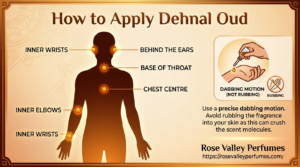
- Never rub the application site. This is the single most common mistake made by first-time Dehnal Oud wearers. Rubbing breaks the aromatic molecular chains prematurely, destroying the structured scent development – particularly the beautiful dry-down phase. Pat or dab only, then leave the oil entirely alone.
- Choose your pulse points thoughtfully. The ideal application sites – where body heat aids continuous aromatic release throughout the day – are:
- Inner wrists – the most common traditional application point.
- Behind the ears – excellent for subtle, intimate projection.
- Inner elbows – warm, slightly hidden, and excellent for longevity.
- Base of the throat – creates a rising scent trail that is unmistakable.
- Centre of the chest – warms the oil against the body all day.
- Wait a minimum of 15 minutes before forming any judgement. The opening phase is not the full picture. The real character of Dehnal Oud reveals itself in the heart – and its full depth only arrives in the dry-down.
How Much Dehnal Oud to Use
| Amount | Experience | Occasion |
| 1 drop | Subtle, skin-close, personal – felt before it is noticed | Quiet days, private wear, at home |
| 2 drops | Clearly present without asserting itself | Daily wear for most occasions |
| 3 drops | A deliberate and recognisable statement | Important occasions, celebrations |
| More than 3 | Almost never necessary with genuine pure oil | Rarely, if ever |
The extraordinary concentration of real Dehnal Oud means quantity is never the key to impact. One to two drops is sufficient for almost every occasion.
Advanced Application: Fabric, Layering, and Bakhoor
Fabric application:
- A single drop on natural fabric – a wool coat collar, a cotton abaya, a linen shirt – can hold the scent for two to three full days.
- Natural fibres absorb and preserve the deeper base notes particularly well.
- Fabric application creates a warm, ambient scent presence around the wearer – gentle rather than assertive.
- Avoid synthetic fabrics – they do not hold pure oud oil the same way and can sometimes alter its character.
Bakhoor layering (traditional Gulf method):
- Apply Dehnal Oud to the skin first.
- Light your bakhoor in a mabkhara incense burner and allow it to begin producing fragrant smoke.
- Stand briefly over or beside the rising smoke – allowing it to settle into your hair, abaya, thobe, or garments.
- The oil on the skin and the smoke in the fabric combine to create a total olfactory environment unlike anything in Western fragrance culture – deeply immersive and extraordinarily long-lasting.
Body oil layering (modern technique):
- Apply a small amount of unscented natural body oil to the skin first.
- Allow it to absorb for two to three minutes.
- Apply Dehnal Oud on top.
- The body oil extends projection, softens the opening, and creates a more integrated, skin-close wear – particularly useful in dry climates where bare skin absorbs fragrance quickly.
How to Store Your Dehnal Oud Oil
Essential storage rules:
- Store in a cool, dark location – a drawer, cabinet, or dedicated fragrance storage area. Direct sunlight causes photo-oxidation that gradually alters the top notes.
- Keep the cap tightly sealed at all times when the oil is not in use. Prolonged air exposure can change the character of the oil over time.
- Choose a stable temperature environment – consistent cool temperatures are ideal. Avoid locations that heat up and cool down repeatedly.
- Do not store in a bathroom. Temperature, humidity, and steam fluctuations create an unstable environment for any sensitive oil.
- Do not store near heat sources – radiators, sunny windowsills, and kitchen areas are all unsuitable.
The most important storage fact: Unlike virtually every other fragrance or cosmetic product, genuine Dehnal Oud stored correctly does not expire. Many collectors find that oil stored for five, ten, or twenty years develops greater sweetness, depth, and overall complexity – more valuable and more beautiful than when it was first purchased. A tightly sealed, well-stored bottle of Dehnal Oud is genuinely an appreciating object.
How to Identify Real Dehnal Oud: A Complete Buyer’s Guide to Authenticity
The Dehnal Oud market has a serious and widespread counterfeit problem. Because genuine oil is expensive and synthetic alternatives are dramatically cheaper to produce, strong economic incentives exist to sell diluted, adulterated, or completely synthetic products to buyers who cannot immediately identify the difference.
Here is exactly how to protect every purchase you make.
What Genuine Dehnal Oud Looks, Feels, and Smells Like
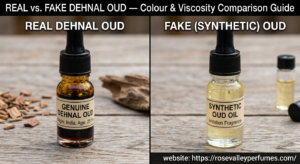
Colour – what to look for:
- Deep amber, dark brown, or near-black.
- The colour should be clearly and visibly dark when held to light.
- Never light-coloured, pale yellow, or clear.
- The darker the colour, generally the higher the resin concentration.
Viscosity – how it should move:
- Noticeably thick – moves slowly like a light syrup or thin honey when the bottle is tilted.
- Clings to the inside of the glass bottle rather than flowing freely.
- Never thin, watery, or free-flowing.
- If it pours or drips freely, it has been cut with carrier oil or replaced with something synthetic.
Scent evolution – the most reliable test:
- Changes significantly and noticeably over 30 to 60 minutes on skin.
- Three distinct phases: opening, heart, and dry-down – all clearly different from each other.
- The dry-down is sweeter and warmer than the opening.
- Synthetic versions are flat, linear, and essentially unchanged from application to two hours later.
- If the scent smells identical after one hour as it did at the moment of application, it is not genuine Dehnal Oud.
Longevity – the durability standard:
- Minimum 8 to 12 hours of clear detection on clean, unscented skin from a single application.
- High-quality varieties often persist for 16 to 24 hours.
- Fading noticeably within 2 to 3 hours is a strong signal of adulteration or synthetic base.
Price – the economic reality:
- Genuine Dehnal Oud is always meaningfully expensive – this is non-negotiable given the production economics.
- Very low prices for large quantities of “pure Dehnal Oud” are economically impossible for authentic material.
Origin information – the seller transparency test:
- Authentic sellers state: country of origin, Aquilaria species, distillation method.
- Vague descriptions like “premium oud oil” or “pure oud” with no origin stated are red flags.
Red Flags That Signal a Fake
Watch carefully for every item on this list before any purchase:
- Very light colour, pale amber, or clear oil in a product described as pure Dehnal Oud.
- Thin, watery consistency that flows freely rather than moving slowly and thickly.
- A “clean,” pleasant, but completely linear scent that never develops or transforms on skin.
- No stated country of origin, species information, or distillation method on the product or listing.
- Marketing language using terms like “oud-inspired,” “oud accord,” “oud fragrance oil,” or “premium oud blend” – every one of these terms describes a synthetic product, not Dehnal Oud.
- Dramatically low prices for large volumes of supposedly pure oil.
- No verifiable seller address, no sourcing transparency, no independent quality verification.
- A product that smells pleasant but “safe” and predictable – genuine Dehnal Oud has a boldness that synthetic accords deliberately avoid.
The Tissue Test: Simple Home Authentication
What you need: One drop of the oil and a clean white cotton tissue.
Step-by-step method:
- Place a single drop of the oil on a clean section of the white tissue.
- Leave it completely undisturbed for 30 to 45 minutes.
- Return to the tissue, observe it visually under good light, and smell it carefully.
What genuine Dehnal Oud produces:
- A visible, persistent dark stain remains – resinous compounds bind to fibres rather than evaporating.
- A clearly detectable scent that has deepened and evolved from the initial impression.
- A warm, complex, balsamic dry-down note that is pleasant and unmistakably multi-layered.
What synthetic or diluted oil produces:
- Little to no stain – the carrier or synthetic base has largely evaporated.
- The scent is faint or entirely absent.
- Any remaining scent is flat and completely unchanged – the same synthetic note it opened with, now just quieter.
The Language Test: Knowing Exactly What You Are Buying
The fragrance market uses specific language that clearly distinguishes authentic Dehnal Oud from synthetic alternatives – if you know what each term actually means.
Language that confirms an authentic product:
| Term | What It Means |
| “Dehnal Oud” / “Dehn Al Oud” / “Dehn Al Oudh” | Pure Agarwood essential oil – authentic terminology |
| “Pure Agarwood essential oil” | Correctly describes undiluted, unblended oil |
| “Hindi Oud / Cambodian Oud / Vietnamese Oud” | Origin-specific – indicates the seller knows their product |
| “Aquilaria [species name]” | Species-level sourcing transparency – a genuine quality signal |
| “Hydro-distilled” / “Steam distilled” | Identifies the extraction method – authentic industry language |
Language that signals synthetic or misleading products:
| Term | What It Actually Means |
| “Oud-inspired” | A synthetic accord designed to suggest the character of oud |
| “Oud accord” | A blended synthetic composition – not an essential oil |
| “Oud fragrance oil” | A perfumery oil – almost always synthetic or heavily diluted |
| “Oud-scented” | Scented like oud – explicitly not oud itself |
| “Premium oud blend” | A blend – explicitly not pure Dehnal Oud oil |
Frequently Asked Questions
What is Dehnal Oud made from?
Dehnal Oud is made from the resin-saturated heartwood of the Agarwood tree (Aquilaria genus) through traditional hydro-distillation. When an Aquilaria tree is infected by specific fungi, it produces a dark, aromatic resin in its heartwood as a biological defence. This resin-saturated wood is harvested, soaked for weeks, and slowly distilled for 10 to 30 days to extract the pure essential oil. Nothing is added – the final product is 100% natural Agarwood oil.
Is Dehnal Oud the same as oud perfume?
No – they are fundamentally different products. Dehnal Oud is 100% pure Agarwood essential oil with no alcohol, no carrier oil, and no added fragrance materials. Most “oud perfumes” are alcohol-based blends that use a small percentage of oud oil – or more commonly a synthetic oud accord – alongside other fragrance ingredients. The difference is comparable to freshly squeezed fruit juice versus a commercially produced fruit-flavoured drink. The name overlaps. The substance does not.
Why is Dehnal Oud so expensive?
The price is justified entirely by biology and production economics – not by branding. Fewer than 10% of wild Aquilaria trees ever develop Agarwood. The resin takes 10 to 40+ years to form. Producing 12 ml of premium oil can require up to 80 kg of infected heartwood. Distillation takes 10 to 30 days. High-grade wild Dehnal Oud can reach $1,000 per gram – sometimes exceeding the spot price of gold.
How long does Dehnal Oud last on skin?
Genuine Dehnal Oud lasts a minimum of 12 hours on clean skin from a single application. High-quality Hindi and Vietnamese varieties regularly persist for 16 to 24 hours, and traces on natural fabric can remain detectable two to three days after application. This longevity results directly from 100% oil concentration – no alcohol evaporates, and the heavy aromatic molecules bind strongly to skin and fabric.
How do I know if Dehnal Oud is real or fake?
Check four things: First, colour – genuine oil is dark amber to near-black, never pale or clear. Second, viscosity – real Dehnal Oud is thick and moves slowly, like a light syrup. Third, scent evolution – apply to wrist and wait 30 to 60 minutes; genuine oil transforms noticeably across phases, while synthetic versions remain flat and unchanging. Fourth, perform the tissue test – one drop left for 30 minutes should leave a persistent stain and a deepening, complex scent. Avoid any product using language like “oud-inspired,” “oud accord,” or “oud blend” – these are synthetic products.
Can women wear Dehnal Oud?
Absolutely – Dehnal Oud has no gender. It has been worn equally by men and women across the Arab Gulf, South Asia, and East Asia for centuries. Cambodian and Vietnamese varieties are particularly popular among women for their sweeter, more approachable character. In Gulf culture, women have always worn Dehnal Oud as a core daily fragrance. The idea that oud is “masculine” is a Western market interpretation with no grounding in the cultures where Dehnal Oud originated.
Is Dehnal Oud halal?
Yes – pure Dehnal Oud is completely halal. It is a 100% natural essential oil containing no alcohol and no animal-derived ingredients. It is specifically praised in authentic Hadith literature and has been an integral part of Muslim personal practice for over 1,400 years, used across all major schools of Islamic jurisprudence without any restriction.
What is the rarest type of Dehnal Oud?
Wild-sourced Vietnamese Dehnal Oud from the Nha Trang region – known in Japan as Kyara – is the rarest and most precious category in existence. Kyara-grade material costs more per gram than gold on the Japanese market. Wild-sourced Hindi Dehnal Oud from old-growth Aquilaria agallocha in Assam is in the same tier of rarity. Aged Dehnal Oud – properly stored and matured for 10 to 20+ years post-distillation – represents the absolute market pinnacle regardless of origin.
Where can I buy genuine Dehnal Oud in Dubai?
Dubai’s Deira district has been the heart of authentic Arabian fragrance trading for generations. For UAE buyers, the essential standard is sourcing from specialists who provide verified origin, species, and distillation information for every product. You can explore our full collection of authentic Dehnal Oud oils, verified-origin Agarwood, and traditional Bukhoor at Rose Valley Perfumes – with stores in Murshid Bazar, Deira Dubai, and full online ordering available. Contact us for guidance on selecting the right variety for your preference and experience level.
A Single Drop, A Thousand Years of Story
We began this article with a simple image: a merchant on an ancient trade route, a small clay vessel, a single dark drop catching firelight. A room shifting. A scent that every person who encountered it remembered for the rest of their lives.
By now, you understand everything that was behind that single drop.
You now know:
- The pale Aquilaria tree standing in a tropical forest, waiting for an infection that may or may not come over the next decade or three.
- The decades of biological alchemy that transform odourless timber into one of the most chemically complex aromatic substances on earth.
- The harvesters who separate resinous heartwood by sight, weight, and smell – and the master distillers who run their copper vessels for thirty days at low heat, collecting precious oil drop by drop.
- The Mughal courts, the Japanese samurai, the Gulf homes where this oil has perfumed the air and marked the significant moments of life for generation after generation.
- The Sanskrit Vedas, the Hadith, the Egyptian burial rites, and the imperial terroir classification systems of medieval Japan – all built around this one substance.
Dehnal Oud is precious not because anyone decided it should be. It is precious because biology, time, irreplaceable craft, and three thousand years of unbroken human recognition have made it exactly that. These are facts that no synthetic alternative, no competitor, and no marketing budget can change or imitate.
When you open a genuine bottle of Dehnal Oud and touch a drop to your wrist, you are not simply applying a fragrance. You are joining a tradition older than most of the world’s religions, wider than any single culture, and deeper than any single lifetime.
That is what one drop carries.
Explore our full collection of authentic Dehnal Oud oils, certified-origin premium Agarwood, and traditional Bukhoor & Oud Muatter at Rose Valley Perfumes.
Proudly serving fragrance lovers in Deira Dubai, across the UAE, and internationally since 1990.