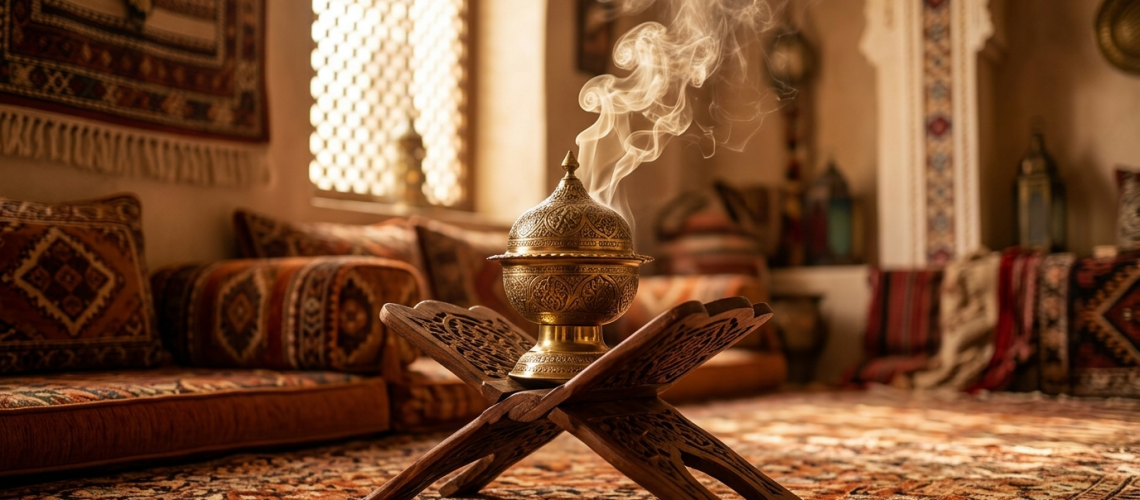
Bukhoor (also spelled Bakhoor) is a traditional Arabic incense made from agarwood wood chips soaked in fragrant oils. how to use bukhoor in Dubai, you need three things: a Mabkhara burner, self-igniting charcoal discs, and metal tongs.
Here is the complete process from start to finish:
- Hold a charcoal disc with metal tongs and light it over an open flame for 20 to 30 seconds until it sparks across the surface.
- Place the lit disc inside the Mabkhara and wait 1 to 2 minutes.
- Once a thin grey ash layer forms over the entire disc surface, place a small piece of bukhoor on top.
- Allow the aromatic smoke to rise and fill the room naturally.
- Hold garments over the smoke for 10 to 15 seconds to scent fabric in the traditional Emirati way.
- Never leave the burning Mabkhara unattended. Allow the charcoal to cool fully – at least 30 to 45 minutes – before touching or cleaning it.
That is the core process. But if you want , how to use bukhoor in Dubai the way it has been done here for centuries – with the right tools, correct technique, cultural awareness, and genuine quality – there is a great deal more worth understanding.
Walk Into Any Dubai Home and You Will Understand Why
There is a moment every visitor to Dubai carries with them long after leaving. You step into someone’s home, a traditional hotel lobby near the creek in Deira, or one of the old shops in Al Fahidi, and before you see anything, you smell it.
Something warm, woody, deep, and unmistakably Arabian rises from a brass burner on a carved stand. Pale smoke curls upward. The host holds the burner briefly under the hem of his kandura, letting the scent settle into the fabric, then passes it to you.
That fragrance is bukhoor. In Dubai, it means you are welcome.
Bukhoor is not simply incense. It is one of the oldest continuous traditions in Emirati culture – older than the city itself. Families across the Arabian Peninsula have been burning it in their homes, passing it among guests, and wearing it in their clothing for over a thousand years. It survived the Bedouin era, the pearl-diving years, the oil era, and the transformation of Dubai into one of the most modern cities in the world. It survived because it means something.
This guide is written for:
- Expats who have just moved to Dubai and want to genuinely understand the culture around them.
- Tourists who encountered this fragrance and want to bring the experience home.
- Residents who received a Mabkhara as a gift and are unsure where to begin.
- Fragrance enthusiasts drawn to the depth and centuries-long history of Arabic aromatic tradition.
Every section in this guide is built from practical knowledge and cultural accuracy. The goal is to help you do this right – and enjoy every part of it.
What Is Bukhoor? The Definition You Actually Need
What Does the Word Bukhoor Mean?
Bukhoor (بخور), also written as bakhoor or bakhur, comes from the Arabic root word meaning “vapor” or “smoke.” The name tells you exactly what the product does – it delivers fragrance through smoke rather than through a spray or liquid carrier. Both spellings are used interchangeably throughout Dubai and the wider UAE.
At its core, bukhoor is made from four key ingredients:
- Agarwood chips – the foundational base material, sourced from the Aquilaria tree and the most prized component.
- Fragrant essential oils – rose, sandalwood, amber, musk, and sometimes saffron are the most common.
- Natural resins – aromatic compounds such as frankincense and labdanum that bind the fragrance and extend the burn duration.
- Blending agents – dried flowers, spices, and natural fixatives that shape the final character of the scent.
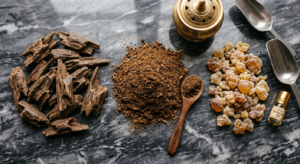
This mixture is dried and sold either as small solid chips, irregularly shaped wood pieces, or as a finely ground powder called Mabsoos. When placed on a heat source, it releases a rich, sustained, aromatic smoke that clings to fabric, hair, and the air of a room for hours – sometimes well into the following day.
How Is Bukhoor Different From Regular Incense?
The difference is not subtle. Here is exactly what separates bukhoor from the incense sticks sold in gift shops:
- Material quality. Incense sticks are made from a bamboo core coated in a mixture of sawdust, powder, and chemical binding agents. Bukhoor is made from real, naturally aged agarwood – a material of genuine rarity, botanical complexity, and cultural depth.
- Fragrance complexity. The scent produced by quality bukhoor is multi-layered and evolves as it burns, moving from lighter top notes through to deeper woody base notes. It can linger in fabric well into the following day.
- Method of use. Incense sticks burn in open air and require no special equipment. Bukhoor requires a dedicated Mabkhara burner, charcoal discs, and the knowledge to use them correctly.
- Cultural weight. In Dubai, burning bukhoor for a guest is a deliberate and meaningful act of hospitality. Lighting a synthetic incense stick carries no comparable cultural significance.
Is Bukhoor the Same as Oud?
This question comes up constantly in Dubai, and the distinction genuinely matters for anyone new to Arabic fragrance.
| Term | What It Is | How It Is Used |
| Oud (Agarwood) | Resinous heartwood of the Aquilaria tree | Burned as chips or distilled into concentrated perfume oil |
| Dehnal Oud (Oud Attar) | Concentrated liquid perfume oil distilled from agarwood | Applied directly to the skin at pulse points |
| Bukhoor | A crafted incense blend using oud chips alongside other aromatics | Burned over charcoal to fragrance rooms and clothing through smoke |
Think of oud as the raw ingredient and bukhoor as the finished fragrance composition – the same way you might think of grapes and wine. Genuine oud oil can reach prices exceeding USD 50,000 per kilogram for the rarest Kyara grade, which explains why premium bukhoor carries the price it does, and why suspiciously cheap “pure oud” bukhoor is almost never what it claims to be.
The Four Main Types of Bukhoor to Know Before You Buy in Dubai
Understanding which type to choose before your first session matters more than most beginners realise. The wrong choice often leads to a frustrating experience – too much smoke, too little fragrance, or a burnt, acrid smell that puts people off entirely.
Type 1 – Oud-Based Bukhoor
Best for: Experienced users, formal occasions, and premium gifting.
Key characteristics:
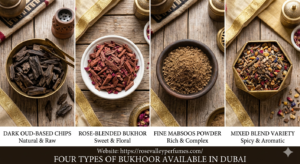
- Made from genuine agarwood chips sourced from India, Cambodia, or Indonesia.
- Produces a deep, dark, woody fragrance with complex resinous and leathery undertones.
- The most traditionally prestigious category – associated with high-end Emirati hospitality and important social occasions.
- Typically the most expensive bukhoor variety on the market.
- Requires the most careful heat management of any type.
Recommended for: Users who are already comfortable with the basic process and want to explore the full depth of Arabic incense tradition.
Type 2 – Rose Bukhoor
Best for: Beginners, everyday home use, and gifting to first-time users.
Key characteristics:
- Blends agarwood base material with rose essential oil and soft floral notes.
- Produces a lighter, warmer, more welcoming fragrance than pure oud.
- More forgiving of small technique errors during charcoal preparation.
- Moderate smoke volume – well-suited for bedrooms, living rooms, and daily home use.
- Available across all price points, including accessible options for new buyers.
Recommended for: Anyone learning how to use bukhoor in Dubai for the first time. The most approachable, enjoyable, and forgiving starting point in the entire category.
Type 3 – Mabsoos (Powdered Bukhoor)
Best for: Quick fragrance impact before events, experienced users who need speed.
Key characteristics:
- Finely ground powder rather than chips or solid pieces.
- Vaporises quickly upon contact with heat, releasing fragrance in a strong, rapid burst.
- Used in Dubai immediately before guests arrive, before Eid prayers, or during gatherings where immediate fragrance impact is the priority.
- Burns faster and more intensely than any other bukhoor type.
Recommended for: Users who already understand heat management. For beginners, start with a pinch no larger than a quarter teaspoon until you understand how your space responds.
Type 4 – Blend Bukhoor
Best for: Everyday home use, sampling multiple scent profiles, and gifting to anyone.
Key characteristics:
- Combines oud base material with sandalwood, amber, musk, saffron, and other aromatics in varying ratios.
- Scent profiles vary widely across different blends – sampling is the best way to find your preference.
- The most widely available category in Dubai’s perfume market.
- Excellent value across mid-range price points.
- Versatile and easy to enjoy without specialised knowledge.
Recommended for: Everyday home use and as a gift for anyone curious about traditional Arabic bukhoor. The best starting blend for building your own personal fragrance preference over time.
What You Need to Use Bukhoor in Dubai – The Complete Beginner’s Kit
Before you light anything, confirm you have every item on this list. Attempting to burn bukhoor without the correct tools is both ineffective and genuinely unsafe. Each piece of equipment has a specific, non-replaceable function.
1. The Mabkhara Burner
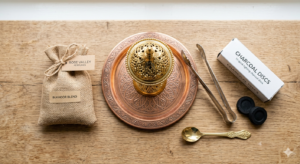
A Mabkhara (المبخرة) is a traditional Arabic incense burner designed to hold a charcoal disc at a safe, controlled height above the surface below it. Its design is not primarily decorative – it is a purpose-built vessel refined over centuries for exactly this process. The wide base provides stability. The deep bowl contains the heat. The material manages heat distribution in ways that protect both the user and the surface underneath.
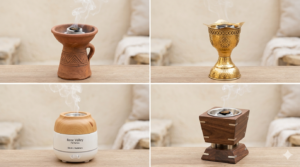
The four main Mabkhara types available in Dubai:
- Traditional clay or ceramic Mabkhara – The most authentic and affordable option. Clay absorbs fragrance oil over time, deepening the character of every subsequent burn – a quality experienced users actively value. Prices start from around AED 15 in Dubai markets. Ideal for beginners.
- Brass or copper Mabkhara – The formal, decorative choice. Highly heat-retentive, long-lasting, and often intricately engraved. Excellent for a majlis setting. A meaningful gift in its own right. The exterior gets very hot during use – handle with care at all times.
- Electric Mabkhara – The most practical option for Dubai apartment residents. Uses a heated ceramic or metal plate instead of charcoal. No open flame, significantly less smoke, and no risk of triggering the building’s fire detection system. The fragrance is slightly lighter than charcoal burning but the experience is genuinely authentic.
- Wooden Mabkhara with metal insert – Very common in everyday Dubai homes. A decorative wooden exterior with a removable metal cup for the charcoal. The wood insulates the surface below, and the removable insert makes cleaning simple and quick.
Choosing the right Mabkhara size for your space:
| Room Size | Recommended Mabkhara Size | Notes |
| Small bedroom (under 15m²) | Small ceramic or clay Mabkhara | One piece of bukhoor is sufficient |
| Living room or majlis (15–35m²) | Medium burner of any type | Add 2–3 pieces over 20–30 minutes |
| Large open-plan space (35m²+) | Large Mabkhara or multiple sessions | 3–5 pieces across two to three additions |
Where to buy a Mabkhara in Dubai:
- Deira Perfume Souk – Sikkat Al Khail Street, Al Ras area.
- Al Fahidi Historical Neighbourhood – independent perfumeries in the restored wind-tower buildings.
- Arabic fragrance boutiques in major Dubai malls including Dubai Mall and Mall of the Emirates.
- Online from UAE fragrance retailers, including incense burners and accessories delivered across the UAE.
2. Self-Igniting Charcoal Discs
Charcoal discs generate the heat that releases fragrance from the bukhoor. This is not an area for improvisation. You need self-igniting charcoal discs specifically – flat, round discs pre-treated with a chemical igniting compound (typically potassium nitrate) that lights with a single flame and reaches a consistent, controlled heat level.
Key buying guidelines:
- 33mm discs – The right size for most home sessions and personal use.
- 40mm discs – Better for larger spaces or sessions longer than one hour.
- Avoid hookah or shisha charcoal discs – Widely available in Dubai but designed for different temperatures and not suitable for incense use.
- Buy from: Arabic perfumery shops, most supermarkets, and online retailers throughout the UAE.
One critical safety fact that cannot be overstated:
Charcoal discs reach temperatures of 300°C to 600°C during active burning. Touching a lit disc with bare fingers will cause a severe burn within a fraction of a second. Metal tongs are not optional.
3. Metal Tongs
This is the most consistently overlooked item in bukhoor guides available online, and its absence causes more beginner injuries than any other single factor.
Metal tongs with a minimum length of 15 centimetres are required for:
- Holding the charcoal disc safely while lighting it over an open flame.
- Placing the lit disc inside the Mabkhara without touching the burner’s hot interior.
- Adding additional bukhoor pieces to the burning disc without getting burned.
- Moving or repositioning the Mabkhara during a session if needed.
Tong types compared:
- Metal kitchen tongs – Widely available, safe, perfectly functional for bukhoor use.
- Traditional Arabic incense tongs – Purpose-made, often decorative, sold alongside Mabkhara in Dubai markets.
- Wooden tongs – Functional but can char or catch fire if held too close to an open flame for too long. A last resort.
This item costs a few dirhams. Buy it. Use it every single time.
4. A Heat-Safe Surface or Tray
A lit Mabkhara gets hot on its exterior surface – particularly brass and clay varieties. That heat causes immediate, irreversible damage to the following:
- Wooden furniture and shelves.
- Plastic or resin decorative trays.
- Woven mats and fabric surfaces.
- Lacquered or painted furniture.
- Any surface not explicitly designed for high heat exposure.
Safe surface options:
- Marble slab or tile.
- Ceramic tile or trivet.
- Stainless steel or cast iron tray.
- Purpose-made decorative Mabkhara stand with a stone or metal inset.
In traditional Emirati homes, the Mabkhara sits on a carved wooden stand elevated off the floor – a design solution that is both functional and culturally meaningful, signalling the care and intention behind the burning ritual.
5. Your Bukhoor – Buying and Storing It Correctly
How much to buy for a first session:
- 50 to 100 grams is a sensible starting amount for a beginner.
- This is enough for several full sessions of genuine practice without a significant financial commitment.
- Avoid buying large quantities of an unfamiliar variety until you know you enjoy it.
Storage rules – all five matter:
- Keep bukhoor in an airtight container with a tight-fitting lid.
- Store away from direct sunlight – UV exposure degrades aromatic compounds over time.
- Keep away from humidity – Dubai’s climate is particularly relevant here. Moisture encourages mould growth on untreated wood chips.
- Avoid storing near heat sources – a warm drawer near a stove will accelerate fragrance loss.
- Store in a cool, dark cupboard or drawer year-round for maximum scent preservation.
Quick test when buying in person:
Always smell the bukhoor before purchasing. Genuine quality bukhoor has a rich, earthy, complex smell even when cold and unburned. Synthetic or low-quality blends often smell sharp, chemical, or artificially sweet before any heat is applied. If a vendor declines a smell test, that is a clear signal to look elsewhere.
How to Use Bukhoor in Dubai – The Complete 6-Step Process
Follow these six steps in order every time. Read through all of them once before your very first session so there are no surprises mid-process.
Step 1 – Prepare Your Space Before You Light Anything
The right environment makes the fragrance experience significantly better.
Choosing the right room:
- Select a room with moderate ventilation – enough airflow to prevent heavy smoke buildup, but not so much wind or draft that the fragrance disperses before settling.
- A room with one window slightly open is ideal in most Dubai homes and apartments.
- A hermetically sealed room is not suitable – smoke accumulates and the experience becomes overwhelming.
- A balcony on a windy day will scatter the fragrance before you can enjoy it.
Setting up the burner correctly:
- Place your Mabkhara on a heat-safe tray on a stable, level surface.
- Position it in the centre of the room, not in a corner. Central placement allows fragrance to distribute evenly. A corner accumulates smoke rather than spreading it.
- In Dubai, it is traditional to place the Mabkhara near the entrance to the majlis so guests receive the fragrance the moment they enter.
Safety checklist before lighting:
- Children under ten are in a separate area.
- Pets are away from the immediate area.
- All flammable materials are at least 30 centimetres away from the burner – tablecloths, papers, books, fabric cushions, dried flowers, curtain hems.
- Surface under the Mabkhara is heat-resistant.
- Window is slightly open for moderate ventilation.
- If smoke detectors are nearby, choose an electric Mabkhara or position the burner as far from the detector as possible.
Step 2 – Light the Charcoal Correctly
This step makes or breaks the entire bukhoor experience. Follow it precisely.
The complete lighting sequence:
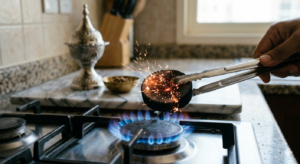
- Pick up a charcoal disc using your metal tongs. Hold it firmly.
- Hold the disc over an open flame – a lighter, a gas stove burner, or a long match – for 20 to 30 seconds.
- Watch for a sparkling or fizzing reaction spreading across the disc’s surface. This is the self-igniting compound activating. It confirms the disc has lit correctly.
- Place the disc carefully into the centre of the Mabkhara using the tongs. Set it down gently – do not drop it in.
- Stop. Do not add bukhoor yet.
- Wait 1 to 2 minutes until a thin, even grey-white ash layer covers the disc’s entire surface.
Why the grey ash layer is the most important thing in this entire guide:
This is the step the vast majority of beginners skip – and it is the reason most beginners have a disappointing first experience.
Placing bukhoor directly onto a fully red, freshly lit disc exposes the fragrant wood chips to the most
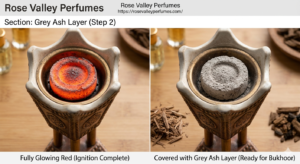
intense concentrated heat in the entire burn cycle. At that temperature, the delicate aromatic compounds in the agarwood do not vaporise beautifully. They combust. The result is a sharp, acrid, burnt smell that most beginners mistake for a sign they purchased low-quality bukhoor.
In most cases, the bukhoor is perfectly fine. The timing was wrong.
The grey ash layer acts as an insulating buffer between the extreme heat of the charcoal and the bukhoor placed on top. It moderates heat transfer, allows aromatic compounds to release gradually, and produces the sustained, complex fragrance that authentic bukhoor is genuinely known for.
Patience here is not optional. It is what separates a disappointing first session from a beautiful one.
Step 3 – Place Your Bukhoor With Precision
Once the grey ash layer fully covers the disc, it is time to add the bukhoor.
How to add it correctly:
- Use a small metal spoon or your tongs – never your bare fingers. The disc is still extremely hot beneath that ash layer.
- For solid chips: Use one piece approximately the size of your fingertip.
- For Mabsoos powder: Use a pinch – roughly the amount of dried herb you might add to a single cup of soup.
- For blend bukhoor: Start with one small chip or a conservative pinch.
The most consistent beginner mistake:
Using too much in the first session. Here is the simple rule:
One small piece for a bedroom. Two to three pieces for a living room. Add more after ten minutes only if the fragrance feels insufficient.
Within 30 to 60 seconds of placing the bukhoor, pale, aromatic smoke will begin rising from the disc. That is your signal that everything is working correctly. Let it rise. Do not interfere.
Step 4 – Direct and Enjoy the Fragrance – Three Traditional Dubai Methods
Dubai’s bukhoor tradition offers three distinct, well-established ways of directing and enjoying the fragrance. Each has its own purpose and its own cultural context.
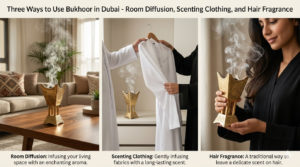
Method 1 – Room Diffusion (For Home Fragrance)
How to do it:
- Leave the Mabkhara in the centre of the room and allow the smoke to disperse naturally.
- Do not wave it around or move it between rooms during active burning.
- Do not place it in corners or against walls – smoke accumulates rather than distributes.
- Allow 5 to 10 minutes for a standard room to fill with fragrance.
Best placement in the home:
- Near the entrance to the majlis – guests receive the fragrance as they arrive.
- On the central coffee table in the living room for even distribution.
- In the hallway to fragrance the entire home from a central point.
Method 2 – Scenting Clothing (The Traditional Emirati Tabkheer Method)
This is the most distinctly Emirati method – and the one most newcomers to Dubai have never encountered.
How to do it step by step:
- Hold the garment – an abaya, kandura, dress, shirt, or jacket – over the rising smoke from the Mabkhara.
- Allow the fabric to act like a sail, catching the aromatic smoke and allowing it to settle into the fibers.
- Hold each section of fabric over the smoke for approximately 10 to 15 seconds.
- Shift to expose a different area – sleeves, back panel, collar area, hem.
- Repeat until the entire garment has been lightly exposed.
What to expect:
- The fragrance remains in the fabric for several hours and is refreshed by body warmth throughout the day.
- In traditional Emirati culture, this practice – called “tabkheer” in some Gulf dialects – is standard preparation before leaving the house, before prayers, and before receiving guests.
- It is the reason people dressed traditionally in Dubai carry that deep, distinctive, impossible-to-replicate personal scent.
Method 3 – Scenting Hair
How to do it correctly:
- Hold the Mabkhara at arm’s length – never directly beneath the head.
- Tilt your head briefly toward the rising smoke for no more than a few seconds.
- Allow the fragrance to settle lightly into the hair before moving away.
- Never prolong this exposure. Brief is sufficient. The hair holds fragrance delicately and dissipates it more quickly than fabric.
Step 5 – Maintain the Burn for Longer Sessions
A single charcoal disc sustains active, effective burning for approximately 45 to 60 minutes. During this window, you can maintain continuous fragrance by adding bukhoor in stages.
Guidelines for maintaining the burn:
- Add additional bukhoor every 10 to 15 minutes to maintain continuous fragrance throughout the session.
- There is no need to clean residue from the previous piece before adding the next. Old residue continues releasing trace fragrance as it slowly cools on the disc.
- Add each new piece directly alongside or on top of the previous residue.
- Observe how the fragrance builds and shifts between each addition – this evolution is considered one of the most pleasurable aspects of the ritual.
For extended sessions – gatherings, Ramadan evenings, or special occasions:
- Prepare a second charcoal disc before the first one is fully exhausted.
- Begin lighting the second disc approximately five minutes before the first loses effective heat.
- Transfer the fresh disc carefully into the Mabkhara once it has its grey ash layer.
- Continue the session without any gap in fragrance output.
What experienced users notice: The fragrance from bukhoor in a room is not a straight line that gradually fades. It builds, shifts, and changes character as different aromatic compounds vaporise at different temperatures across the burn cycle. This progression – from lighter top notes through to deeper, woodier base notes – is one of the most genuinely pleasurable aspects of the entire ritual.
Step 6 – Safe Extinguishing and Cleanup
This step is the most completely absent from other bukhoor guides available online. It matters as much as any other step.
How to extinguish safely – what to do and what never to do:
DO:
- Allow the Mabkhara to extinguish naturally by leaving it undisturbed until the charcoal burns out completely.
- Move the burner to a safe, stable location away from foot traffic while it cools.
- Wait a minimum of 30 to 45 minutes after visible smoke stops before touching or moving the burner.
NEVER DO:
- Never pour water on a hot charcoal disc. The rapid temperature change causes the disc to crack and can shatter ceramic or clay Mabkhara from the inside.
- Never blow on the disc to extinguish it. Blowing re-oxygenates the charcoal and extends the burn.
- Never assume the exterior is cool just because it looks quiet. Brass and clay Mabkhara retain dangerous surface heat long after smoke subsides.
Cleanup process once fully cooled:
- Remove ash and residue using a small brush or dry cloth.
- Do not wash the interior of a clay or ceramic Mabkhara with water. Absorbed fragrance oils built up through multiple uses add depth and character to every subsequent burn – water washing removes this.
- Wipe the exterior of the burner with a dry cloth if needed.
- Wrap cooled ash in foil or paper before placing in general waste.
- Never place a recently used disc directly into a plastic bin – residual heat can melt bin linings.
How People in Dubai Actually Use Bukhoor – The Cultural Side
The six steps above cover the technical process entirely. But understanding why bukhoor is used in Dubai – the way it fits into daily life, social rituals, and Emirati identity – transforms the experience from a simple procedure into something genuinely meaningful.
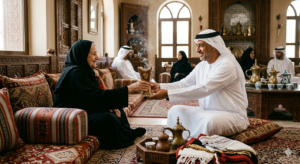
Bukhoor as the Most Meaningful Act of Emirati Hospitality
In Emirati culture, lighting bukhoor for a guest communicates something that goes well beyond making a room smell pleasant. It signals clearly: you matter enough for me to use my finest fragrance for you.
The type of bukhoor burned reflects the level of respect the host wishes to convey:
- Rose-based or common blend bukhoor – Everyday home use, casual visits, informal gatherings.
- Premium blend bukhoor – Welcoming respected family members and close friends.
- Pure oud-based bukhoor from prized origins – Formal occasions, important guests, significant life events.
When bukhoor is offered to you as a guest, here is the correct response:
- Lean forward and allow the smoke to reach your clothing briefly.
- Acknowledge it – a simple “ma sha Allah” (Arabic expression of admiration and gratitude) is entirely natural.
- Do not decline. Politely refusing bukhoor in a traditional setting can come across as dismissive of the hospitality extended. If you have genuine respiratory sensitivities, accept the Mabkhara briefly for just a moment, then explain gently. Emirati hosts always respect a genuine health reason.
The Ritual of Passing the Mabkhara Among Guests
One of the most distinctly Emirati social rituals – and one that almost no English-language guide ever describes in detail – is the practice of passing the Mabkhara among seated guests in a majlis.
How the passing ritual works:
- The host burns the bukhoor and allows the fragrance to build in the room.
- The Mabkhara is carried to each guest in turn, or passed from person to person around the room.
- Each guest holds the burner briefly under their clothing or near their wrists and hands to receive the fragrance.
- The guest passes it to the next person with a gentle nod or a soft “shukran” (thank you).
- In formal settings, the direction of passing is typically clockwise around the room.
This ritual is not simply about fragrance. It is a moment of collective participation – everyone sharing the same scent, the same warmth, the same experience simultaneously. It creates a sense of connection and welcome that is difficult to achieve through any other means.
When Bukhoor Is Burned in Dubai – The Cultural Calendar
Understanding when bukhoor use peaks in Dubai gives genuine insight into Emirati life:
- Thursday evenings – The eve of Friday Jumu’ah prayer. Homes are prepared and fragranced.
- After Maghrib (evening prayer) daily – The transition from the working day to family time in traditional households.
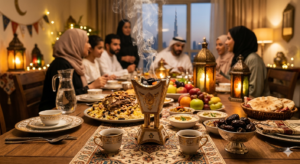
- Throughout Ramadan – Burned before Iftar gatherings every evening of the holy month.
- Eid al-Fitr and Eid al-Adha – Every room of a traditional home is fragranced before guests arrive.
- Emirati weddings – The bride’s ceremonial clothing is scented using the tabkheer method on the morning of the wedding day.
- UAE National Day (December 2nd) – Bukhoor features prominently in cultural events and public celebrations as a symbol of Emirati national identity.
- Friday prayers (Jumu’ah) – Many households burn bukhoor to purify and prepare the prayer space before noon.
Cultural Mistakes to Avoid as a Beginner in Dubai
Understanding what not to do matters as much as knowing what to do:
- Do not blow on the smoke to direct it. The smoke should rise and disperse naturally. Move the item you are trying to scent toward the smoke rather than redirecting the smoke itself.
- Do not place the Mabkhara directly on the floor in a majlis. A formal reception room requires the burner to be elevated on a proper stand or side table.
- Do not substitute synthetic incense sticks for bukhoor and present them as equivalent. This substitution is immediately recognisable to anyone familiar with the tradition.
- Do not rush the charcoal ash process. Patience is not just a safety instruction – it is an attitude that is built into the ritual itself.
- Do not use an excessive amount of bukhoor when first experimenting with a new variety. A small piece reveals far more than a large one ever will.
Advanced Techniques That Experienced Dubai Users Actually Know
These techniques are widely used by experienced users in Dubai and across the Gulf region, but they are almost never documented in English-language resources.
1. The Aluminium Foil Technique – Smoother, Longer Fragrance
This is one of the most practically useful advanced techniques for home use, and almost no beginner guide mentions it.
How to do it:
- Cut a small piece of aluminium foil – approximately 4cm × 4cm.
- Form it into a shallow cup shape by pressing it gently over your thumb.
- Once your charcoal disc has its grey ash layer, place the foil cup on top of the ash.
- Place your bukhoor on top of the foil rather than directly on the ash.
Why it works:
- The foil creates a second insulating layer between the charcoal’s heat and the bukhoor.
- This slows heat transfer further, resulting in a longer, more gradual, smoother fragrance release.
- The scent lasts noticeably longer per piece and produces fewer acrid notes.
- Particularly valuable when using high-quality, expensive oud-based bukhoor where extracting every layer of fragrance matters.
2. Scent Layering – Burning Two Types in Sequence
The correct sequence and timing:
- Begin with a lighter variety – rose or sandalwood bukhoor.
- Allow it to burn for 15 to 20 minutes, building a soft floral presence in the room.
- When that first piece is nearly exhausted, place a small piece of oud-based bukhoor on the disc.
- The heavy, woody base notes settle over the floral atmosphere already present, creating a layered profile that neither variety would produce alone.
The golden rule of layering:
Always go light to heavy. Never go heavy to light. A powerful oud fragrance already established in the room will completely overwhelm a lighter rose bukhoor added afterward.
3. Combining Bukhoor With Dehnal Oud – A Layered Emirati Signature Scent
One of the most elegant Emirati fragrance habits – unknown to most outsiders – is applying Dehnal Oud (liquid oud attar) to pulse points after clothing has been scented with bukhoor smoke.
Why this combination works:
- Bukhoor provides a dry, smoky, ambient base that settles into fabric from the outside in.
- Dehnal Oud, applied to the wrists and neck, provides a warm, concentrated, intimate personal fragrance from the skin outward.
- Together, they create a layered signature scent – neither purely smoke nor purely oil, but a third, deeply personal and complex presence that is the hallmark of a refined Emirati fragrance profile.
This is standard practice among Emirati fragrance enthusiasts. It explains the signature, impossible-to-replicate aromatic presence of someone dressed traditionally in Dubai.
4. Room-Size Dosage – Exactly How Much to Use
The most asked practical question answered clearly:
| Room Size | Amount per Session | Charcoal Disc Size |
| Small bedroom (under 15m²) | 1 small piece or 1 pinch of Mabsoos | 33mm |
| Standard living room (15–35m²) | 2–3 pieces added over 20–30 minutes | 33–40mm |
| Large majlis or open-plan (35m²+) | 3–5 pieces across two to three additions | 40mm |
| Covered outdoor veranda | 2–4 pieces depending on air movement | 40mm |
| Exposed outdoor space | Not recommended – wind disperses fragrance immediately | – |
The golden rule for every scenario:
Start with less than you think you need. Add more after ten minutes. You cannot remove it once it is burning.
Is Bukhoor Safe? A Complete Safety Guide for Dubai Homes and Apartments
Yes – bukhoor is safe to use in Dubai homes and apartments when burned correctly, on a heat-safe surface, with proper ventilation, and using a Mabkhara designed for the purpose.
The three primary risks, and how to prevent each one:
| Risk | Cause | Prevention |
| Fire | Unstable burner or flammable materials too close | Heat-safe tray, 30cm clearance, never unattended |
| Heat injury | Handling charcoal disc without tongs | Metal tongs – every time, no exceptions |
| Smoke accumulation | Burning in a fully sealed room | Window slightly open, or use electric Mabkhara |
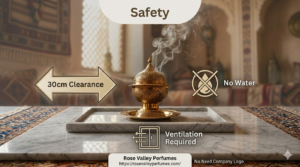
Fire Safety – The Non-Negotiable Rules
Follow every one of these without exception:
- Charcoal discs reach 300°C to 600°C during active burning – they will ignite paper, most fabrics, and natural materials within seconds of direct contact.
- Maintain at least 30 centimetres of clearance from all flammable materials around the burner.
- Never leave a lit Mabkhara unattended – not for five minutes, not to answer the door, not for a brief errand. If nobody is watching it, it should not be burning.
- Keep fabric curtains, tablecloths, and soft furnishings well away from the burner.
- Never burn bukhoor and fall asleep in the same room.
Smoke Detectors in Dubai Apartments – What Every Resident Must Know
This is the most practically important safety consideration for the majority of Dubai residents, and it is almost never addressed in other bukhoor resources.
Dubai residential buildings – particularly those built in the last 15 years – use multi-sensor smoke detection systems that respond to any significant particulate presence in the air, not just large visible clouds of smoke. Charcoal-burned bukhoor in a sealed apartment room can and does trigger these systems.
Practical solutions for Dubai apartment residents:
- Open a window in the burning room to provide continuous ventilation.
- Use an electric Mabkhara – produces minimal smoke and involves no open charcoal flame.
- Burn in the room furthest from the nearest hallway detector.
- Turn on a kitchen or bathroom exhaust fan to draw particulates away from living areas.
- Check your tenancy agreement – some Dubai buildings have specific clauses about open-flame burning in residential units.
Respiratory Health Considerations
For most healthy adults, brief, well-ventilated exposure to bukhoor smoke is not a concern. For people with respiratory conditions, adjust your approach:
- Asthma or COPD: Limit sessions to under 10 minutes. Ensure strong cross-ventilation. Consider an electric Mabkhara as your primary method.
- Respiratory sensitivities: Choose rose-based or sandalwood blend bukhoor – these produce significantly less particulate smoke than heavy oud-based varieties.
- Pregnant women: Use lightly and avoid prolonged heavy smoke exposure. The electric Mabkhara is the safest option.
- If in doubt: A brief conversation with your doctor before making charcoal-burned bukhoor a regular daily routine is a reasonable precaution.
Children and Pets – Specific Safety Guidelines
For children in the home:
- Keep children under ten out of the room during lighting and for the first five minutes of burning.
- The Mabkhara exterior remains dangerously hot for 30+ minutes after visible smoke subsides. Do not assume it is cool just because it looks quiet.
- Store all charcoal discs and bukhoor in a locked cabinet inaccessible to children.
For pets in the home:
- Dogs and cats can be sensitive to concentrated aromatic compounds in bukhoor smoke.
- Brief exposure in a well-ventilated space is generally not a concern for healthy animals.
- Pets with any diagnosed respiratory conditions should not be in the room during active burning.
- Allow the room to air fully before any respiratory-sensitive pet re-enters.
Where to Buy Authentic Bukhoor in Dubai – And What to Avoid
Dubai has more bukhoor available per square kilometre than almost anywhere else in the world. The quality range, however, is enormous. Knowing where to look and what to watch for makes a genuine difference.
Deira Perfume Souk – The Most Authentic Source in the City
The Deira Perfume Souk on Sikkat Al Khail Street, Al Ras area, is one of the oldest and most authen
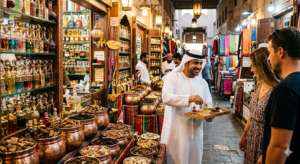
tic fragrance markets in the UAE. With over 200 specialist shops, it sits within walking distance of the Gold Souk and Spice Souk – three markets that form the commercial heart of historic Dubai.
What you will find there:
- Raw agarwood chips from India, Cambodia, and Indonesia – available to smell before purchase.
- Traditional bukhoor in dozens of varieties, from accessible blends to rare oud-based compositions.
- Custom-mixed attar oils prepared to order by experienced perfumers.
- Mabkhara burners in every style, from simple clay to elaborately engraved brass.
- Charcoal discs, metal tongs, and all accessories for home use.
How to get there:
- By Metro: Green Line to Al Ras Station – the souk is a short walk from the exit.
- By Abra: Cross Dubai Creek by traditional water taxi from the Bur Dubai side.
- Opening hours: Saturday to Thursday – 10:00 AM to 10:00 PM. Friday – approximately 4:00 PM to 10:00 PM.
Smart buying tips for the Deira Perfume Souk:
- Always smell the bukhoor before committing to a purchase. Reputable vendors actively encourage this.
- Ask the vendor to name the country of origin of the agarwood. India, Cambodia, and Vietnam are the most valued sources for premium quality.
- Buy from specialist incense and attar shops – not from vendors offering hundreds of imitation Western brand perfumes alongside their Arabic products.
- If a vendor is vague about what is in their bukhoor, walk away.
Al Fahidi Historical Neighbourhood – The Boutique Alternative
The Al Fahidi Historical Neighbourhood (Al Bastakiya) in Bur Dubai contains small, independent perfumeries operating from within the city’s beautifully restored wind-tower buildings. These shops carry handcrafted bukhoor blends from traditional Gulf Arab perfumers – smaller batches, more individual character, and a purchasing experience that feels genuinely rooted in Dubai’s heritage.
Key facts:
- Prices are mid-range – higher than Deira souk’s best values, lower than mall boutiques.
- Quality is generally reliable and well-sourced.
- A particularly good choice when looking for a thoughtful, high-quality bukhoor gift.
Online – The Most Practical Route for Beginners in Dubai
For anyone new to bukhoor who is not yet comfortable navigating the souk experience, buying from a trusted online Arabic perfumery offers distinct advantages:
Why buying online makes sense for beginners:
- Full ingredient transparency – you can read exactly what is in the product before purchasing.
- Fragrance intensity guides – useful for knowing whether a variety is appropriate for first-time use.
- Verified customer reviews describing the actual post-burn fragrance experience.
- Starter kits bundling a Mabkhara, charcoal discs, and introductory bukhoor varieties together.
- Delivery across the UAE – no trip to the souk required for your first session.
If you are ready to begin, browsing an established UAE bukhoor collection with clear product descriptions and honest ingredient listings is the most reliable starting point for a genuinely good first experience.
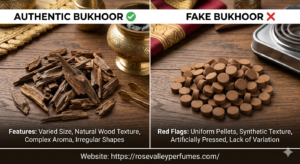
Five Red Flags When Buying Bukhoor Anywhere in Dubai
Avoid any product or seller showing these warning signs:
- Prices dramatically below market rate for claimed oud content. Genuine oud-based bukhoor is expensive to produce. Prices well below AED 25–30 for meaningful quantities of “pure oud” bukhoor warrant serious scepticism.
- No ingredient information provided. Sellers of authentic quality bukhoor have nothing to hide about their ingredients.
- A sharp, synthetic, or chemical smell when the bukhoor is cold. Natural bukhoor smells earthy, resinous, and complex before burning – not harsh or artificial.
- Perfectly uniform, machine-pressed chips presented as natural handcrafted bukhoor. Genuinely natural bukhoor varies in size, texture, and shape.
- Dense black smoke during burning. Quality bukhoor produces pale, aromatic white or cream-coloured smoke. Dense black smoke signals low-quality base materials, excessive heat, or artificial additives.
Frequently Asked Questions About Using Bukhoor in Dubai
What is bukhoor and how is it used?
Bukhoor is a traditional Arabic incense made from agarwood chips soaked in fragrant oils. Place a charcoal disc in a Mabkhara burner, wait for a grey ash layer to form, then add a small piece of bukhoor on top. The rising smoke is used to fragrance rooms, clothing, and hair.
What is the difference between bukhoor and oud?
Oud is the raw resinous heartwood of the Aquilaria tree. Bukhoor is a crafted incense blend that may contain oud chips alongside rose, musk, and other aromatics. Oud attar is a liquid perfume worn on skin. Bukhoor is burned – the two are different products used in different ways.
Can bukhoor be burned without charcoal?
Yes. An electric Mabkhara uses a heated plate to release fragrance without charcoal or open flame. This is the recommended option for Dubai apartment residents where charcoal smoke can trigger building fire alarm systems.
How long does bukhoor fragrance last in a room?
In an enclosed room, bukhoor fragrance typically lasts 2 to 6 hours after burning. Oud-based varieties last the longest. Clothing scented with bukhoor smoke retains the fragrance for several hours, often into the following day.
Is bukhoor harmful to health?
Moderate use in well-ventilated spaces is safe for healthy adults. People with asthma, COPD, or respiratory sensitivities should keep sessions brief, ensure ventilation, and consider an electric Mabkhara. Pregnant women should use bukhoor lightly and avoid heavy smoke exposure.
How much bukhoor should you use at one time?
One small piece (fingertip-sized) is sufficient for a bedroom. Two to three pieces added over 20–30 minutes work well for a standard living room. Always start with less than you think you need and add more if required.
Is bukhoor only for Muslims?
No. Bukhoor is a cultural tradition enjoyed by people of all backgrounds and faiths across Dubai. While it holds significance in Islamic tradition, it is widely used by residents and visitors from every background as a home fragrance and connection to Emirati culture.
What is a Mabkhara?
A Mabkhara (المبخرة) is a traditional Arabic incense burner – made from clay, ceramic, brass, or wood – designed to hold a charcoal disc safely and release fragrance from bukhoor in a controlled way. It is the essential tool for anyone how to use bukhoor in Dubai correctly.
Which is better – charcoal or electric Mabkhara?
Charcoal delivers a stronger, more authentic fragrance experience. Electric Mabkhara are cleaner, safer, and far more practical for Dubai apartments with sensitive fire detection systems. For beginners and apartment residents, the electric option is the recommended starting point.
Where can I buy bukhoor and Mabkhara burners in Dubai?
Bukhoor and Mabkhara burners are available at the Deira Perfume Souk, Al Fahidi perfumeries, and Arabic fragrance boutiques in major Dubai malls. Buying online from a trusted UAE perfumery lets you compare varieties, check ingredient lists, and have everything delivered to your door across the UAE before your first session.
Your First Session Starts With One Moment
The first time smoke rises from your Mabkhara and that warm, woody, unmistakably Arabian fragrance fills the room around you, something shifts. There is a depth and an age to that scent – a connection to thousands of years of human experience behind it.
The Bedouin travelling by firelight. The merchant’s tent opened wide for a trusted guest. The family gathered after evening prayers in a room warm with shared fragrance and meaning.
That is what bukhoor actually is. It is not just incense. It is an invitation.
To begin your first session, you need only four things:
- One piece of bukhoor.
- One Mabkhara burner.
- One charcoal disc and a pair of metal tongs.
- The patience to wait for the grey ash layer before placing anything on the disc.
Let the smoke rise. Let the fragrance fill the room. Add nothing else the first time.
When you are ready to explore further – to discover the depth of different bukhoor varieties, try the layering techniques, pair your bukhoor with a Dehnal Oud for a true Emirati signature scent, or find a meaningful gift for someone special – the quality, authenticity, and guidance you need will matter enormously.
For everything from beginner-friendly rose blends and premium agarwood varieties to Mabkhara burners and all the accessories for your first setup, you can explore the full Arabic fragrance collection here. Start with one spark. Everything else follows naturally.