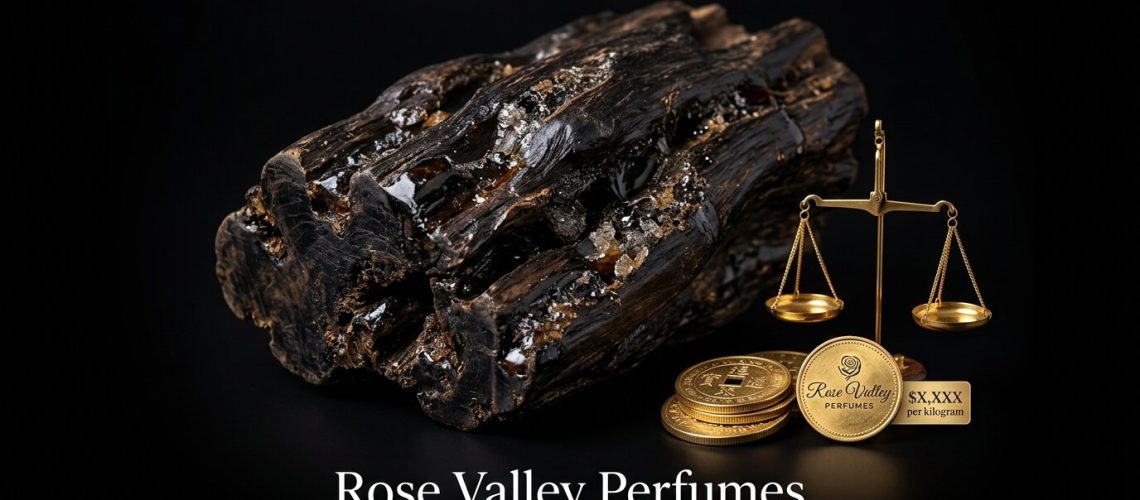
Agarwood is so expensive because only 7–10% of wild Aquilaria trees ever produce it naturally, it takes 10 to 50+ years to fully develop inside a living tree, and global demand for it spans luxury perfumery, Gulf Arab cultural tradition, Buddhist rituals, and traditional medicine – all at the same time, with no viable substitute at the premium level.
By weight, premium agarwood is worth more than gold. Unlike gold, it cannot be mined, recycled, or industrially produced at any scale. Every gram of premium agarwood is the product of a specific tree, a specific fungal encounter, and decades of undisturbed biological time inside a disappearing rainforest.
This article explains every factor driving that price – in full detail, and in plain language – and why none of those factors are going away.
A Wood Called “Liquid Gold” for Over 3,000 Years
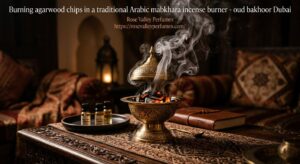
Picture a small, dark block of wood – roughly the size of a paperback novel. You pick it up and it feels surprisingly heavy, almost dense enough to feel like stone. You hold a flame near it, and a slow, complex wave of fragrance rises – woody and warm at first, then something deeper underneath, something ancient that you cannot quite name.
That block might cost $30,000.
Agarwood is known by many names across the world, and every one of them carries a sense of centuries-old reverence:
| Language / Region | Local Name | Literal Meaning |
| Arabic | Oud or Oudh | Wood / Fragrant stick |
| Chinese | Chen Xiang | Sinking fragrance |
| Sanskrit | Agar | Source of the city name Agartala |
| Malay / Indonesian | Gaharu | Fragrant wood |
| Japanese | Jinkoh | Sinking incense |
| Japanese (rarest grade) | Kyara | A word that commands silence |
| Gulf Arabic (incense form) | Bakhoor | Fragrant chips burned as incense |
| Gulf Arabic (oil form) | Dehnal Oud | Oil of oud |
Three facts that show how deep its history runs:
- The earliest known written reference to agarwood dates back approximately 3,400 years to the ancient Indian Vedas.
- A third-century Chinese chronicle described collectors already seeking fragrant wood in the mountains of what is now central Vietnam.
- By 595 CE, a piece had drifted ashore in Japan and been presented to the Empress – an event recorded in the Nihon-shoki, one of the oldest books of Japanese history.
Agarwood has not survived this long in human culture because of trend or fashion. It has survived because nothing else smells like it, and nothing else can replace it.
The global agarwood chip market was valued at over USD 10 billion in 2024 and is projected to reach USD 17.61 billion by 2033 at a CAGR of 6.41%, according to Straits Research. That is not a niche market. That is one of the most financially significant aromatic commodities on the planet.
So what exactly makes a piece of wood command prices that dwarf gold, diamonds, and most rare-earth elements? The answer begins not in a market or a perfumery – but deep inside a dying tree in the rainforests of Southeast Asia.
What Is Agarwood and Why Is It So Rare?
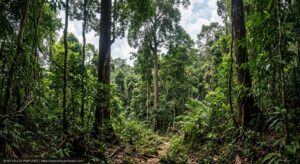
The Aquilaria Tree: Completely Worthless Until It Suffers
The Aquilaria genus includes 21 recognized species spread across South and Southeast Asia. These trees grow naturally across a wide geographic band that includes:
- Bangladesh – One of the earliest historically documented sources.
- India – Primarily the northeastern states of Assam, Nagaland, Manipur, and Arunachal Pradesh.
- Vietnam – Particularly the Nha Trang, Hoi An, and Central Highland forest regions.
- Indonesia – Borneo, Sumatra, Sulawesi, and Kalimantan.
- Malaysia – Including both Peninsula Malaysia and the Borneo states of Sabah and Sarawak.
- Cambodia, Laos, and Thailand – Important historic producing regions now under heavy regulatory protection.
- The Philippines – Home to at least eight Aquilaria species, six of them endemic.
- Parts of southern China – Particularly Guangdong and Yunnan provinces.
In their natural, healthy state, Aquilaria trees are entirely unremarkable. The wood is pale, lightweight, practically odorless, and has almost no commercial value. A timber merchant would walk straight past it.
The central paradox of agarwood is this: the tree only becomes one of the most valuable natural materials on Earth after it begins to suffer.
The Biological Event That Creates Agarwood
When an Aquilaria tree is invaded by specific fungal strains – most notably Phaeoacremonium parasiticum, along with various Aspergillus and Fusarium species – a remarkable and irreversible defense response begins inside the living tree.
Here is exactly how the agarwood formation process unfolds:
- The fungal pathogen penetrates the outer bark and begins spreading through the inner wood tissue toward the heartwood.
- The tree detects the biological invasion and immediately begins producing a dark, oleoresinous defensive compound – a chemical attempt to wall off the infection and prevent it from consuming the whole tree.
- The resin seeps slowly outward through the surrounding heartwood, darkening it progressively, adding density, and chemically transforming what was pale, worthless timber into the intensely fragrant material the world calls agarwood.
- Aromatic compounds accumulate over years and decades. The primary fragrant molecules – sesquiterpene alcohols including agarospirol and jinkohol, along with chromone derivatives – build in concentrations shaped by the tree’s genetics, the specific fungal strains present, local soil chemistry, regional climate, altitude, and the sheer number of years that pass.
- The result is unique to every single tree. No two pieces of agarwood smell exactly alike because no two trees face identical combinations of these variables. This is precisely why experienced perfumers and collectors treat each specimen as an irreplaceable natural artifact rather than a traded commodity.
The critical number: only 7–10% of wild Aquilaria trees ever develop this infection naturally. CITES-cited academic research confirms this consistently. A review by TRAFFIC notes that approximately 90% of historical agarwood trade has involved wild Aquilaria malaccensis – placing the full weight of global demand on a fraction of trees in a forest ecosystem that is already in serious decline.
The Time Factor: The One Ingredient No Market Can Buy
Even after infection begins, the resin development timeline is the factor that no investment, no technology, and no agricultural engineering can change.
| Agarwood Grade | Minimum Time to Develop |
| Low-grade floating wood | 10 years from infection onset |
| Mid-grade semi-sinking | 15–25 years |
| Sinking Grade A | 25–50 years |
| Kyara / Kinam (rarest known grade) | Believed to exceed 100 years |
What this timeline means in practical terms:
- A Kyara-grade piece forming in a Vietnamese rainforest today will not reach its full aromatic potential until after the year 2125.
- A sinking Grade A piece forming right now in Assam will not be commercially harvestable until roughly 2050–2075.
- Even the cheapest commercial agarwood available today started forming sometime around 2015 at the earliest.
This is not a supply chain problem waiting for a solution. This is a biological reality calibrated to a timescale that no market can compress. Time is the one irreducible ingredient in premium agarwood – and it is the foundational reason why prices are what they are.
Why Is Agarwood So Expensive to Find and Harvest?
The Wild Population Collapse Driving Scarcity
Agarwood’s scarcity is not only a matter of low natural infection rates. It is also about what decades of relentless global demand have done to the forests that once produced it.
The regulatory timeline tracks the scale of the crisis:
- 1994 – India proposes international trade restrictions at the 9th CITES Conference of the Parties.
- 1995 – Aquilaria malaccensis is listed on CITES Appendix II, requiring export permits for all international trade.
- 2004 – Malaysia classifies Aquilaria malaccensis as a protected species in Sabah Forest Reserves.
- 2005 – All 21 Aquilaria species and all related Gyrinops species are placed under CITES Appendix II protection.
- 2022 – A CITES workshop determines that Non-Detriment Findings are “largely non-existent” in most exporting countries.
- 2025 – A CITES Standing Committee analysis finds many countries still rely on outdated population surveys over a decade old.
Countries with the strictest wild agarwood protections currently in force:
- India – Export quotas capped at 151,080 kg of chips and 7,050 kg of oil annually from April 2024.
- The Philippines – Wild collection prohibited under RA 9147, with prison sentences and heavy fines for violations.
- Bangladesh – Wild harvesting effectively banned.
- Thailand – Wild harvesting heavily restricted under national forestry law.
- Malaysia (Sabah) – Prohibited species status in all designated Forest Reserves since January 2004.
The 7% Wild Lottery and the Compounding Scarcity Loop

To understand why finding quality agarwood is so difficult, consider the actual odds in a natural forest:
- Walk through 100 Aquilaria trees.
- Statistically, only 7–10 of them carry any meaningful resin deposits at all.
- Of those 7–10, only a fraction will carry resin dense enough for commercial value.
- Of that fraction, only a tiny handful will have the depth, distribution, and aromatic complexity needed for premium grades.
Historical harvesting practice made this worse in a way that is now structurally irreversible:
- Rising global prices created stronger incentives to harvest more aggressively.
- More trees were felled searching for the infected few among the many.
- Wild populations declined faster across every major producing region.
- The remaining wild agarwood became even scarcer as productive areas were exhausted.
- Prices rose again – reinforcing the cycle and pushing it into the next producing region.
This scarcity feedback loop has no natural correction mechanism. It has progressively shifted the center of commercial supply eastward across decades – from India, to mainland Southeast Asia, to Sumatra and Borneo, to Papua New Guinea – as each region’s wild populations were depleted faster than they could regenerate.
Legal Compliance Costs: A Price Driver Nobody Mentions
Operating legitimately in the agarwood trade carries its own substantial cost at every stage:
- CITES export permits from the relevant government authority in the country of origin.
- Non-Detriment Findings documenting that harvest levels will not threaten species survival.
- National-level harvesting licences or official plantation certification.
- Chain-of-custody documentation tracking the material through every intermediary.
- Import permits and customs compliance in every destination country.
- Third-party verification for buyers requiring independently certified sourcing.
Legitimately CITES-certified agarwood with complete legal documentation trades at a consistent premium of 25–40% above uncertified material – not because it has higher resin content, but because the legal paper trail proving its origin has real, measurable financial value in a market where compliance is far from the norm.
How Is Agarwood Harvested – And Why Is Every Step So Costly?
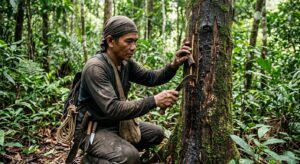
Most sources describe agarwood harvesting as “labor-intensive” and stop there. What follows is what that labor actually involves – at every stage – and why each step translates directly into the price a buyer ultimately pays.
Step 1 – Finding the Right Tree: Days to Weeks of Skilled Forest Work
Experienced agarwood hunters in Indonesia and Malaysia are called pencari gaharu – “agarwood seekers.” Their equivalents across Vietnam, India, and Cambodia carry knowledge passed through generations of family tradition. This is a highly specialized profession, not casual forestry work.
Their identification methods include:
- Hollow tapping – Striking the trunk and listening for the distinct resonance of resin-saturated heartwood, which sounds measurably different from clean wood when struck.
- Bark scent detection – Infected trees sometimes emit a faint but detectable aromatic signal through the outer bark.
- Visual inspection of bark texture and color – Subtle changes near old wound sites, unusual bark discoloration, or abnormal growth patterns can indicate internal infection.
- UV light scanning – Under ultraviolet light, resin deposits reflect differently from clean wood fiber and become visible to a trained eye.
- Handheld resin sensors – Emerging technology now assists hunters in verifying infection before any cutting begins.
- Generational intuition – Experienced hunters describe knowing which microclimates, soil compositions, tree ages, and elevation patterns are most likely to harbor infection – knowledge built over decades that cannot be digitized.
Finding a productive tree can take several days of active searching. Finding a high-grade tree can take weeks of navigating dense, humid, roadless forest terrain. All of that time, physical labor, and remote logistics cost is priced into the final product before a single gram of agarwood is extracted.
Step 2 – Extraction: Precision Work in a Rainforest
Once a productive tree is confirmed, extracting the agarwood correctly requires a level of precision more commonly associated with surgical procedure than forestry.
Critical facts about the extraction stage:
- Resinous wood typically constitutes only 10–30% of the total trunk volume. The remaining 70–90% is pale, worthless, and commercially useless.
- A skilled harvester follows dark resin veins through the trunk section by section, carving only the infected material and leaving uninfected wood intact where possible.
- One fully processed tree may yield only a few hundred grams of truly premium material – sometimes less than the contents of a standard coffee mug.
- Ethical sustainable harvesting leaves sections of the living tree intact to allow continued resin development over coming years – but this practice is rarely followed in illegal poaching operations, which extract everything and leave nothing.
Step 3 – Hand-Sorting and Artisan Grading
Raw harvested agarwood arrives at processing facilities as a mixed collection with wildly varying resin content. Skilled artisans then hand-separate the material over multiple days, assessing each piece by:
- Color – Deeper black-brown coloration consistently indicates higher resin concentration. Pale or tan-colored sections indicate low resin or none at all.
- Weight and density – Higher-resin material feels noticeably heavier in the hand even before the formal water test.
- Fragrance response to gentle heat – Skilled sorters hold each piece briefly near a heat source and assess the fragrance character. A thin, flat, or chemical scent means low grade. A deep, complex, evolving fragrance means premium.
- Texture – Resin-saturated wood has a distinctly different surface texture and solidity compared to uninfected sections of the same trunk.
Getting this sorting stage wrong carries serious financial consequences. Mixing high-grade and low-grade material in the same batch destroys the commercial value of the premium pieces – because buyers at the top of the market pay specifically for purity of grade within a batch.
Step 4 – The Water Test and Formal Grade Assignment
The water flotation test is the most widely used and universally recognized quality assessment in the global agarwood trade. It is elegantly simple and biologically reliable:
- Wood that sinks completely = resin content above 25–30% of mass = sinking grade = premium.
- Wood that partially floats = resin content 15–25% = semi-sinking grade = mid-tier.
- Wood that floats = resin content below 15% = floating grade = entry-level or incense use only.
The financial consequence of a single grade difference:
A piece of semi-sinking Grade B agarwood and a piece of sinking Grade A agarwood may look almost identical to an untrained eye. But that single grade difference – determined by a water bucket – can represent a price multiplier of 5 to 10 times for the same weight of wood. Formal grading by an experienced appraiser is itself a specialized and well-compensated skill.
Step 5 – Oud Oil Distillation: The Yield Problem in Hard Numbers

For agarwood destined to become dehnal oud – the pure liquid aromatic extract – the final production stage makes the price of the finished oil completely understandable.
The distillation process, step by step:
- Quality agarwood chips are submerged in clean water for an extended soaking period to begin releasing and mobilizing the aromatic compounds locked inside the wood.
- The soaked material is transferred to a distillation still for steam or hydro-distillation, where sustained controlled heat drives aromatic vapor out of the wood tissue and into a collection vessel.
- The vapor condenses back into liquid form, separating the aromatic oil from the water carrier through natural density difference.
- The process runs continuously – 10 to 20 full days without interruption – under constant monitoring and temperature management.
- The resulting oil is collected, filtered, and rested before being assessed for fragrance quality, color, and viscosity.
The yield number that explains every oud oil price:
It takes 70 to 100 kilograms of quality agarwood chips to produce just one liter of dehnal oud oil.
What this means in cost terms:
- If raw agarwood chips cost $5,000 per kilogram (conservative for decent quality).
- One liter of oud oil requires 70–100 kg of chips.
- Raw material cost alone: $350,000–$500,000 per liter.
- Before a single hour of distillation labor, energy, equipment maintenance, or packaging.
This is the mathematical explanation – not a marketing claim – for why authentic dehnal oud oil trades at $30,000–$80,000 per liter on the legitimate market. Kyara-derived oud oil has been documented at up to $200,000 per liter in specialist transactions, according to Première Peau’s research.
The Six Reasons Why Agarwood Is So Expensive – All at Once
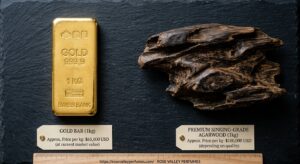
Understanding the price requires seeing all six factors together, because the real answer is not a single explanation – it is six distinct forces operating simultaneously, each one reinforcing all the others.
- Biological Rarity – The Odds Are Structurally Against It
- Only 7–10% of wild Aquilaria trees will ever develop the fungal infection needed to produce resin.
- There is no reliable way to predict which trees will be infected in a natural forest setting.
- The vast majority of Aquilaria trees – even in forests full of them – have zero commercial value for agarwood purposes.
- Irreversible Time Investment – Cannot Be Shortened by Any Means
- Low-grade material: minimum 10 years from infection onset.
- Premium sinking Grade A: 25 to 50 years of continuous resin accumulation.
- Kyara: potentially over 100 years in documented specimens.
- No capital investment, agricultural technology, or scientific intervention can make an Aquilaria tree age faster.
- Time is the single truly irreducible ingredient – and it cannot be purchased at any price.
- Labor-Intensive Supply Chain – Cannot Be Mechanized at Quality Levels
- From the multi-day forest search to surgical hand-extraction to artisan sorting and grading, every stage where quality matters depends on human skill and judgment.
- Machines cannot reliably replicate the simultaneous color, density, and fragrance assessment that an experienced sorter performs in seconds.
- The premium end of this market will remain handcraft-dependent for the foreseeable future.
- Catastrophic Distillation Yield – A Function of Biology, Not Process Design
- 70–100 kg of quality agarwood chips produce just 1 liter of oud oil.
- This ratio reflects the actual concentration of aromatic compounds in the wood – a biological constant.
- There is no engineering shortcut that meaningfully improves this yield.
- At $5,000/kg input cost, raw material alone for one liter of oil exceeds $350,000–$500,000.
- Irreversible Wild Scarcity – No Recovery Timeline in This Century
- Wild Aquilaria populations are legally protected and ecologically depleted across their entire natural range.
- CITES, TRAFFIC, IUCN, and WWF assessments all describe ongoing, continued declines.
- The forests of Assam, Borneo, and the Mekong Delta that once produced commercial wild agarwood are not regenerating at demand pace.
- No conservation intervention currently proposed could restore commercially productive wild populations within 30 years.
- Simultaneous Global Demand – Multiple Markets With No Viable Substitutes
Agarwood is simultaneously demanded by six completely independent global markets:
| Market | How Agarwood Is Used |
| Gulf Arab households | Bakhoor burned for hospitality and religious tradition |
| Western luxury perfumery | Premium oud base note in $300–$1,500+ fragrances |
| Buddhist temples (Japan, Vietnam, China, Thailand) | Sacred ritual incense and meditation aid |
| Hindu religious practice | Havan fire offerings and purification ceremonies |
| Traditional Chinese Medicine | Chen xiang for digestive, respiratory, and neurological applications |
| Global wellness market | Aromatherapy oil for anxiety relief, focus, and relaxation |
Not one of these demand streams accepts a substitute for authentic agarwood. Each is entirely independent of the others. When one market softens, the others hold the price floor firm.
Who Pays These Prices – And Why They Keep Paying Them
The Gulf Arab World: Where Agarwood Is a Cultural Pillar, Not a Luxury
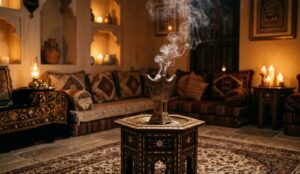
In the UAE, Saudi Arabia, Kuwait, Qatar, and Oman, the relationship with agarwood is not transactional. It is cultural, social, and deeply personal. Burning bakhoor – agarwood chips on glowing coals in a traditional mabkhara – is one of the most embedded rituals of Gulf Arab hospitality.
What makes Gulf Arab demand so powerful and structurally consistent:
- The quality of the agarwood you offer a guest reflects your standing as a host. The richer and more complex the fragrance, the greater the honor being conveyed.
- Gifting premium oud to a business partner or distinguished visitor carries social weight comparable to presenting fine jewelry or gold.
- Islamic texts reference agarwood favorably as one of the fragrant materials of paradise, adding a spiritual dimension that makes every purchase transcend personal taste.
- During Ramadan and Eid, consumption surges significantly as mosques, homes, and public spaces are perfumed for the sacred season.
- The UAE is home to globally recognized fragrance brands – Ajmal, Arabian Oud, Rasasi, Swiss Arabian – all of which feature agarwood as a central ingredient in signature formulations.
According to CITES trade data, the UAE and Saudi Arabia are consistently among the world’s largest final destination markets for agarwood globally. This demand is not cyclical or trend-driven. It has been constant for centuries and shows no sign of moderating.
The Western Luxury Perfume Industry: A New Market With Enormous Scale
Something shifted in Western luxury perfumery in the early 2000s. Perfumers discovered that oud offered something European and American aromatic traditions had never quite captured – depth, extraordinary skin longevity, and an animalic complexity that smelled ancient and expensive in a way that floral and citrus-forward compositions could not match.
The brands that drove the oud revolution in Western markets:
- Tom Ford Oud Wood – One of the bestselling luxury oud fragrances globally, responsible for introducing oud to a mainstream luxury audience outside the Gulf.
- Guerlain Oud Essentiel – A prestige anchor from one of France’s oldest fragrance houses.
- Amouage Interlude – From Oman, considered among the great oud fragrances by specialist critics worldwide.
- Maison Francis Kurkdjian Oud Satin Mood – Priced above $600 per 70ml, regularly cited among the world’s most expensive mainstream perfumes.
- Clive Christian oud range – Positioned explicitly at ultra-high-net-worth buyers, with some bottles exceeding $1,000.
The numbers behind the market:
- According to Persistence Market Research, perfumery accounted for over 50% of global agarwood essential oil revenue in 2025.
- Natural agarwood oil commands over 77% of global agarwood market value due to its complexity and cultural resonance.
- The agarwood essential oil market is projected to grow at a CAGR of 4.7%–6.4% through 2034.
Western demand for oud has created a massive new consumer base layered on top of an already strained supply chain – at volumes that have no historical precedent.
For those in Dubai looking to explore Arabian oud fragrance oils or the full range of oud-based perfumes that capture this aromatic tradition, the selection across price points has never been wider or more accessible.
Buddhist and Hindu Traditions: Over 1,500 Years of Continuous Religious Demand
The documented history of agarwood in Buddhist practice:
- 595 CE – A piece of agarwood drifts ashore on Awaji Island in Japan. Locals use it as cooking fuel until the smoke releases a fragrance so extraordinary they present the wood to the Empress. This event is recorded in the Nihon-shoki.
- 710–794 CE (Nara Period) – Agarwood enters the official ceremonies of the Japanese Imperial court.
- 12th century onward – Kōdō (“the Way of Incense”) develops as a refined meditative tradition in Japan, in which practitioners “listen to” agarwood rather than merely smell it – treating fragrance as a contemplative art form comparable to the tea ceremony or calligraphy.
- Present day – Buddhist temples across Japan, Vietnam, China, Thailand, and Tibet continue using premium agarwood incense for significant ceremonial occasions.
The Lotus Sutra states: “If one offers agarwood, sandalwood, camphor, and other exquisite fragrances to the Buddhas, the merits gained shall be immeasurable.”
In Hindu tradition, agarwood is used in:
- Havan – Sacred fire offerings in which fragrant woods are burned as spiritual gifts.
- Temple incense preparations – For purifying sacred spaces before and during worship.
- Ritual purification ceremonies – For consecrating objects, spaces, and individuals.
This religious demand has been consistent for over a millennium and shows no structural sign of diminishing.
Traditional Medicine: A Fast-Growing Demand Stream the Market Often Underestimates
In Traditional Chinese Medicine (TCM):
- Known as chen xiang – “sinking fragrance.”
- Prescribed for centuries to address digestive disorders, respiratory conditions, and anxiety.
- Used in classical formulations documented in Chinese medical texts dating back over 1,000 years.
- Demand growing alongside China’s expanding middle class and rising interest in premium-grade natural therapeutics.
In Ayurvedic medicine:
- Used historically for mental clarity, calming the nervous system, and supporting immune function.
- Documented in ancient Ayurvedic texts as a treatment for neurological and psychological conditions.
- Increasingly relevant to the global wellness market through aromatherapy entry points.
The numbers:
- According to Industry Research Biz, approximately 27% of global agarwood essential oil is used in therapeutic formulations.
- Over 45 million consumers worldwide currently use agarwood oil in relaxation therapy contexts.
- This is a demand stream that barely existed as a distinct market 20 years ago and now represents a meaningful and growing percentage of total global consumption.
Agarwood Grades Explained: What Each Grade Costs and Why
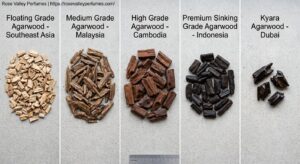
Not all agarwood is the same product. The price gap between the cheapest and most expensive grades is not measured in percentage points – it is measured in multiples of thousands. Understanding how grading works is the most practically useful thing any buyer can know before making a purchasing decision.
The Core Grading Principle
The primary metric is resin density – the percentage of the wood’s total mass that is composed of dark, aromatic oleoresin rather than standard wood fiber.
Higher resin content produces:
- Greater weight and physical density per cubic centimeter.
- Deeper, more complex, and longer-lasting fragrance.
- A more layered aromatic evolution when heated gently over time.
- A dramatically higher commercial market price.
Complete Grade-by-Grade Breakdown With Prices
Kyara / Kinam / Qinan – The Absolute Pinnacle
- Resin content: Highest of any graded category, typically above 40% of total mass.
- Water test result: Sinks instantly and completely without hesitation.
- Geographic origin: Found almost exclusively in Vietnam, in old-growth wild forest areas.
- Fragrance character: Not just intense – extraordinarily layered. Experienced appraisers describe multiple distinct aromatic phases evolving over time: initial bitter-sweet opening, a warm middle sweetness, a cooling green note, and a deep balsamic woody dry-down. This progressive evolution is what separates Kyara from every other grade in existence.
- Price range: $50,000–$1,000,000+ per kilogram for authenticated raw wood.
- Oud oil derived from Kyara: Up to $200,000 per liter in documented specialist transactions.
- Availability: Practically unavailable on the open market. Traded primarily at private auction and through established collector-to-collector networks.
Sinking Grade A – The Premium Commercial Standard
- Resin content: 25–40% of total mass.
- Water test result: Sinks reliably and consistently.
- Fragrance: Deep, rich, genuinely complex, with a long aromatic evolution over heat.
- Price range: $10,000–$100,000 per kilogram depending on geographic origin, tree age, and scent complexity.
- Primary uses: High-end dehnal oud oil production, luxury incense for serious collectors, premium bakhoor blends for significant occasions and gifting.
Semi-Sinking Grade B – The Mid-Market Standard
- Resin content: 15–25% of total mass.
- Water test result: Some pieces sink, some partially float – hence “semi-sinking.”
- Fragrance: Genuine and pleasant, but with less aromatic complexity than Grade A.
- Price range: $2,000–$10,000 per kilogram.
- Primary uses: Mid-range oud oil production, quality bakhoor and incense blends, regular home use in Gulf Arab households.
Floating Grade C – The Entry Level
- Resin content: 5–15% of total mass.
- Water test result: Floats.
- Fragrance: Present but noticeably thinner and less evolved than sinking grades.
- Price range: $200–$2,000 per kilogram.
- Primary uses: Incense blends, everyday bakhoor mixtures, and entry-level fragrance products.
Agarwood Dust and Powder – Processing Byproduct
- Resin content: Below 5%, or mixed from processing byproducts.
- Price range: $50–$500 per kilogram.
- Primary uses: Mass-market incense sticks, basic bakhoor blends, lowest-tier aromatic applications.
Agarwood Price by Origin: Geography as a Quality Signal
Where agarwood comes from creates its own price premium, even within the same grade tier.
🇻🇳 Vietnamese Agarwood – The Global Benchmark for Quality
- Particularly from the Nha Trang and Hoi An forest regions.
- Globally recognized as the finest for fragrance complexity and depth.
- Commands the highest prices worldwide across all grade tiers.
- Vietnamese Kyara is the benchmark against which all other origin Kyara is measured.
- If you want to experience the Vietnamese agarwood character, the Moori Vietnam agarwood collection represents one of the most respected Vietnamese chip origins available in Dubai.
🇮🇳 Indian Agarwood – Prized Across the Gulf Market
- Primarily from Assam, Nagaland, Manipur, and Arunachal Pradesh.
- Particularly prized in Arab markets for its warmer, sweeter, and earthier resin profile.
- High-quality Indian chips trade at approximately AED 22,000–44,000 per kilogram in Dubai as of 2025.
- For those exploring the Indian agarwood character, Hindi Moori and Hindi Sollah chips are among the most respected expressions of the Assam origin.
🇮🇩 Indonesian Agarwood – The Backbone of the Mid-Tier Market
- More commercially available, particularly from plantation cultivation in Kalimantan and Sumatra.
- Known for a distinctly resinous, slightly smoky fragrance profile.
- Indonesian Oud Super chips offer a genuine entry into the agarwood experience with the warm, characteristic Indonesian wood fragrance.
🇱🇰 Sri Lankan Agarwood – A Valued Specialty Origin
- Known in the specialist trade for a slightly sweeter and less earthy profile than Indian varieties.
- Valued in both Gulf and East Asian markets.
- Oud Sri Lanka chips represent a less discussed but genuinely respected origin in the serious agarwood trade.
Cultivated Agarwood (Any Origin)
- Consistently trades at a 30–70% discount compared to wild material of an equivalent stated grade.
- Reflects the acknowledged quality gap in resin density and aromatic complexity resulting from shorter development time.
Can Agarwood Be Farmed – And Does Cultivation Solve the Price Problem?
Yes – agarwood can be and is being commercially cultivated on a growing scale. But what cultivation does and does not solve requires honest and specific acknowledgment.
How Artificial Inoculation Works
Cultivators recognized that if fungal infection is the trigger for resin formation, that infection might be induced deliberately rather than left to natural chance. Several methods have been developed:
- Mechanical wounding – Drilling holes or making precise cuts in the trunk to simulate the physical injury that typically precedes natural infection.
- Chemical inoculation – Introducing acidic or fungicidal compounds through prepared wounds to create a chemical stress environment that encourages resin production.
- Biological inoculation – The most sophisticated approach: introducing specific cultured fungal strains – most commonly Phialophora-type organisms – directly into prepared wound sites. This is now the most reliable method for triggering resin formation consistently.
Countries leading cultivated agarwood production:
- 🇻🇳 Vietnam – The largest volume producer of cultivated agarwood globally.
- 🇨🇳 China – Major plantation investment in Yunnan and Guangdong provinces.
- 🇹🇭 Thailand and Malaysia – Significant commercial plantation industries serving regional and export markets.
- 🇮🇳 India (Assam and Kerala) – Growing sector supported by government agroforestry programs.
According to Industry Research Biz, the number of agarwood plantation projects worldwide exceeded 6,500 by 2024, with India, Laos, and Cambodia accounting for over 62% of total plantation area.
What Cultivation Does Well – and What It Cannot Do
What cultivated agarwood does effectively:
- Can be produced in 5–8 years instead of 25–50+ years for wild premium material.
- Available in consistent, commercially useful quantities at accessible price points.
- Has genuinely expanded the mid-tier and entry-level market that barely existed 20 years ago.
- Supports rural livelihoods for thousands of smallholder farming families.
- Reduces harvesting pressure on wild populations at lower quality grades.
What cultivated agarwood cannot do:
- It cannot replicate the resin density of wild wood that has been saturating for 30–50 years.
- It cannot reproduce the layered aromatic complexity of old-growth wild agarwood. Cultivated oud oil is consistently described by experienced perfumers as “flatter” – fewer distinct aromatic phases, less aromatic evolution over time.
- It does not reduce demand or prices for wild Grade A or Kyara. The buyers in that market are not looking for an approximation. They are purchasing what only decades of wild resin formation can produce.
The honest conclusion:
Cultivation has successfully created an accessible market tier that did not meaningfully exist before. What it has not done – and structurally cannot do – is relieve price pressure at the top of the market. As wild supply continues declining, the premium commanded by authenticated wild agarwood over cultivated equivalents is likely to widen rather than narrow over the coming decade.
Does Agarwood Have a Black Market – And What Does It Do to Prices?
This part of the agarwood story is uncomfortable but essential to fully understanding the price picture.
The Scale of Illegal Trade
TRAFFIC – the wildlife trade monitoring network working alongside IUCN and WWF – classifies agarwood as one of the most heavily trafficked plant commodities globally.
Documented facts about illegal agarwood trade:
- Criminal networks operating across Laos, Cambodia, Myanmar, Indonesia, and Papua New Guinea move illegally harvested wild agarwood through processing hubs before it enters international trade flows.
- A 2025 Mongabay study found that 70% of global agarwood trade still depends on wild-harvested trees from threatened populations – despite CITES regulations in force for over 30 years.
- India alone saw more than 1.25 tonnes of agarwood chips and 6 liters of oil seized between 2017 and 2021, according to TRAFFIC – and seizures represent only cases where enforcement actually succeeded.
- Despite Interpol involvement and periodic large-scale operations, enforcement remains chronically under-resourced relative to the scale and profitability of the trade.
Documented Fraud Types in the Agarwood Market
Alongside outright illegal sourcing, product fraud is a well-documented, persistent reality at every level of the supply chain:
- Oil infusion fraud – Lower-grade chips soaked in synthetic oud compounds and dried, causing them to smell temporarily like higher-grade material. The synthetic scent fades quickly on sustained heating, but the deception works at point of sale.
- Fake Kyara – Pieces presented as the rarest and most expensive subcategory that are actually lower-grade or cultivated wood, treated to mimic Kyara’s external appearance and initial fragrance opening.
- Origin misrepresentation – Indonesian or Malaysian wood sold with documentation claiming Vietnamese origin to command the Vietnamese price premium.
- Grade inflation – Semi-sinking material documented and sold as sinking grade, with paperwork that most buyers cannot independently verify.
The Price Opacity Problem That Makes Everything Worse
Unlike gold, coffee, or crude oil, there is no public commodity exchange for agarwood. There is no globally recognized independent grading authority. There is no publicly accessible reference price.
The practical consequences:
- A piece of wild sinking-grade agarwood worth $500 in the forest may trade for $5,000 by the time it passes through three intermediary traders and reaches a Dubai perfume souk – with no benchmark against which either party must justify that number.
- Legitimately CITES-certified agarwood with complete chain-of-custody documentation trades at a consistent premium of 25–40% above uncertified material – not because it smells better, but because the legal proof of its origin has real financial value.
Practical guidance for buyers at any level:
- Always request CITES export documentation and country-of-origin certificates from the producing country’s relevant authority.
- Request chain-of-custody records tracing the material from harvest through every intermediary.
- For premium grades, work only with suppliers with documented reputations and verifiable sourcing history.
- For any purchase in Dubai, explore established and reputable sources in the Deira and Murshid Bazar area – where you can browse the full agarwood collection and discuss origin documentation directly.
- Be immediately skeptical of any seller who cannot provide full legal documentation on request.
The Future of Agarwood: Will Prices Keep Rising?
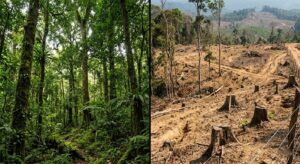
Looking ahead, the structural forces shaping the agarwood market point consistently in one direction for premium wild material: continued scarcity, continued price appreciation, and growing difficulty obtaining authenticated wild product at any commercial scale.
Wild Supply Is Not Recovering – By Any Realistic Assessment
Key indicators of the wild supply trajectory:
- The forests of Assam, Borneo, and the Mekong Delta that once supplied commercial quantities of wild agarwood are severely and irreversibly depleted.
- No conservation intervention currently proposed could realistically restore commercially productive wild populations within 30 years under any scenario being actively implemented.
- The historical geographic shift of supply – from India to mainland Southeast Asia to Indonesian islands to Papua New Guinea – has left few unexploited wild populations of any commercial significance.
- CITES, TRAFFIC, IUCN, and WWF assessments all describe ongoing decline across the species’ full range, with no trajectory reversal in sight.
For serious buyers, this means authenticated wild agarwood available today may represent not a floor price but something closer to a final commercial window before genuinely premium wild material becomes effectively unavailable at any meaningful scale.
Agarwood as an Alternative Hard Asset
Premium agarwood – particularly authenticated Kyara and wild Grade A material – is increasingly discussed in niche investment and alternative asset circles. Its properties make it unusual:
- Storable without degradation: Properly stored agarwood maintains its aromatic quality for decades and can appreciate over time.
- Culturally inelastic demand: Purchasing decisions from Gulf Arab households, Buddhist institutions, and Japanese collectors are not driven by financial market conditions and do not contract during economic downturns.
- Permanently supply-constrained: Unlike gold, which can be mined from newly discovered deposits, premium wild agarwood can only grow scarcer. No new Kyara of equivalent age is forming anywhere that will be harvestable in any current investor’s lifetime.
- Zero financial market correlation: Its value is driven entirely by cultural and biological factors independent of stock markets, interest rates, or currency movements.
Synthetic Oud Research: What It Can and Cannot Replace
What synthetic oud will successfully address:
- Mid-tier and mass-market fragrance formulations will increasingly use bioengineered oud compounds.
- Mass-market products – diffusers, room sprays, entry-level incense sticks – will shift toward synthetic and bio-fermented oud.
- This will make oud-inspired fragrances more accessible and affordable for general consumers.
What synthetic oud cannot replace:
- The full aromatic complexity of aged wild oud – with its multiple distinct phases evolving over hours on skin or in a burning incense burner.
- The cultural meaning embedded in authentic agarwood for Gulf Arab buyers, Japanese collectors, or Buddhist temple procurement.
- The specific physical material that premium buyers are purchasing, which is the authentic article – not an approximation of it.
Emerging technology to watch:
- AI-assisted imaging and infrared scanning are being developed for non-invasive resin content testing.
- If this technology achieves commercial reliability, it could create the foundation for a more transparent, standardized grading system – addressing one of the market’s oldest and most persistent structural weaknesses.
Why Agarwood in Dubai Holds Such a Special Place in the Global Market
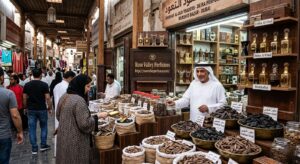
Dubai is not simply a market for agarwood. It is one of the world’s most important cultural, commercial, and knowledge centers for the entire global oud and agarwood trade.
Why the UAE holds a uniquely powerful position in the global agarwood market:
- Cultural depth – Burning bakhoor – agarwood chips on glowing coals – before receiving guests is a practice embedded in Gulf Arab hospitality that predates modern commerce by centuries. It is not a trend. It is a tradition.
- Geographic centrality – Dubai sits at the trade crossroads between the major producing regions of South and Southeast Asia and the high-consumption markets of the Arab world, Africa, and increasingly Europe.
- Market sophistication – Dubai’s perfume souks in Deira and the Gold Souq area are home to some of the world’s most knowledgeable agarwood traders and buyers. Consumer literacy about grade, origin, and quality is generally higher in Dubai than in any Western market.
- Demand scale – The UAE is consistently one of the world’s largest final destination markets for agarwood, per CITES trade data. The combination of a large Gulf Arab consumer base, a significant South Asian expatriate population with their own oud traditions, and a growing global luxury tourist market creates layered demand unlike any other single city.
- Religious calendar amplification – During Ramadan and Eid specifically, agarwood consumption across Dubai and the UAE surges as homes, mosques, offices, and public spaces are perfumed for the sacred season.
For anyone in Dubai looking to understand the full range of agarwood origins, grades, and product formats – from raw agarwood chips to pure dehnal oud oil to ready-to-burn bakhoor and oud muatter blends – the Deira and Murshid Bazar area offers one of the most concentrated and knowledgeable agarwood trading environments anywhere in the world.
Understanding the grade system detailed in this article is the single most useful piece of knowledge you can carry into any agarwood purchasing decision – whether you are buying chips for home use, sourcing dehnal oud for personal fragrance, or selecting a gift for someone who understands the difference.
Why Agarwood Is So Expensive: A Final Summary
Somewhere in a Vietnamese or Indian rainforest right now, an Aquilaria tree is slowly responding to a fungal infection it cannot fight off. Year by year, it is pushing dark, aromatic resin into its own heartwood – a process that will take decades to complete. If that tree survives long enough and is eventually found by someone with the skill to recognize what it has become, it will produce something that a family in Dubai, a perfumer in Paris, and a collector in Tokyo will each pay extraordinary sums to possess – for entirely different reasons, from entirely different cultural traditions.
Agarwood’s price is not the result of manipulation, artificial scarcity, or luxury markup. It is the direct and unavoidable result of six irreversible forces operating simultaneously:
- Only 7–10% of wild Aquilaria trees will ever produce it – the starting odds are structurally against sufficient supply at any grade.
- It requires decades, sometimes over a century, to reach its full aromatic expression – and that timeline cannot be shortened by any means currently available.
- Every stage of bringing it to market depends on irreplaceable human expertise that cannot be meaningfully mechanized at quality levels.
- Distilling one liter of dehnal oud oil requires 70–100 kg of quality wood processed over 10–20 continuous days of distillation.
- Wild Aquilaria populations are legally protected and ecologically depleted across their entire natural range, with no realistic recovery timeline within this century.
- Demand comes simultaneously from every major cultural, religious, and luxury market on Earth, with no viable substitute in any of them.
Agarwood does not cost more than gold simply because it is rare. It costs more because it requires a wounded tree, a specific fungus, decades of undisturbed time in a disappearing forest, a skilled hunter who reads a jungle by sound and scent, artisan hands that distinguish resin density by touch, and a distillation process of extraordinary inefficiency – all working together across generations to create something that no factory, no algorithm, and no shortcut in existence can replicate.
That is not a luxury premium. That is the actual, verifiable cost of something genuinely, structurally, and permanently irreplaceable.
Frequently Asked Questions
Why is agarwood so expensive?
Agarwood forms naturally in only 7–10% of wild Aquilaria trees after a rare fungal infection. It takes 10–50+ years to develop quality resin. Harvesting is entirely hand-operated in remote rainforests, and distillation yields just 1 liter of oud oil per 70–100 kg of quality wood. Wild supplies are legally protected under CITES and severely depleted, while demand grows continuously from Gulf Arab culture, luxury perfumery, Buddhism, and traditional medicine simultaneously.
What is agarwood used for?
Agarwood is used as raw incense chips – called bakhoor – burned in a traditional mabkhara burner to perfume homes and clothing, as the source material for pure dehnal oud oil used in luxury perfumery, in Traditional Chinese Medicine and Ayurveda for therapeutic applications, and in Buddhist and Hindu religious ceremonies as sacred incense. You can explore the full range of agarwood and bakhoor products across every grade and format.
What is the most expensive type of agarwood?
Kyara (also called Kinam or Qinan) is the most expensive agarwood in the world. Found almost exclusively in Vietnam, it has an extraordinarily complex, multi-layered fragrance that evolves through multiple aromatic phases when heated. Prices range from $50,000 to over $1,000,000 per kilogram for authenticated raw wood.
Is agarwood legal to buy?
Yes, but under regulated conditions. Wild agarwood trade is governed by CITES Appendix II, requiring export permits and Non-Detriment Findings. Cultivated agarwood faces fewer restrictions. Always request full CITES documentation and chain-of-custody records from any supplier. Purchasing from established, reputable dealers with traceable sourcing is the safest approach.
How can you tell if agarwood is genuine?
Authentic high-grade agarwood sinks in water due to its resin density. When heated gently, it produces a deep, complex fragrance that evolves through multiple distinct phases over time. Fake or adulterated material typically smells flat, sharp, or chemical when burned, often floats despite being sold as sinking grade, and lacks aromatic depth. When in doubt, purchase from reputable suppliers who can provide documentation and origin details.
Which country produces the best agarwood?
Vietnam – particularly from the Nha Trang and Hoi An regions – produces the globally recognized highest-quality agarwood. Vietnamese Kyara commands the highest prices internationally. India’s Assam-origin agarwood is highly prized in Arab markets for its warm, sweet fragrance profile. You can explore Moori Vietnam and Hindi Moori to compare these two benchmark origins directly.
How long does it take for agarwood to form naturally?
Low-grade agarwood takes a minimum of 10 years from infection onset. Premium sinking Grade A requires 25–50 years of continuous resin saturation. Kyara-grade is believed to require over 100 years in some documented specimens. These timelines are the primary structural reason why wild premium agarwood cannot be replaced by cultivation at quality levels.
Why is dehnal oud oil so expensive?
One liter of authentic dehnal oud oil requires 70–100 kg of quality agarwood chips and 10–20 continuous days of steam or hydro-distillation. At raw chip prices of $5,000 per kg, the input material cost alone exceeds $350,000–$500,000 per liter before labor, energy, or equipment. This yield mathematics – not luxury markup – explains why authentic dehnal oud oil trades at $30,000–$80,000 per liter on the legitimate market.