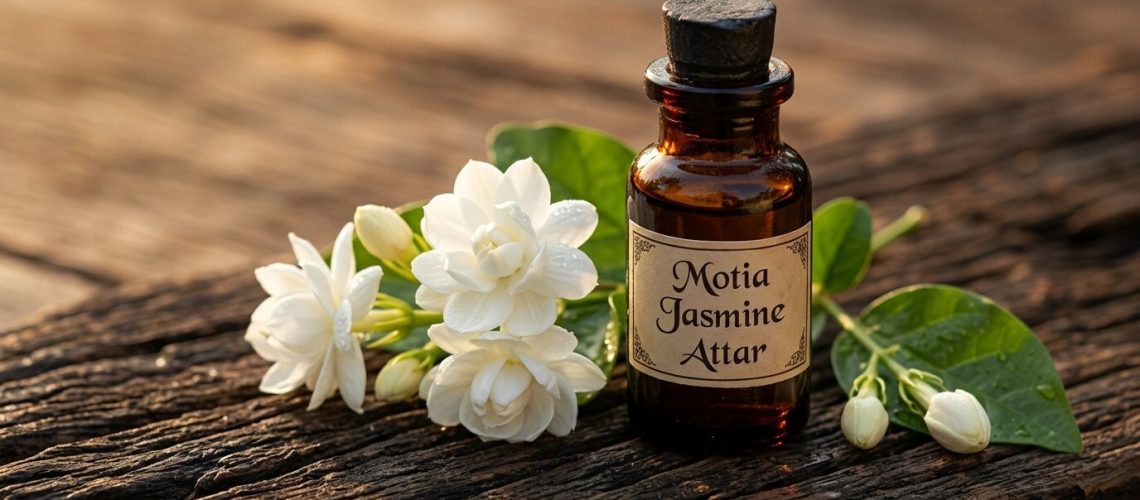
Attar Motia (Jasmine Attar) is a pure, alcohol-free perfume oil made from Jasminum sambac, distilled into a sandalwood base using the traditional Indian deg-bhapka method. Applied to pulse points, it gives a rich, sweet floral fragrance lasting 6 to 10 hours, suits Dubai’s heat far better than spray perfume, and is the daily fragrance of choice for thousands of UAE residents who prefer a skin-safe, alcohol-free attar.
Walk through Murshid Bazar in Deira at dusk and you will smell it before you see it: a warm, heavy sweetness drifting from behind a wooden counter, where a small glass vial of golden oil sits beside a stack of handwritten labels. No spray bottles, no nozzles. Just a glass stopper, a steady hand, and a fragrance that has been moving along this same Indian Ocean trade route for centuries.
That oil is Attar Motia, jasmine attar, and it has been part of the Deira fragrance trade for as long as anyone here can remember. It is not loud. It does not announce itself across a room the way a heavy oud or a department-store spray does. It settles close to the skin, deepens with body heat, and by the third hour smells like something that has always belonged to you.
This guide goes well beyond a quick definition. It covers the full history of jasmine attar from Mughal courts to modern Deira, the genuine science behind why people reach for it, a complete step-by-step application method, a full buying and authentication guide for the Dubai market, and a set of short, direct answers to the questions people search for most. Whether you are buying jasmine attar for the first time or have worn it your whole life, there is something here worth knowing.
What Is Attar Motia – Jasmine Attar?
Attar Motia, also called Jasmine Attar, is a traditional Indian perfume oil made from steam-distilled Jasminum sambac (Arabian jasmine) captured into a pure sandalwood oil base. “Motia” is the Hindi and Urdu name for this jasmine variety; “Attar” comes from the Arabic word for fragrance. One kilogram of Attar Motia requires roughly eight million hand-picked jasmine flowers.
What the Names Actually Mean
Understanding the name tells you almost everything about what you are buying, and almost no other guide explains it properly:
- is the Hindi and Urdu word for Jasminum sambac, the compact, intensely fragrant jasmine variety grown around Kannauj in North India. It is a different species from Jasminum grandiflorum, the jasmine used in French perfumery and in fragrances like Chanel No. 5. The two are related but smell distinct: grandiflorum is softer and greener, sambac is richer and more narcotic.: Motia (also spelled mogra)
- comes from the Arabic word for fragrance. It refers to a concentrated, oil-based perfume applied directly to the skin, with no alcohol added. The word has been used across the Islamic world for centuries to describe exactly this kind of botanical perfume oil.: Attar (also spelled ittar or itr)
- is the purest, undiluted form of jasmine attar, with no sandalwood carrier at all. Ruh means soul or spirit in both Arabic and Urdu. We cover the full difference between Ruh Motia and Attar Motia in detail later in this guide, including price and longevity comparisons.: Ruh Motia
In India the same flower is also called mallika, bela, and chameli depending on the region. In the Philippines it is sampaguita, the national flower. In Indonesia it is melati putih. Every one of these names, across every culture that uses them, refers to something small, white, and precious. That is exactly how the flower behaves and exactly how the attar wears.
Where the Flower Comes From
Jasminum sambac is a small, white-flowered evergreen shrub native to South Asia, also known as Arabian jasmine despite not originating in Arabia at all. It produces small, waxy, five-petalled flowers that open in clusters of three to twelve at the ends of branches. A few facts that explain why this flower is so prized, and why genuine attar costs what it costs:
- typically between four and six in the morning, when their essential oil content peaks. Any delay, any exposure to direct sunlight after the flower opens, and the fragrance quality begins to degrade.: Flowers are hand-picked before sunrise
- are needed to produce one kilogram of pure jasmine absolute. A skilled picker can typically gather three to five kilograms of flowers in a single morning, meaning a single kilogram of finished oil represents an entire harvest season of labour.: Roughly eight million flowers
- and is woven into ceremonial garlands, temple offerings, and bridal traditions across both countries.: It is the national flower of the Philippines (Sampaguita) and Indonesia (Melati Putih)
- where dried jasmine sambac flowers are layered with green tea leaves to produce one of the most widely consumed scented teas in the world.: It scents jasmine tea across China
- known locally as pikake, a name borrowed from the peacocks once kept in the gardens where the flower was first introduced to the islands.: It is used to make leis in Hawaii
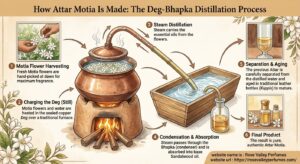
How Attar Motia Is Made: The Deg-Bhapka Distillation Process
Attar Motia is produced through deg-bhapka, a traditional Indian hydro-distillation method practised continuously in Kannauj, Uttar Pradesh for more than four hundred years. According to National Geographic, Kannauj began producing attar centuries before the famous perfumeries of Grasse, France emerged as a global fragrance centre, and the city is still widely regarded as the perfume capital of India. The basic process has barely changed in all that time:
- harvested before sunrise are packed into a large copper pot called the deg, filled with water, and sealed tight with clay-soaked cloth so that no aromatic steam can escape. – Fresh jasmine flowers
- connects the sealed deg to a second copper vessel, the bhapka, which is pre-filled with pure sandalwood oil and sits submerged in a tank of cool running water. – A bamboo pipe called the chonga
- is lit beneath the deg. As the water heats and the flowers steep, aromatic steam builds and travels through the bamboo pipe into the cool bhapka, where it condenses directly into the sandalwood oil. – A slow wood fire
- over multiple distillation cycles that can span several days. The master distiller, known as a dighoo, regulates the fire entirely by hand and by ear, judging temperature by the sound of the steam rather than any instrument. This knowledge is passed down across generations, and some Kannauj families are currently in their sixth or seventh generation of attar-making. – The sandalwood oil absorbs the jasmine steam molecule by molecule
- porous leather bottles traditionally made from camel or goat hide, where any remaining moisture evaporates slowly over weeks or months. Premium batches are aged for a minimum of one year, with some rested for several years to deepen and round out the fragrance. – The finished attar is poured into kuppis
Attar Motia is not cold-pressed. Jasmine flowers yield no oil under mechanical pressure – genuine production always requires steam or hydro-distillation. Any seller calling it ‘cold-pressed’ is either mistaken or mislabelling the product, and either way it is a signal to ask more questions before buying.

A Royal History: Jasmine Attar from the Mughal Court to Modern Dubai
Jasmine attar has a documented royal history stretching back to the Mughal Empire, when emperors including Jahangir were known for their devotion to fragrance, and through to the princely state of Hyderabad, where Ruh Motia was reportedly a favourite of the Nizams. This same craft, carried along Indian Ocean trade routes, became deeply embedded in Gulf fragrance culture long before the modern perfume industry existed.
Most guides to Attar Motia treat it as a modern wellness product. It is not. This is one of the oldest continuously practised perfume traditions on earth, and understanding where it comes from changes how it feels to wear it.
The Mughal Courts and the Birth of Indian Perfumery
According to National Geographic, the first Mughal emperor, Babur, celebrated the connection between fragrance and both spiritual and sensual contentment, and this appreciation shaped Mughal court culture for the next two centuries. The Ain-i-Akbari, the administrative chronicle of Emperor Akbar’s reign, records the emperor’s own habit of dabbing his body with fragrant attars, burning incense throughout his palaces, and rubbing doors and furniture with perfume.
Jahangir, Akbar’s son, and his wife Noor Jahan are considered Kannauj’s first true royal patrons. Court legend holds that Noor Jahan became so captivated by the scent of Kannauj’s rose attar during her bath that demand for it surged across the empire. Queens and courtesans of the period are said to have worn their personal attar stash in miniature glass vials around their necks, a habit not unlike how a small attar bottle is still carried or gifted today.
Ruh Motia and the Nizams of Hyderabad
The princely state of Hyderabad, founded in 1724 by Asaf Jah I as the Mughal Empire’s authority weakened, became one of the wealthiest and most culturally significant courts in India. The Nizams who ruled Hyderabad were notable patrons of art, architecture, and fragrance, and jasmine attar specifically held a privileged place at court.
- worn at court and gifted between nobility.: Historical sources note that Ruh Motia, the pure jasmine distillate, was among the favoured fragrances of the Nizams of Hyderabad
- a position that reflected both commercial success and royal trust.: One of Hyderabad’s oldest ittar houses, founded in 1896, became the official ittar supplier to the Nizams by 1920
- and is reported to have created a custom blend of twelve flowers for the royal court.: A nearby attar establishment, founded in 1840 by a perfumer from Kannauj, served Nizam Mahboob Ali Pasha (Asaf Jah VI), himself a noted ittar connoisseur
This royal patronage is part of why jasmine attar, and Ruh Motia in particular, still carries a sense of occasion in South Asian and Gulf culture today. It was never an everyday commodity in the way mass-market perfume became in the twentieth century. It was, and in many circles still is, a considered, valuable, and slightly ceremonial object.
How the Tradition Reached the Gulf
Deira was a creek port long before it had skyscrapers and a metro line. Dhows carrying spices, pearls, textiles, and fragrant oils crossed the Indian Ocean between the Gulf coast and the ports of Gujarat and the Malabar Coast for centuries, and fragrance was always part of that exchange. Kannauj’s attars, rose, jasmine, vetiver, and sandalwood, moved into Gulf homes and royal courts through exactly this trading network.
Jasmine specifically was valued in the Gulf for reasons that were as practical as they were aesthetic. It was an alcohol-free oil that stayed fixed on skin through the desert heat, it was calming in a climate where heat itself could be a source of stress, and it carried a lush floral richness that the arid Gulf landscape could not produce on its own. The result is a fragrance culture in which jasmine attar has never really been a foreign import. It has simply always been here.
Attar Motia in Dubai: Why the UAE Loves Jasmine
Attar Motia has been part of Dubai’s fragrance culture for centuries, arriving through the Indian Ocean trade routes that connected Deira’s markets to the attar makers of Kannauj. In the UAE today, jasmine attar is worn for Friday prayers, at majlis gatherings, for bridal preparation, and as a Ramadan or Eid gift.
Walk into the perfume district of Deira on a Thursday evening and you will see the living, present-day reality of this history. Men in thobes stop on their way home from the mosque. Women in abayas browse the small glass vials lined up at the counter. Expatriates from South Asia reach for familiar names: mogra, motia, chameli. Everyone is looking for the same thing, a genuine, oil-based jasmine fragrance that works on skin, in this heat, in these spaces.
Across the UAE today, Attar Motia is woven into specific, recognisable occasions:
- many men apply a drop to the wrist or thobe collar before Jumu’ah, in line with the well-documented Sunnah of wearing fragrance to the Friday prayer. An alcohol-free attar removes any question about its appropriateness before salah.: Friday prayers (Jumu’ah)
- a soft, close-to-skin fragrance like Attar Motia suits an indoor gathering without overwhelming guests, and complements rather than competes with the oud or bukhoor often burning nearby.: Majlis gatherings
- jasmine attar is applied during henna (mehndi) nights and on the day of the nikah, often layered with rose attar, a combination that is genuinely traditional across both South Asian and Gulf wedding culture.: Bridal preparation
- a small bottle of Attar Motia in a velvet pouch is a thoughtful, culturally appropriate gift, reflecting both its natural composition and its long association with considered, rather than casual, giving.: Ramadan and Eid gifting
- for many residents, it is simply the fragrance worn every day, performing in Gulf heat in a way that alcohol-based sprays genuinely cannot match.: Daily wear
The UAE’s broader fragrance market reflects this heritage. The sector is projected to keep growing steadily through the next decade, driven in large part by sustained demand for traditional oil-based attars and oriental fragrance blends rather than a shift away from them. That growth is not happening despite the Gulf’s fragrance history. It is happening because of it.
Rose Valley Perfumes has been part of this same Deira fragrance district since 1990, and our team can tell you more about our story on the About Us page. We have watched customers’ children grow up and come back with their own children, and the demand for genuine Attar Motia has never really changed here, only people’s access to clear, honest information about what they are buying has.
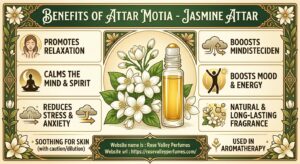
Benefits of Attar Motia – Jasmine Attar
Attar Motia offers five key benefits: it eases stress and anxiety through the calming compound linalool, found in Jasminum sambac; it is gentle on sensitive skin because it contains no alcohol; it lasts 6 to 10 hours by bonding to skin naturally; it carries genuine spiritual and ritual significance in Islamic and South Asian tradition; and its sandalwood base offers mild skin conditioning.
1. Eases Stress and Supports Calm
The calming effect of jasmine is not just a pleasant claim, it has a measurable chemical basis worth understanding properly. Jasminum sambac contains three dominant aromatic compounds:
- a monoterpene compound with confirmed calming and anxiolytic properties, studied for its effect on the nervous system when inhaled. Research has linked inhaled linalool to reduced anxiety responses through its action on GABA-related pathways in the brain, the same general system targeted by conventional anti-anxiety approaches.: Linalool
- the sweet, floral ester primarily responsible for jasmine’s signature scent, and one of the compounds that gives genuine jasmine its immediately recognisable richness.: Benzyl acetate
- the compound that gives real jasmine its deep, slightly narcotic, almost honeyed warmth. Indole is found naturally in jasmine flowers and in small quantities in human skin chemistry, which is part of why genuine jasmine attar feels so intimate and alive when worn, rather than simply applied.: Indole
In Ayurveda, Jasminum sambac is classed as a sheetal, or cooling, oil, used to pacify Pitta dosha. In this context cooling does not refer to body temperature. It refers to emotional temperature, the calming of overheated states including irritability, frustration, anxiety, and mental fatigue. This is precisely why jasmine attar has been used in meditation and prayer settings across India for centuries, not as decoration but as a functional aromatic tool.
Simply wearing Attar Motia at your pulse points means you inhale the fragrance continuously through the day. No diffuser or special technique is needed to benefit from this, the calming effect works through ordinary, everyday wear.
2. Gentle on Sensitive Skin
Attar Motia contains zero alcohol, and the reason this matters is rarely explained properly. Your skin has a protective layer called the acid mantle, a slightly acidic film formed from sebum and sweat that defends against bacteria, pollutants, and moisture loss. Ethanol, the alcohol base used in most spray perfumes, has a denaturing effect on this layer. Applied repeatedly, alcohol-based perfumes can strip the acid mantle and lead to dryness and irritation over time, particularly in a dry, air-conditioned climate like Dubai’s.
- unlike ethanol-based sprays, because the oil base does not have the same denaturing effect on the skin’s surface chemistry.: Leaves the skin’s protective pH layer intact
- flavonoid compounds present in Jasminum sambac extracts with documented anti-inflammatory properties, potentially useful given Dubai’s high-UV, air-conditioned environment where skin is under near-constant oxidative stress.: Contains quercetin and kaempferol
- that itself has mild skin-soothing benefits. Santalol, the primary active compound in sandalwood oil, has been studied for its anti-inflammatory and skin-conditioning properties, meaning a genuinely produced Attar Motia offers more than fragrance alone.: Uses a sandalwood carrier
Always patch-test first. Apply one drop to the inner elbow and wait 24 hours before wider use. Do not apply to broken or irritated skin, and discontinue use if any redness or reaction develops.
3. Long-Lasting Wear, Especially in Dubai’s Heat
A well-applied Attar Motia lasts six to ten hours on moisturised skin, and noticeably longer on cotton fabric. The reasons are entirely practical, not anecdotal:
- in the outermost layer of skin, the stratum corneum, and release slowly as body heat rises throughout the day, rather than evaporating all at once.: Oil molecules bond to skin keratin
- a spray that lasts four hours in a cooler climate may fade within ninety minutes during a Dubai summer, as the ethanol carrier evaporates rapidly above 35 to 40 degrees Celsius and takes the fragrance molecules with it.: Alcohol-based perfumes evaporate fast in heat
- the heat that destroys an alcohol-based spray actually works in jasmine attar’s favour, gently warming the oil against the skin and releasing the fragrance more richly as the day progresses.: Attar Motia’s oil base resists this evaporation
There is also a practical point about projection. Attar Motia is deliberately intimate in how it carries, a soft personal trail rather than a strong sillage cloud. In the UAE’s enclosed office environments, mosques, shopping malls, and indoor majlis spaces, this is a genuine advantage rather than a limitation. People near you will notice a beautiful scent without being overwhelmed by it.
4. Spiritual and Ritual Significance
Fragrance, specifically alcohol-free attar, holds a documented and recognised place in Islamic practice:
- is a well-known Sunnah, referenced across multiple hadith collections, and an alcohol-free attar avoids any complexity around its use before prayer.: Wearing fragrance before Jumu’ah and salah
- reflecting its broader spiritual association across cultures, from devotional garlands in South Asian temples to its symbolic presence in Vedic-era ritual.: Jasminum sambac has also been used in Hindu and Buddhist temple offerings for centuries
- which now includes hundreds of registered yoga studios and wellness centres, Attar Motia’s calming linalool content also makes it a genuinely functional tool for meditation and breathwork, rather than simply a pleasant accompaniment to it.: In Dubai’s growing wellness community
5. Mild Skin Conditioning from the Sandalwood Base
Genuinely produced Attar Motia is jasmine captured directly into sandalwood oil, not a synthetic fragrance suspended in a neutral, inert carrier. Sandalwood oil itself has mild emollient and soothing properties, which is part of why traditional attar feels noticeably different on skin compared to mass-market alternatives, smoother, slightly richer, and longer-settling rather than simply scented.
Quick comparison: Attar Motia vs synthetic jasmine spray:
| Feature | Attar Motia (Pure Oil) | Synthetic Jasmine Spray |
| Base | Sandalwood or carrier oil | Alcohol (ethanol) |
| Longevity on skin | 6-10 hours | 2-4 hours |
| Effect on skin | Leaves acid mantle intact | Can dry and irritate skin |
| Key aromatic compounds | Linalool, benzyl acetate, indole | Synthetic analogues |
| Scent behaviour | Evolves: top, heart, dry-down | Projects then fades (linear) |
| Dubai heat performance | Excellent | Fades quickly above 35C |
| Alcohol-free / mosque-safe | Yes | No |
What Does Attar Motia Smell Like?
Attar Motia smells rich, sweet, and intensely floral, the deep, concentrated jasmine scent that synthetic jasmine fragrances imitate but rarely replicate. The opening is fresh and slightly green. The heart deepens into a warm, indolic, almost narcotic floral character. The dry-down is soft, woody, and powdery as the sandalwood base emerges.
Generic descriptions like fresh or floral tell you almost nothing useful. Here is what jasmine attar genuinely smells like on skin, across real wear time, broken into the three stages every genuine attar passes through.
- fresh, dewy, and slightly green, like jasmine sambac flowers just before sunrise, when their essential oil content is at its peak. Some wearers notice a faint honeyed edge sitting behind the floral even at this early stage. This brief, slightly sharp opening is the genuine fingerprint of real jasmine. Synthetic versions tend to smell immediately sweet and smooth from the first second, with no edge at all.: Opening note (first 10 to 20 minutes)
- this is where Attar Motia becomes unmistakable. The indolic character of Jasminum sambac comes forward, warm, rich, and slightly narcotic. Indole is found naturally in real jasmine and in small amounts in human skin chemistry, which is part of why genuine jasmine attar feels intimate rather than simply applied. It does not smell like a product. It smells like something alive.: Heart note (20 minutes to roughly 2 hours)
- the sandalwood base comes forward quietly. The jasmine does not disappear, it softens into something warmer and quieter, cradled by the sandalwood’s creamy, woody character. By the sixth hour the two are fully integrated, and this is often described as the fragrance at its most beautiful.: Dry-down (roughly 2 hours onward)
Scent profile at a glance:
| Scent Stage | Description |
| Opening (0-20 min) | Fresh, dewy, slightly green. A subtle honeyed note behind the floral. |
| Heart note (20 min-2 hrs) | Rich, warm, indolic. The concentrated, real jasmine character. |
| Dry-down (2 hrs+) | Soft, woody, powdery. Sandalwood integrates with jasmine into a quieter finish. |
| Overall character | Sweet, intimate, natural. Never sharp, never synthetic, never linear. |
| Sillage / projection | Close to skin. A soft personal aura rather than a projection cloud. |
| Longevity on skin | 6-10 hours on moisturised skin, up to 12+ hours on cotton fabric. |
For context: Chanel No. 5 uses jasmine grandiflorum, lighter, more diffuse, designed for projection. Dior J’adore uses a jasmine blend deliberately polished and controlled for a Western fine-fragrance audience. Both are excellent perfumes, but both are built to smell like jasmine as an idea. Attar Motia smells like jasmine as an actual flower, and the difference is genuinely noticeable the first time you compare them side by side.
How to Wear Attar Motia – Jasmine Attar
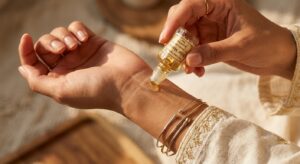
To wear Attar Motia correctly: moisturise pulse points first, then dab one drop onto the inner wrists, base of the throat, and inner elbows. Press wrists together gently, never rub. Use one drop per point, Attar Motia is highly concentrated. Avoid applying directly to silk or light fabrics, as the oil can stain.
Wearing attar is genuinely different from wearing a spray perfume, and most people get it wrong on the first attempt, not because the technique is difficult, but because they bring years of spray-perfume habits to a product built on entirely different principles.
Five Steps to Apply Jasmine Attar Correctly
- Unscented lotion applied two to three minutes beforehand helps the oil bind to skin and noticeably extends wear time, especially in Dubai’s air-conditioned environments where skin dehydrates quickly. This single step typically adds two to three hours of additional wear. – Moisturise your pulse points first.
- Inner wrists, the base of the throat, inner elbows, and behind the knees, areas where blood vessels sit closest to the skin surface and body heat continuously releases the fragrance throughout the day. – Apply to warm pulse points.
- Pressing wrists together preserves the delicate top notes. Rubbing generates friction heat that breaks down the volatile linalool and benzyl acetate molecules early, collapsing the fresh opening note before it has a chance to develop. – Press gently, never rub.
- Attar Motia is far more concentrated than spray perfume, typically four to eight times stronger. One small drop is usually enough for six to eight hours of wear. Two drops is noticeably strong, and more than that risks the jasmine becoming cloying rather than beautiful. – Use only one drop per point.
- A light touch to a cotton collar adds a lovely subtle trail, and cotton holds attar oil particularly well. Pure oil can permanently stain silk and light-coloured fabrics, however, so always test on an inconspicuous spot first and never pour attar directly onto clothing. – Be careful with fabrics.
Wearing Attar Motia in Dubai’s Climate and Culture
This is the part of the guide written specifically for a Dubai reader, not adapted from a generic international fragrance article.
- apply to the wrists and throat. Its close, soft projection suits indoor UAE spaces well, where colleagues working within a metre of you will appreciate restraint over a heavy projection cloud.: Indoors (offices, malls, homes)
- apply to covered pulse points, such as the inner elbow under a sleeve or the chest under a thobe or abaya, to slow evaporation. Heat actually vaporises the oil upward and outward from a covered point, increasing the fragrance presence around you even though the skin itself is covered.: Outdoors in summer heat (38-45C)
- apply one drop to the wrist or thobe collar. Being alcohol-free, it raises no concern around prayer or wudu in the way some scholars discuss regarding alcohol-based fragrances.: Before Jumu’ah or salah
- layer one drop of Attar Motia over oud attar on the chest for a classic Gulf combination, applying the oud first and allowing five minutes for it to settle before adding the jasmine.: At majlis gatherings
- a small bottle in a velvet pouch is a thoughtful, culturally appropriate choice for Ramadan, Eid, or a wedding, reflecting its natural, alcohol-free composition.: As a gift
Layering Attar Motia with Other Attars
Layering, applying two or more attars to different pulse points, is a long-standing practice in Gulf perfumery, not a modern trend. The three classic combinations for Attar Motia are:
- apply sandalwood to the chest first, wait two minutes, then add Attar Motia to the wrists for a rounder, longer-lasting blend. The jasmine top note floats above the sandalwood’s warm, creamy base, and the sandalwood’s fixative properties extend the jasmine’s wear time.: Motia + Sandalwood Attar
- equal drops on alternating pulse points, a classic bridal combination across South Asia and the Gulf, sweet and romantic without becoming heavy.: Motia + Rose Attar
- oud on the chest, Motia on the wrists, for a bold floral-and-smoky contrast suited to evenings and formal occasions. The jasmine’s sweetness cuts through the oud’s resinous intensity in a way that is distinctly Gulf in character.: Motia + Oud Attar
Curious about other oud-based options for layering? Our guide on how to burn oud wood at home in Dubai covers the traditional Arabic bukhoor method, while our Bukhoor and Oud Muatter collection is worth browsing if you want to pair jasmine attar with traditional bakhoor at home.
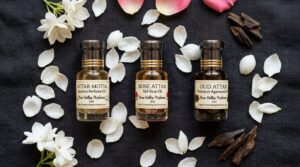
Ruh Motia vs Attar Motia: What Is the Difference?
Ruh Motia is the pure, undiluted jasmine distillate with no carrier oil, more intense but shorter-lasting (3-5 hours). Attar Motia is the same distillate fixed into a sandalwood base, more balanced and longer-lasting (6-10 hours). Ruh Motia costs more per millilitre because it contains no diluting carrier.
This is the single most common question asked at the Rose Valley counter, and it deserves a proper answer. Both products start from the same copper pot in Kannauj, fresh jasmine sambac flowers and the slow heat of a wood fire. The difference is simply what the bhapka is filled with before distillation begins.
- the bhapka is pre-filled with sandalwood oil, which absorbs the jasmine steam directly, becoming the carrier, base note, and fixative all at once. The result is balanced, longer-lasting, and easier to wear daily.: Attar Motia
- no sandalwood is used at all. What you get is the pure jasmine distillate, intense to the point of being challenging at first application, shorter-lived than the attar version, but unmistakably, completely itself.: Ruh Motia
How to choose between them: Ruh Motia suits fragrance connoisseurs who want the purest possible jasmine experience, premium gifting, or experimental layering in very small quantities. Attar Motia suits anyone who wants an easy, balanced, long-lasting daily fragrance that does not require careful dosing. Neither is objectively better. They are different expressions of the same flower, built for different purposes.
| Feature | Ruh Motia | Attar Motia |
| Carrier base | None – pure jasmine | Sandalwood or neutral oil |
| Intensity | Very high | Balanced |
| Longevity | 3-5 hours | 6-10 hours |
| Ease of application | Requires careful dosing | User-friendly, 1 drop |
| Best for | Connoisseurs, gifting | Daily wear, layering |
Uses of Attar Motia Beyond Personal Fragrance
Beyond personal fragrance, Attar Motia is used for hair and beard scenting, aromatherapy and meditation, bridal preparation, fabric fragrancing, and as a culturally significant gift for Eid, Ramadan, and weddings across the UAE.
Hair and Beard Scenting
This use surprises people who have only ever known spray perfume, but it is one of the oldest applications of jasmine oil and it works exceptionally well. Rub a single drop between your fingertips and run them lightly through your hair or beard.
- in many conditions, since it is less affected by sweat and absorbs the oil into the hair shaft rather than evaporating from a flat surface.: Hair holds fragrance oil longer than exposed skin
- without any need for reapplication.: A single morning application remains noticeable by the afternoon
- a practical bonus that spray perfume simply cannot offer.: The oil base provides a mild conditioning benefit
Men who wear thobes in the UAE often apply a small amount of Attar Motia to the beard for exactly this reason, it complements the warm, intimate fragrance culture of the majlis perfectly.
Aromatherapy and Meditation
The linalool content of Jasminum sambac means Attar Motia functions as a genuine aromatherapy tool, not merely a pleasant scent. Applied to the wrists before yoga, meditation, or breathwork, it creates a consistent olfactory anchor. Over time the nervous system begins to associate the scent with a state of calm, and the fragrance itself becomes a conditioned relaxation cue. Traditional Ayurvedic practitioners used mogra oil in exactly this way, applied before meditation as part of a ritual preparation that included breathwork and mantra.
Room Fragrance via Mabkhara
Attar Motia is not suitable for ultrasonic diffusers or reed diffusers, its oil viscosity will clog diffuser membranes and does not wick correctly through reed sticks. Two effective alternatives exist instead:
- curtains, cushion covers, or a wooden diffuser bead. The oil releases gently for several hours.: Apply a few drops to natural cotton or linen fabric
- the traditional Gulf approach. Bukhoor combines jasmine essence with agarwood chips, resins, and aromatic materials, producing a warm, smoky, floral fragrance that fills a room in the way Gulf indoor fragrance culture has always preferred.: Burn jasmine bukhoor on a mabkhara
If you would like to explore traditional incense alongside your attar, our Bukhoor and Oud Muatter range includes jasmine-infused blends suited to mabkhara burning at home.
Bridal and Ceremonial Preparation
Across the South Asian and Arab communities of Dubai, mogra jasmine is synonymous with weddings. The scent of motia attar on a bride’s wrists is part of a cultural memory that spans generations and continents. Attar Motia is applied during mehndi nights and on the day of the nikah itself, often layered over rose attar to create a combined jasmine-rose fragrance that is traditional across both South Asian and Gulf wedding cultures. It is not applied to the bride alone, the women helping apply henna, the mothers and sisters present at the ceremony, all reach for the same vial. The fragrance marks the occasion olfactorily, which is why the smell of motia can trigger vivid emotional memories for anyone who grew up attending South Asian or Gulf weddings.
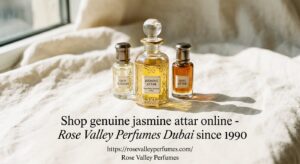
How to Buy Genuine Attar Motia – Jasmine Attar in Dubai
Genuine Attar Motia is clear to pale golden-yellow, evolves in scent over thirty minutes rather than smelling static, causes no stinging or fast evaporation on skin, and the seller can name the distillery origin (typically Kannauj). Prices for an authentic 6ml bottle in Dubai rarely fall below roughly AED 55.
Dubai’s fragrance market is large, competitive, and not always transparent. Synthetic jasmine oil, produced from laboratory-synthesised chemical analogues, is widely available at very low prices and is frequently labelled as Attar Motia. The difference in quality, longevity, and skin experience between a genuine and a synthetic product is significant, and the following tests will protect your money every time.
Four Quick Tests Before You Buy
- Genuine Attar Motia is clear to pale golden-yellow, the colour of very light honey. Bright yellow, distinctly orange tones, or any visible added colour is a warning sign. Natural jasmine oil does not require colouring. – Check the colour.
- Apply a drop and observe over 30 minutes. Real jasmine attar changes, fresh and green at first, then richer and warmer through the heart phase, then quieter and woodier in the dry-down. Synthetic versions smell the same throughout because they lack the biological complexity of real jasmine absolute. – Watch how the scent evolves.
- Stinging, a cooling sensation, or the scent vanishing within a minute usually means alcohol has been added. Pure attar feels like silk oil on contact and deepens rather than disappearing. – Test for alcohol.
- A genuine seller can name the distillation origin, typically Kannauj, Uttar Pradesh, and the method, deg-bhapka hydro-distillation. Vague answers, or no answer at all, are a reliable red flag. – Ask about the source.
Realistic Price Guide for Genuine Attar Motia in Dubai
| Product / Volume | Typical Price Range (AED) |
| Attar Motia 2ml | AED 25 – 40 |
| Attar Motia 6ml | AED 55 – 85 |
| Attar Motia 12ml | AED 90 – 120 |
| Ruh Motia 2ml | AED 45 – 80 |
| Synthetic jasmine oil 6ml | Under AED 15, usually adulterated |
Genuine deg-bhapka jasmine attar production simply does not allow for sub-AED-15 pricing on a 6ml bottle. The labour involved, roughly eight million flowers per kilogram, multi-day distillation, months of ageing in leather kuppis, makes that price mathematically implausible for an authentic product. If you see prices in that range, you are very likely looking at a synthetic version.
Prefer to ask directly? You can reach our Murshid Bazar team on WhatsApp or visit the Contact Us page for both branch locations and phone numbers.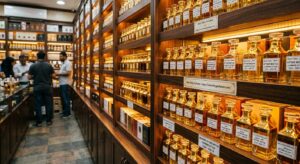
Attar Motia vs Other Jasmine and Floral Fragrances
Attar Motia outperforms most Western jasmine perfumes and synthetic jasmine oils on longevity, skin compatibility, and Dubai heat performance, while offering a deeper, more complex scent than commercial alternatives. Rose attar remains its closest cultural counterpart for layering and gifting in the Gulf.
Dubai’s fragrance market offers jasmine in many forms, at many price points, with widely varying quality. The table below sets out how Attar Motia compares across the categories most relevant to a UAE buyer.
| Feature | Attar Motia | Western Jasmine EDP | Rose Attar |
| Alcohol content | None | 70-85% | None |
| Natural source | 100% | Partial (5-20%) | 100% |
| Longevity in Dubai heat | 6-10 hrs | 2-4 hrs | 6-10 hrs |
| Mosque and prayer safe | Yes | No | Yes |
| Layering with oud | Very high | Medium | Very high |
| Best suited for | Daily wear, all occasions | Western formal settings | Romantic occasions, gifting |
In every metric that matters most to a Dubai resident, climate performance, mosque suitability, longevity in heat, and oud layering compatibility, Attar Motia consistently outperforms both Western alternatives and synthetic jasmine oils. The only context where a Western jasmine EDP holds a genuine advantage is in formal European or American settings where spray application is the cultural norm. For everyday life in the UAE, jasmine attar remains the more practical, more culturally aligned choice.
Frequently Asked Question
What is Attar Motia?
Attar Motia is a 100% natural, alcohol-free perfume oil made from Jasminum sambac (Arabian jasmine), traditionally distilled into a sandalwood oil base.
How long does Attar Motia last?
On moisturised skin, Attar Motia typically lasts 6 to 10 hours. On cotton fabric, it can last noticeably longer.
What does Attar Motia smell like?
Rich, sweet, and floral. It opens fresh and slightly green, deepens into a warm jasmine heart, and settles into a soft, woody sandalwood dry-down.
Is Attar Motia halal?
Yes. Traditional Attar Motia contains no alcohol, making it suitable for wear before salah and at Jumu’ah, in line with the Sunnah of wearing fragrance to prayer.
Can men wear Attar Motia?
Yes. Jasmine attar is worn by both men and women across the Gulf, often by men as a daily fragrance or layered beneath oud.
What is the difference between Ruh Motia and Attar Motia?
Ruh Motia is pure, undiluted jasmine distillate with no carrier oil. Attar Motia is the same distillate fixed into a sandalwood base, making it more balanced and longer-lasting.
How do I apply Attar Motia?
Apply one drop to the inner wrists, throat, or inner elbows. Press gently, never rub, and avoid direct contact with light-coloured fabrics.
Where can I buy genuine Attar Motia in Dubai?
Specialist attar retailers in Deira’s Murshid Bazar, including Rose Valley Perfumes, stock traditionally produced Attar Motia and Ruh Motia.
Is Attar Motia good for sensitive skin?
Generally yes, since it contains no alcohol. A patch test on the inner elbow is still recommended before full use.
Can Attar Motia be used in a diffuser?
No. Its oil base is too viscous for ultrasonic or reed diffusers. For room fragrance, jasmine bukhoor burned on a mabkhara is the traditional alternative.
Where does Attar Motia come from?
Genuine Attar Motia is traditionally distilled in Kannauj, Uttar Pradesh, India, a city with over four hundred years of attar-making history and a long association with royal patronage, including the Mughal court and the Nizams of Hyderabad.
Why is Attar Motia more expensive than synthetic jasmine oil?
Genuine production requires roughly eight million hand-picked jasmine flowers per kilogram of oil, multi-day steam distillation, and months of ageing, costs a synthetic, lab-made fragrance simply does not carry.
Experience Genuine Jasmine Attar at Rose Valley Perfumes
Attar Motia is more than a fragrance. It is a small piece of a centuries-old tradition, carried from the Mughal courts and the Nizams of Hyderabad to the counters of Deira, where it has been part of daily life in Dubai for generations.
Rose Valley Perfumes has operated from Murshid Bazar, Deira since 1990, sourcing traditional Arabian attars and oud. To see our wider range of fragrance oils, agarwood and oud, and bukhoor, visit our shop or get in touch through our Contact Us page.