Agarwood health benefits include stress and anxiety relief, improved sleep quality, anti-inflammatory pain relief, digestive comfort, and antimicrobial protection. These effects come from bioactive sesquiterpene compounds – including alpha-guaiene, agarospirol, and beta-guaiene – that form inside the Aquilaria tree during its natural resin-producing response to fungal infection. Agarwood is used through aromatherapy, topical oil application diluted in a carrier oil, and traditional incense burning known as bukhoor.
Agarwood is not a product of health – it is a product of injury.
Deep inside the heartwood of the Aquilaria tree, something goes wrong. A mould fungus breaches the wood. The tree cannot expel it. So instead, it does something remarkable: it floods the infected tissue with a dense, dark, aromatic resin – essentially walling off the invader with its own chemical armour. That resin is what the world has burned in mosques, gifted to kings, traded across the Silk Road, and distilled into some of the most expensive oil on earth for over a thousand years.
A few numbers put this in perspective:
- The global agarwood industry is estimated to be worth up to USD 30 billion, according to CITES.
- The agarwood chip market alone stood at USD 7 billion in 2024.
- Resinous agarwood formation occurs in only around 2% of wild Aquilaria trees without human intervention.
These are not the numbers of a passing wellness trend. They are the numbers of a substance that human civilisations have independently concluded, across centuries and continents, is worth almost any price.
In Dubai’s Murshid Bazar – one of the oldest fragrance trading districts in the city – agarwood is not something that needs explaining. Known locally as oud, and in its purest distilled oil form as dehnal oud, it permeates Gulf culture the way wine permeates Bordeaux or tea permeates Japan. It is burned at the entrance of homes, offered to guests before they sit, carried on the body as a daily fragrance, and used in prayer.
Long before the words ‘aromatherapy’ or ‘sesquiterpene’ existed, the people of the Arabian Peninsula had already catalogued what agarwood does to a person – through observation, through tradition, through 1,400 years of written scholarship. What modern science has spent the past three decades doing is catching up.
Why Agarwood’s Healing Power Begins With a Wound
Agarwood forms when the heartwood of an Aquilaria tree is infected by a specific mould fungus, triggering a defensive resin-producing response. This resin – dense with sesquiterpenes, chromones, and phenylpropanoids – is the source of every documented agarwood health benefit. Trees that have never been infected produce no agarwood resin, and therefore no therapeutic compounds whatsoever.
How Does the Aquilaria Tree Produce Agarwood?
Under normal conditions, the Aquilaria tree’s heartwood is pale, lightweight, and completely odourless. It has no fragrance and no medicinal value. It is just wood. Everything changes once infection sets in. The process unfolds in three broad stages:
- Infection: Mould species from genera including Phialophora and Fusarium breach the sapwood and begin colonising the heartwood.
- Defence response (tylosis): Unable to physically remove the pathogen, the tree produces a thick, lipophilic resin that saturates the infected tissue, starving the fungus of oxygen.
- Accumulation: The resin deepens over years, sometimes decades, sealing the invasion zone in a dark, fragrant barrier and increasing in density the longer the infection persists.
The medicine comes from the wound. The tree’s emergency defence chemistry is also humanity’s therapeutic chemistry. What the Aquilaria tree produces to protect itself from disease turns out to be, for human physiology, a compound of remarkable benefit.
This is why genuine agarwood is so rare. In the wild, without intervention, only a small fraction of trees ever produce resin of any real density – which is also why so much of what is sold globally as ‘oud’ is, in fact, synthetic or heavily diluted.
Does Agarwood Grade Affect Its Health Benefits?
Yes – and this matters when sourcing agarwood for therapeutic use. What the Gulf market calls Grade A, Super Grade, or Double Super corresponds directly to resin density. The grading hierarchy, broadly, looks like this:
- Double Super / Royal Grade: Deepest resin saturation, darkest colour, heaviest weight relative to size, and the highest sesquiterpene concentration.
- Super Grade / Grade A: Strong resin presence with a slightly lighter wood-to-resin ratio, still rich in therapeutic compounds.
- Standard Grade: Lower resin density, lighter aroma, and a correspondingly lower concentration of bioactive sesquiterpenes and chromones.
- Fragrance-grade or synthetic: No genuine resin content at all – scented for fragrance only, with none of the therapeutic chemistry discussed in this article.
A low-quality or adulterated agarwood product may smell broadly similar to genuine high-grade agarwood, particularly when artificially scented. But its therapeutic profile is fundamentally different. Anyone exploring the full range of authentic agarwood and oud products sourced directly from known origins will notice the difference in both density and depth of scent – a reliable indicator that the resin content, and the therapeutic chemistry it carries, is genuinely there.
The Active Compounds Behind Agarwood Health Benefits
The health benefits of agarwood are produced by three primary compound classes: sesquiterpenes, chromone derivatives unique to the Aquilaria genus, and phenylpropanoids. When inhaled as vapour, these molecules enter the olfactory system and act directly on the brain’s limbic system – which is why agarwood’s effects are felt within minutes, not hours.
What Are Sesquiterpenes and Why Do They Matter?
Sesquiterpenes are C15 carbon compounds that form the dominant volatile fraction of genuine agarwood essential oil, constituting between 60% and 80% of its aromatic profile depending on species and origin. The key ones identified in agarwood research include:
- Alpha-guaiene and delta-guaiene: The primary anti-inflammatory sesquiterpenes, shown in laboratory research to inhibit nitric oxide production in macrophage cells – a standard marker of inflammatory activity.
- Agarospirol: A major contributor to agarwood’s deep, woody fragrance and one of its key antimicrobial and mood-regulating compounds.
- Beta-guaiene and alpha-humulene: Sedative and secondary anti-inflammatory sesquiterpenes isolated from Aquilaria malaccensis in pharmacology research.
- Beta-caryophyllene: Shared with black pepper and cloves, demonstrating strong antibacterial activity against Gram-positive pathogens in agarwood isolate studies.
Sesquiterpenes are small enough to cross the blood-brain barrier via olfactory pathways. When you inhale agarwood vapour, these molecules reach limbic brain structures – the amygdala, hippocampus, and hypothalamus – within minutes. The effects on mood and stress are not metaphorical; they are a direct pharmacological result of specific molecules reaching specific neural targets.
What Makes Agarwood Chemically Unique?
The answer lies in 2-(2-phenylethyl)chromones, compounds found in high concentrations exclusively in the Aquilaria genus. Over 120 distinct chromone derivatives have been isolated from agarwood to date – agarwood’s true chemical signature, absent from sandalwood, frankincense, and every other commonly used aromatic wood. Three things make chromones important:
- Neurological modulation: A 2025 review in Phytochemistry Reviews confirmed that chromones, alongside sesquiterpenoids and flavonoids, modulate neurotransmitter balance and regulate the excitatory/inhibitory system via GABAergic activity.
- Neuroinflammation suppression: Early laboratory research links chromone activity to reduced neuroinflammatory markers, an area of growing scientific interest.
- Authentication: Chromone derivatives are the chemical fingerprint researchers use to verify genuine agarwood and distinguish it from synthetic oud fragrance, which contains none of these compounds.
How Does Inhaling Agarwood Affect the Brain?
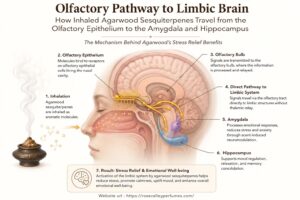
This is the part that explains everything else – why agarwood has been used in prayer across five major world religions, and why burning a few genuine chips in a room shifts the emotional atmosphere within minutes. The pathway works like this:
- Agarwood vapour molecules bind to olfactory receptor neurons in the nasal epithelium.
- These neurons send signals directly to the olfactory bulb.
- From there, signals travel immediately to the amygdala and hippocampus via the limbic system – the only human sensory pathway that bypasses the thalamic relay station entirely.
- Because smell skips this relay, it reaches the brain’s emotional core faster than any other stimulus.
A 2023 study published in Biomedical Reports, led by researchers from the Chinese Academy of Medical Sciences and Peking Union Medical College, confirmed that agarwood essential oil inhalation exerts anti-anxiety and anti-depressant effects via regulation of the glutamate/GABA neurotransmitter system, increasing serotonin and GABA-A receptor expression while inhibiting excitatory glutamate overactivity.
A separate widely cited study demonstrated that agarwood essential oil produces sedative-hypnotic effects specifically through the GABAergic system – effects that were blocked by GABA-A receptor antagonists and did not diminish with prolonged use, unlike pharmaceutical sedatives.
5 Proven Agarwood Health Benefits – Mechanisms, Evidence & Honest Caveats
These five agarwood health benefits – stress relief, sleep support, anti-inflammatory relief, digestive comfort, and antimicrobial protection – are each linked to specific molecular mechanisms. Evidence ranges from peer-reviewed laboratory studies to centuries of documented traditional medical use across independent civilisations. Human clinical trials remain limited, and these benefits should be understood as complementary wellness applications, not medical treatments.
1. Agarwood for Stress and Anxiety Relief
The HPA axis (hypothalamic-pituitary-adrenal axis) is the body’s primary stress-response cascade. Agarwood’s sesquiterpenes appear to work at the top of this cascade in two ways:
- GABA-A receptor modulation: Dampens the alarm signal in the amygdala before it triggers the full cortisol response.
- Serotonin elevation: Confirmed in the 2023 Biomedical Reports study, giving a pharmacological basis for the mood-lifting effects long associated with agarwood aromatherapy.
The result is calm without sedation: a quieting of the mental noise that precedes stress. In the Arabian majlis tradition, burning agarwood chips for guests was never described in neurochemical terms – it was simply observed and codified into culture. Viewed through modern neuroscience, this reflects an empirical understanding of olfactory-limbic modulation that predates formal pharmacology by centuries.
An important caveat: the anxiolytic effects of agarwood aromatherapy are acute, not cumulative. Agarwood is a complementary stress-management tool, not a treatment for diagnosed anxiety disorders.
Practical ways to use agarwood for stress relief:
- Burn two to three genuine agarwood chips and bukhoor in a traditional mabkhara for 20 to 30 minutes during or before a stressful period.
- Use an electric mabkhara indoors for a smoke-free version of the same effect.
- Diffuse a few drops of dehnal oud oil during meditation or focused work for a lighter, sustained background effect.
2. Agarwood for Sleep Support
Agarwood has been used as a sedative in Unani, Ayurvedic, and Traditional Chinese Medicine for so long that the cross-cultural consistency is itself a form of evidence. Three medical traditions, operating independently on three continents, arrived at the same conclusion: this plant quiets the nervous system.
Research on agarwood essential oil’s sedative-hypnotic effects has demonstrated significant calming and hypnotic activity that is blocked by GABA-A receptor antagonists – confirming the GABA-A pathway as the primary mechanism. Critically, prolonged use did not produce desensitisation, distinguishing agarwood’s effect from pharmaceutical sedatives.
- Unani medicine: Classified agarwood as a mufarrih – a cardiac tonic and mood elevator – prescribed for nervous insomnia.
- Traditional Chinese Medicine: Chenxiang appears in China’s national pharmacopoeia with an indication for calming the mind.
For practical sleep support, follow this simple routine:
- Add three to four drops of genuine dehnal oud oil to a cold-water ultrasonic diffuser.
- Run the diffuser 30 to 45 minutes before bed.
- Allow the scent to taper to a light background level before sleeping, rather than running it through the night at full strength.
3. Agarwood for Anti-Inflammatory and Pain Relief
The anti-inflammatory evidence for agarwood is among the most pharmacologically specific of all its documented benefits, coming directly from research on the sesquiterpenes present in genuine agarwood oil.
- Alpha-guaiene and delta-guaiene: Shown to inhibit nitric oxide production in macrophage cells – nitric oxide is a key pro-inflammatory signalling molecule, and limiting its production is one of the central mechanisms behind anti-inflammatory activity.
- Alpha-humulene: Provides a complementary mechanism through NF-κB pathway inhibition, producing a broader cellular dampening of the inflammatory response.
For topical application, agarwood’s lipophilic sesquiterpenes penetrate the skin barrier and produce a sustained local anti-inflammatory effect – the traditional basis for Ayurvedic massage therapy on arthritic joints. A simple, safe approach:
- Choose genuine agarwood fragrance oil rather than a synthetic blend.
- Dilute at 3 to 5% in jojoba, black seed, or argan oil.
- Massage gently into the affected muscle or joint after activity or as needed.
- Never apply concentrated oil directly to the skin.
4. Agarwood for Digestive Comfort
This is the benefit most articles mention in a sentence and move past. It deserves more attention – not because the evidence is strongest, but because it has the longest cross-culturally consistent history of any agarwood application.
Chromone derivatives in agarwood extract appear to act as smooth muscle relaxants in the gastrointestinal tract by interfering with calcium channel activity – the same basic mechanism as pharmaceutical antispasmodics. A pharmacological study on agarwood alcohol extract demonstrated a significant reduction in gastric ulcer occurrence in animal models, alongside reduced inflammatory cytokines and increased antioxidant enzyme activity.
Three independent medical traditions document this use:
- Traditional Chinese Medicine: Chenxiang is listed in China’s national pharmacopoeia for treating vomiting, nausea, and abdominal pain.
- Ayurvedic medicine: Agarwood (Agaru) is classified as deepana (digestive stimulant) and pachana (digestive enzyme enhancer).
- Arabian medicine: Ibn Sina’s Canon of Medicine lists agarwood as beneficial for weakness of the stomach and cold humours of the digestive organs.
Agarwood aromatherapy also promotes the parasympathetic ‘rest-and-digest’ nervous system state through the same olfactory-limbic mechanism described earlier, supporting normal digestion indirectly by reducing cortisol output even without direct ingestion.
5. Agarwood for Antimicrobial Protection
This is perhaps the most evolutionarily logical of agarwood’s health benefits, because it is the original biological purpose of the resin. The Aquilaria tree produces its resin specifically to fight fungal infection. Laboratory research has confirmed that this same chemistry shows activity against:
- Staphylococcus aureus, including resistant strains, linked to skin and wound infections.
- Candida albicans, the most common human fungal pathogen.
- Propionibacterium acnes, the primary bacterial driver of acne.
- Trichophyton species, responsible for ringworm and athlete’s foot.
The Gulf tradition of fumigating rooms with agarwood smoke before receiving guests looks, through this lens, less like ceremony and more like informed practice. Dispersing volatile compounds from dehnal oud into interior air creates a genuinely antimicrobial environment – particularly relevant in Dubai’s humid summer months, when indoor mould risk increases.

Agarwood Health Benefits in 1,400 Years of Arabian Medicine
Arabian and Islamic medical tradition documents agarwood’s health benefits across fourteen centuries of written scholarship – named scholars, named texts, and documented clinical observations made centuries before modern pharmacology had the tools to explain the mechanisms involved.
Prophetic Medicine and the Hadith Record
Oud al-hindi (Indian agarwood) and oud al-qumari (Cambodian agarwood) are referenced in authenticated hadith collections, including Sahih Muslim. The Prophet Muhammad (peace be upon him) used aloeswood for fumigation and personal fragrance, often combined with camphor.
Ibn al-Qayyim al-Jawziyya, a 13th-century scholar whose 277-chapter work Al-Tibb al-Nabawiyy remains one of the most influential texts on prophetic medicine, classified oud’s properties as:
- Opening blockages and dispelling excess moisture
- Strengthening the internal organs and the heart
- Uplifting the spirit and benefiting the brain
- Enhancing the senses
Mapped against modern pharmacology, ‘uplifts the spirit’ and ‘benefits the brain’ align closely with the GABA-A modulation and serotonin elevation confirmed in 2023 research.
Ibn Sina and the Canon of Medicine
Ibn Sina, known in the West as Avicenna, completed Al-Qanun fi al-Tibb (The Canon of Medicine) in 1025 CE – a text that remained a primary medical textbook in Islamic and European universities until the 17th century. He describes agarwood as:
- Hot and dry in character
- Strengthening the heart and uplifting the spirit
- Beneficial for palpitations
- Strengthening the sensory organs
The humoral framework Ibn Sina wrote within is not modern biochemistry, but the symptom clusters he associated with agarwood – nervous weakness, cognitive fog, digestive upset, cardiac unease – map with surprising precision onto what modern medicine describes as HPA axis dysregulation and chronic stress.
Why Three Independent Traditions Reached the Same Conclusion
Arabian Unani medicine, Indian Ayurveda (where agarwood is classified as Agaru), and Japanese Kodo all converged on the same core applications for agarwood, without any documented cross-cultural exchange during their formative periods:
- Unani: Calming the mind, supporting digestion, treating nervous insomnia.
- Ayurveda: Digestive stimulation, sensory clarity, ceremonial purification.
- Kodo: Meditative focus, spiritual refinement, ritual mindfulness.
Independent convergence of this kind across separated cultures is one of traditional medicine’s strongest signals of a genuine physiological effect. For Rose Valley Perfumes, sourcing agarwood from Murshid Bazar, Deira – one of the oldest fragrance trading districts in Dubai – this tradition is the daily commercial context, not a historical footnote.

How to Use Agarwood for Specific Health Benefits
The health benefits of agarwood are delivered through three primary routes: aromatherapy, topical application, and ambient diffusion. The right method depends on the outcome you are seeking:
- Aromatherapy: Burning chips or diffusing oil for inhalation-based effects on mood, stress, and sleep.
40.Topical application: Diluted oil massaged into the skin for localised anti-inflammatory and pain relief.
- Ambient diffusion: Sustained, low-concentration room scenting for antimicrobial air quality and general wellbeing.
| Health Goal | Best Form | Method | Timing | Notes |
| Stress & anxiety relief | Agarwood chips | Burn in mabkhara or diffuser | During or before stress | 2–3 chips; 20–30 min session |
| Sleep support | Dehnal oud oil | Ultrasonic cold diffuser | 30–45 min before sleep | 3–4 drops per 100ml water |
| Muscle & joint pain | Agarwood essential oil | Topical massage with carrier oil | Post-activity or as needed | 3–5% dilution in jojoba |
| Meditation & focus | Agarwood chips | Traditional mabkhara | During practice | Pair with frankincense (lubaan) |
| Ambient antimicrobial | Dehnal oud oil | Cold diffuser or room mist | Humid periods | 5–6 drops per 100ml |
| Emotional grounding | Dehnal oud oil | Pulse-point application | Daily, morning routine | 1–2% dilution in jojoba |
Best Way to Use Agarwood for Stress Relief
The traditional mabkhara method – heating chips on charcoal or an electric plate – delivers the densest and most complete volatile release, producing the layered vapour that cold-diffusion of oil alone cannot fully replicate.
- Charcoal mabkhara: Richest, most traditional vapour release; best for occasional, ceremonial use.
- Electric mabkhara: Smoke-free and temperature-controlled; ideal for daily indoor use in air-conditioned Dubai apartments.
- Cold diffuser (oil): Silent and precise; best for meditation, focused work, and sleep preparation.
How to Safely Apply Agarwood Oil to the Skin
Agarwood essential oil must be diluted before skin application. Follow this simple framework:
- Facial or sensitive skin: 1 to 2% dilution – 1 to 2 drops per 10ml carrier oil.
- Body or joint massage: 3 to 5% dilution in the same ratio.
- Patch test: Always test on the inner forearm 24 hours before broader use, especially with reactive skin.
Recommended carrier oils:
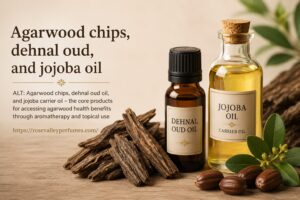
- Jojoba oil: Chemically similar to skin sebum; non-comedogenic and best for facial use.
- Black seed oil (habbatus sauda): Adds its own anti-inflammatory thymoquinone, creating a compounded effect with agarwood’s guaiane sesquiterpenes.
- Argan oil: Rich in vitamin E and oleic acid, adding nourishing antioxidant benefit to joint and muscle blends.
Avoid concentrated application during pregnancy, on broken or inflamed skin, or without a patch test if you have reactive skin.
Best Agarwood Blends for Enhanced Benefit
- Agarwood + Sandalwood: Both sesquiterpene-dominant; sandalwood’s alpha-santalol adds its own GABA-A modulatory and sedative action – a 1:1 blend traditionally used for calm and sleep.
- Agarwood + Frankincense (Lubaan): Complementary anti-inflammatory pathways and the most historically significant aromatic pairing in Arabian medicine.
- Agarwood + Rose Attar: Adds uplifting serotonergic effects to agarwood’s calming GABAergic base, with roots in Sufi ceremonial practice.
For those exploring blends, browsing the full incense oil and fragrance oil collection alongside genuine agarwood is a practical way to build a personal aromatherapy routine suited to a specific health goal. Many customers also start with the shop page to compare grades and forms side by side before choosing what fits their routine.
What Current Research on Agarwood Health Benefits Cannot Yet Confirm
Most research on agarwood’s health benefits currently comes from laboratory and animal studies. Randomised, controlled, peer-reviewed human clinical trials are scarce, largely because agarwood is chemically variable between batches and difficult to standardise for research. These benefits carry strong traditional evidence and promising laboratory support, pending larger human trials. The honest gaps are:
- No standardised dose exists: The volatile concentration from a typical chip session has never been precisely measured in clinical settings; it varies by room size, chip quality, and individual sensitivity.
- Species and origin variation is significant: Compound concentration varies between Aquilaria malaccensis, Aquilaria sinensis, and Aquilaria crassna, so findings on one species do not automatically transfer to another.
- Synthetic oud distorts the evidence landscape: Much of the mass-market ‘oud’ sold globally is fragrance-only and contains none of the sesquiterpenes the research is based on.
- No human RCTs exist yet: For stress, sleep, pain, digestion, or antimicrobial protection, human clinical confirmation is the remaining scientific gap.
- Conservation status affects supply: Roughly 70% of global agarwood trade relies on two CITES-threatened Aquilaria species, putting pressure on the future availability of high-grade wood.
The honest position: agarwood is a high-quality, well-documented complementary wellness tool with a legitimate molecular basis and a 1,400-year traditional record – not a pharmaceutical substitute. The most defensible description is significant traditional evidence, mechanistically plausible via confirmed molecular pathways, with human clinical trials still needed.
None of this diminishes what is already known. It simply means agarwood should be approached the way any thoughtful person approaches a centuries-old remedy: with respect for the tradition, curiosity about the emerging science, and realistic expectations about what aromatherapy can and cannot do. For everyday stress, sleep support, and general wellbeing, the existing evidence is more than sufficient to justify a place in a daily routine. For diagnosed medical conditions, it remains a complement to professional care rather than a replacement for it.
Frequently Asked Questions
What are the health benefits of agarwood?
Agarwood supports stress relief, better sleep, reduced inflammation, digestive comfort, and antimicrobial protection. These effects come from sesquiterpenes and chromones formed inside the wood during the Aquilaria tree’s natural infection response.
Is agarwood good for anxiety?
Yes. Inhaled agarwood sesquiterpenes modulate GABA-A receptors and lower cortisol output, producing a calming effect during and shortly after use. It works well alongside, not instead of, professional care for diagnosed anxiety.
Does burning agarwood have health benefits?
Yes, when the chips are genuine. Burning releases the full sesquiterpene and chromone profile, supporting stress relief, air-quality, and meditation benefits that diluted oil alone cannot fully match.
Is dehnal oud the same as agarwood oil?
Yes – dehnal oud is simply the Arabic term for distilled agarwood essential oil. Quality varies by species, origin, and extraction method, so sourcing genuine wood matters.
Can agarwood oil help with sleep?
Yes. Its mild sedative effect, confirmed through GABA-A receptor activity in laboratory studies, is consistent with centuries of use in Unani and Traditional Chinese Medicine for nervous insomnia.
Is agarwood oil anti-inflammatory?
Yes. Alpha-guaiene and related sesquiterpenes inhibit inflammatory markers in laboratory studies, supporting its traditional use for joint and muscle discomfort when diluted and applied topically.
What are the side effects of agarwood oil?
Few at typical use levels. Undiluted application can cause skin sensitisation, and burning in unventilated spaces may irritate sensitive airways. Always dilute for topical use and ventilate when burning chips.
Is agarwood mentioned in Islamic medicine?
Yes, extensively. Oud al-hindi appears in authenticated hadith, and classical scholars including Ibn Sina and Ibn al-Qayyim al-Jawziyya documented its use for the heart, brain, and digestion centuries ago.
Can I apply agarwood oil directly to skin?
It’s best diluted first – 1 to 2% for the face, 3 to 5% for the body, in a carrier like jojoba or argan oil. Concentrated oil can irritate sensitive skin.
Why is agarwood so expensive?
Genuine resin formation occurs in only around 2% of wild Aquilaria trees, several species are CITES-protected, and distillation requires large quantities of wood per litre of oil.
How can I tell if agarwood is real or synthetic?
Genuine chips sink in water and burn slowly with complex, woody smoke. Genuine oil is dark, viscous, and evolves in scent over hours. Cheap, sweet-smelling ‘oud oil’ is almost always synthetic.
Where can I buy authentic agarwood in Dubai?
Rose Valley Perfumes has supplied genuine agarwood chips, dehnal oud, and bukhoor from Murshid Bazar, Deira, since 1990, with both physical branches open daily and the full range available at rosevalleyperfumes.com. For grade guidance or sourcing questions, the team can also be reached directly via WhatsApp.
Agarwood Health Benefits Are 1,400 Years of Documented Human Experience
Return to the beginning: the wound becomes the medicine.
The Aquilaria tree, under biological siege from a fungal pathogen it cannot expel, produces a dark, dense resin loaded with sesquiterpenes and chromone derivatives. Those molecules interact with human GABA-A receptors, dampen HPA axis cortisol cascades, inhibit inflammatory pathways, disrupt the cell membranes of human pathogens, and reach the limbic brain via the only sensory pathway that bypasses the thalamic relay entirely. The tree’s emergency chemistry turns out to be, by biological coincidence, a remarkably useful tool for human health.
What is most striking is not that modern science is validating agarwood’s benefits, but that fourteen centuries of human observation – across Islamic scholarship, Ayurveda, Chinese pharmacology, and Japanese Kodo – was already describing the same mechanisms in its own language. Ibn Sina called it a heart tonic and brain strengthener. Unani physicians prescribed it for nervous insomnia. The vocabulary has changed completely. The observed effect has not.
The honest limitations remain:
human clinical trials are still limited, dosage is not standardised, and species-to-species variation is significant. Genuine agarwood is a complementary wellness tool with exceptional traditional and emerging laboratory support – not a substitute for medical care.
What can be said with confidence is that the difference between authentic agarwood and synthetic oud is not a fragrance difference – it is a chemistry difference. The sesquiterpenes are either present or they are not. For anyone in the UAE wanting to experience genuine, resin-rich agarwood the way it has been used for centuries, Rose Valley Perfumes in Murshid Bazar, Deira remains one of the few places in Dubai still sourcing wood the traditional way. A reader who understands the science in this article will never again confuse a mass-market synthetic oud spray with what has been burned in mosques, gifted to royalty, and traded across three continents for over a millennium.