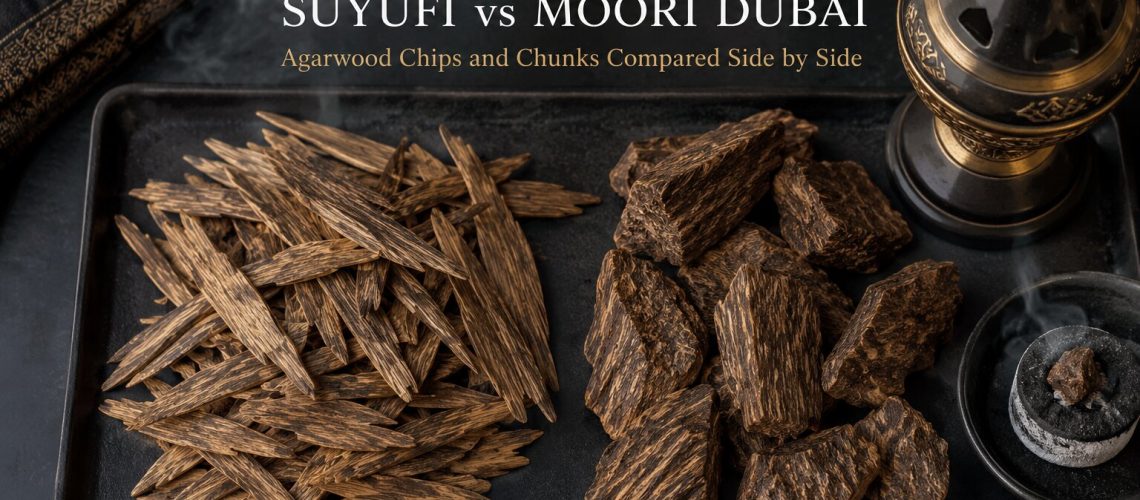
Anyone shopping for raw agarwood in Dubai eventually runs into the same question: Oud Suyufi vs Moori Dubai – what actually separates them? The short answer is that they differ in physical cut, resin placement, geographic origin logic, burn behaviour, and scent character. Oud Suyufi Flat is a cut-shape classification – derived from the Arabic word for sword – where the agarwood is sliced flat and thin, leaving dark oleoresin visibly spread across both exposed surfaces
. Oud Moori, on the other hand, is a quality-and-origin descriptor used widely across Dubai’s oud souks and Gulf markets to describe naturally dense, unprocessed agarwood chunks most commonly sourced from Vietnam. Both come from the same family of aromatic wood, but on a charcoal mabkhara they behave completely differently, smell different at every stage of a session, and suit entirely different occasions.
Oud Suyufi Flat – Key Facts
- A shape-based cut classification, not a geographic or regional origin. Agarwood from India, Vietnam, Thailand, or Indonesia can all be cut and sold in Suyufi form.
- The name comes from the Arabic word “saif” (سيف), meaning sword – a direct reference to the flat, blade-like profile of the chip.
- Dark oleoresin streaks are visible across both broad flat faces of the chip, not buried inside the wood.
- Requires careful charcoal heat management. The thin profile and exposed surface resin make it fast and reactive to heat.
- Delivers a bold, sharp, and immediately intense fragrance – ideal for welcoming guests, majlis gatherings, and short high-impact sessions.
Oud Moori (Vietnam) – Key Facts
- A quality-and-origin descriptor indicating naturally clean, high-resin agarwood – most commonly from Vietnam’s Aquilaria crassna tree species.
- Arrives in natural irregular chunk form. Dense, heavy, and unprocessed in shape, each piece retaining its natural tree-grown structure.
- The resin sits deep inside the core of the wood, not on the outer surface. Heat must penetrate the dense wood before the fragrance begins to release.
- Burns slowly and forgivingly on both traditional charcoal and modern electric mabkhara – the most beginner-friendly raw oud format available.
- Produces a smooth, woody, and sweet-to-balsamic scent that evolves gradually and deepens beautifully across a long burning session.
Everything on this page expands each of those points in full – from the biology of how the resin forms inside the Aquilaria tree, to the step-by-step technique for burning each type without scorching it on your mabkhara.
Oud Suyufi vs Moori Dubai: Quick Comparison at a Glance
If you are short on time, the table below covers the most important differences in a single scan – everything a Dubai buyer needs before walking into a souk or browsing online. Every row is explained in full detail further down the page.
| Feature | Oud Suyufi Flat | Oud Moori (Vietnam) |
| Classification | Cut shape – not a region | Quality and origin descriptor |
| Physical Form | Flat, thin sliced chip | Natural dense irregular chunk |
| Resin Location | Exposed on both outer flat faces | Deep inside the wood’s dense core |
| Burn Speed | Fast – peaks within 10–15 min | Slow – 60 to 90+ minute session |
| Heat Sensitivity | High – careful charcoal control | Low – forgiving on most heat levels |
| Best Burner | Traditional charcoal mabkhara | Both charcoal and electric burner |
| Scent Character | Bold, resinous, sharp opening | Smooth, woody, sweet to balsamic |
| Session Length | 30 to 45 minutes optimal | 60 to 90+ minutes |
| Best Occasion | Guests, majlis, special gatherings | Daily use, personal space, gifting |
| Skill Level | Intermediate burner preferred | Beginner-friendly |
Important: Neither type is better. They serve different occasions and different burning preferences. The correct choice depends entirely on when you plan to burn, what equipment you own, and what kind of fragrance experience you are looking for.
What Is Oud Suyufi Flat? Meaning, Shape, and Burn Character
Oud Suyufi Flat is one of those terms that confuses even experienced oud buyers in Dubai because it sounds as though it should describe where the wood came from. It does not. Suyufi is a processing and shape classification. It describes how the agarwood was cut, not which forest it was harvested from.
The Name and What It Actually Means
The word “Suyufi” (سيوفي) derives directly from the Arabic word “saif” (سيف), which means sword. The name refers to the flat, blade-like profile of the cut chip. This terminology originated within Gulf trading circles, where it was used historically to describe a specific style of Indian agarwood cut. Over time, however, the term expanded and is now applied to wood cut in this flat style from multiple countries of origin – Thai, Vietnamese, Indonesian, and Indian agarwood are all sold in Suyufi form across Dubai’s oud market.
That single point changes how you should approach buying it. When a seller describes something as Suyufi, they are telling you about the shape of the chip. The geographic origin of the wood is a separate piece of information that should always be confirmed independently before purchasing.
Key fact – defined for accuracy: “Oud Suyufi Flat refers to a method of cutting agarwood into thin, flat chips with oleoresin visible on both broad surfaces. The term does not indicate a country of origin, a species of Aquilaria tree, or a quality grade.”
What Authentic Suyufi Flat Looks Like
Knowing what to look for before you pick up a chip is the fastest way to protect yourself in any oud market. Here are the key visual characteristics of authentic Suyufi Flat.
- Cross-section depth: Uniformly thin throughout, typically between 2 and 5 millimetres deep.
- Flat face appearance: Two broad flat faces display dark oleoresin marbling across a pale cream-to-tan wood base.
- Resin pattern: The dark streaks are irregular and organic – never uniform, never perfectly even. Natural resin does not spread symmetrically.
- Surface texture: The flat face should feel very slightly waxy or firm when rubbed gently. Not powdery. Not oily. Not crumbling.
- Cold scent: Unburned, a genuine Suyufi chip has a faint, raw, earthy-resinous scent. Hold it near your nose before purchasing. It should smell of something – wood, earth, the beginning of oud.

Why the Flat Cut Changes Everything About the Burn
In raw agarwood burning, the position of the resin inside the wood determines almost everything – how fast the fragrance releases, how much heat the chip needs, how long the session lasts, and which type of burner is most suitable.
With Suyufi Flat, the oleoresin sits on the outer surface of the chip. It is exposed directly to heat and air the moment the chip is placed on a heat source. There is no thick wood mass for the heat to work through first. The aromatic compounds begin vaporising almost immediately.
This is why Suyufi produces what experienced oud burners call a “bold opening” – a concentrated burst of fragrance that fills a room within the first ten to fifteen minutes. After the surface resin clears, the underlying wood begins to smoulder and gives a quieter second phase. However, Suyufi does not have the long, deeply evolving dry-down that Moori produces. The session is shorter and considerably more intense.
The science behind it: Aromatic compounds in agarwood resin begin to vaporise at around 80°C and reach peak yield at approximately 120°C. When charcoal heat pushes significantly above this range, the resin combusts rather than smoulders – producing harsh, ashy smoke instead of fragrance. With Suyufi’s exposed surface resin, there is almost no buffer between the heat source and the aromatic compounds. Heat management is therefore essential, not optional.
Step-by-Step: How to Burn Suyufi Flat on Charcoal
Burning Suyufi correctly is a skill that takes one or two sessions to develop. Follow these steps in sequence, and the chip will perform exactly as it should.
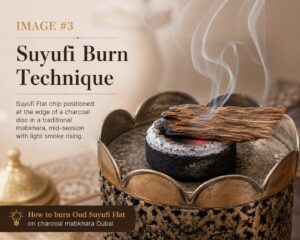
- Light a quick-light charcoal disc using tongs and a flame until the entire disc glows red.
- Set it in your mabkhara on a thin bed of ash or sand and allow it to reach full white-grey ash coverage on the surface – this is the most important step. A red or orange coal is too hot for Suyufi.
- Hold the Suyufi chip using tongs or a wooden-handled tool and place it at the outer edge or periphery of the heat zone – never directly above the coal’s centre.
- Allow the fragrance to develop naturally for 10 to 15 minutes. Resist the urge to reposition the chip immediately – the surface resin needs time to release properly.
- When the scent begins to quiet, slide the chip slightly closer to the centre to draw out the second phase from the underlying wood.
- One chip is sufficient for most rooms. A standard session lasts 30 to 45 minutes.
Where Suyufi Flat Belongs in Gulf Culture
In Gulf households – across the UAE, Saudi Arabia, Kuwait, and beyond – Suyufi is the oud of social energy. Its fast, bold fragrance is exactly what a host wants when guests arrive. In a majlis setting, a single Suyufi chip on a properly prepared charcoal mabkhara creates the distinctive cloud of oud smoke that fills the air, clings to curtains, and coats the clothing of every person in the room within minutes. It signals welcome, generosity, and the deliberate creation of a sensory environment.
Experienced oud collectors also value Suyufi for a practical reason: because it is a cut style rather than an origin, it allows them to experience the same burning format across multiple agarwood origins – comparing how, for example, an Indian Suyufi and a Vietnamese Suyufi differ in fragrance when presented in the same chip geometry.
Common Grades of Suyufi You Will See in Dubai
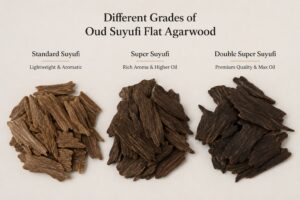
Not all Suyufi is sold at the same level. Dubai shops typically grade flat-cut chips by resin coverage and depth of colour. Knowing the grade names helps you ask the right question at the counter instead of just pointing at a tray.
- Standard Suyufi: Lighter resin coverage, often used for everyday bakhoor sessions and gifting where cost matters more than depth of scent.
- Super Suyufi: Denser resin marbling across both faces, a noticeably stronger cold scent, and a longer-lasting opening burst once lit.
- Double Super Suyufi: The highest commonly available grade, with near-complete resin coverage on both flat faces and minimal pale wood showing through.
- Origin-specific Suyufi: Some shops label Suyufi by source wood – Indian, Vietnamese, or Cambodian – letting collectors compare the same cut across different agarwood origins.
How to Spot Fake or Artificially Treated Suyufi
The Dubai oud market moves an enormous volume of product, and not all of it meets an authentic standard. These are the four most common red flags that indicate artificially treated or misrepresented Suyufi Flat.
- Uniform dark colouring across the flat face. Natural resin marbling is always irregular. If the entire flat surface appears one solid, consistent dark colour, the chip has very likely been dyed or resin-coated artificially.
- Synthetic perfume scent when cold. An authentic chip should smell of raw wood and faint earthiness before burning – not of perfume oil or synthetic fragrance. A chemically sweet or “perfumey” cold scent is a clear signal of artificial treatment.
- Extremely light weight for its size. Real oleoresin adds measurable density to the wood. A Suyufi chip that feels unexpectedly light for a piece of that size has very little natural resin content, regardless of how dark it looks.
- Powdery or crumbling surface texture. Authentic Suyufi is firm to the touch. A powdery, chalky, or crumbling flat face indicates degraded wood, low resin content, or material that has dried out from long, poor-quality storage.
The global agarwood chip market was valued at over USD 10 billion in 2024 and is growing at approximately 6.4% annually toward a projected USD 17.6 billion by 2033. With that volume of commercial activity in the supply chain, adulteration is a well-documented and widespread problem at every price point. Knowing these checks before you buy is standard practice among serious collectors and buyers.
Quality genuinely varies from shop to shop across Dubai, which is why weight and resin marbling matter so much at the point of purchase. Established Deira-based specialists such as Rose Valley Perfumes carry Oud Suyufi Flat sourced and checked against the marks described above, which is a useful reference point if you are comparing chips elsewhere in the souk.
What Is Oud Moori? Meaning, Origin, and Natural Character
Oud Moori – also spelled Mori or Moory – functions differently as a term compared to Suyufi. While Suyufi tells you about the shape of the wood, Moori tells you about the quality standard and origin context of the wood. Across Dubai’s oud trade – and in Abu Dhabi and Saudi Arabia too – Moori has come to indicate agarwood that is naturally resinous, unprocessed in its physical form, clean of artificial treatment, and most commonly Vietnamese in origin.
What “Moori” Actually Means Across Gulf Markets
The term carries a quality implication that goes beyond simple geography. When a knowledgeable buyer in Dubai asks for Moori, they are not only asking for Vietnamese wood – they are asking for naturally formed resin, a dense chunk free of injection or coating, and a weight that confirms genuine oleoresin saturation throughout the wood’s interior. Over time, Moori has become shorthand in Gulf trade for a specific standard: clean, dense, naturally fragrant agarwood in its most honest form.
Vietnam’s strong association with Moori comes from the Aquilaria crassna tree species, which grows primarily across the central and southern regions of the country and produces a particularly smooth and sweet-leaning resin profile that Gulf buyers have long favoured. Vietnam exported more than 8,000 tons of agarwood in 2021 alone, with Saudi Arabia, the UAE, and Kuwait consistently ranking among the top destination markets for Vietnamese oud.
Key fact – defined for accuracy: “Oud Moori refers to naturally resinous agarwood chunks, typically of Vietnamese origin, prized in Gulf markets for their clean, unaltered oleoresin content and smooth, long-burning fragrance profile.”
The Biology Behind Why Vietnamese Moori Smells the Way It Does
Every Aquilaria tree begins its life completely odourless. The fragrance that becomes agarwood – and ultimately Moori – only forms through a specific biological event: a fungal infection. When the tree is infected by a mould species such as Phaeoacremonium parasitica, the tree mounts a defence response by producing oleoresin to isolate and combat the infection. Over time, as the infection spreads and the tree continues producing this resin, the heartwood becomes increasingly saturated with dark, dense, aromatic compounds.
In Vietnam, the combination of climate, soil mineral composition, and the specific subspecies of both Aquilaria tree and infecting fungus produces a resin profile that is notably smooth and sweet-opening compared to other major agarwood origins. Indian agarwood tends toward bold animalic and earthy character. Cambodian agarwood tends toward rich honeyed sweetness. Vietnamese agarwood, particularly in the Moori style, produces a layered complexity that begins soft and floral-woody before deepening into balsamic warmth – a profile Gulf buyers describe as exceptionally balanced.
Natural resin formation in wild trees is not a quick process. Wild Aquilaria trees that produce the highest-grade Moori have been accumulating resin for years or even decades. Only approximately 2% to 7% of wild Aquilaria trees naturally develop resin at all – making genuinely wild-origin Moori one of the scarcest raw materials in the global fragrance industry.
What Authentic Moori Looks Like
The visual profile of authentic Moori is distinctive, and learning to read it quickly protects your purchase. Here are the key physical characteristics to look for.
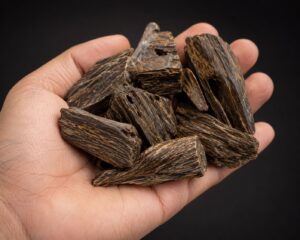
- Form: Irregular natural chunks with no geometric uniformity. Each piece is different in shape, reflecting the natural growth pattern of the agarwood within the tree. Uniform or precision-shaped pieces sold as Moori should raise questions.
- Colour: Dark brown to near-black in the highest-resin zones, with patches of cream-coloured wood where resin density is lower. This two-tone distribution is a positive sign – it shows natural, uneven resin saturation rather than artificial uniform colouring.
- Weight: Noticeably heavy relative to visual size. This is the most reliable single physical test. Genuine high-resin Moori feels denser than it looks. Hold it in your palm – it should surprise you slightly with its weight.
- Surface texture: Slightly oily or waxy when rubbed between the fingers, reflecting the oleoresin content within the wood. Dry, rough, or crumbling surfaces are a concern.
- Cold scent: Even unburned, authentic Moori carries a faint but detectable complex raw scent – a combination of earthiness, mild wood, and a subtle sweetness. Zero cold scent suggests very low resin content or artificial surface treatment.
The Moori Fragrance Experience – What Happens When You Burn It
Moori’s fragrance arc is almost the reverse of Suyufi’s in timing and character. Where Suyufi opens aggressively and peaks within the first ten to fifteen minutes, Moori builds gradually and rewards patience. The opening notes are soft, sweet, and gently woody – unhurried and undemanding. Within ten to thirty minutes of burning, the deeper character of the wood begins to emerge: a balsamic warmth, mild earthiness, and the characteristic Vietnamese oud depth that experienced collectors often describe as the most balanced profile in all of raw agarwood.
After the session ends, Moori leaves a lasting trace. Curtains, cushion covers, and soft furnishings will carry the scent for hours after the burner has cooled. Good Moori burned in a bedroom at night often leaves a detectable warmth on the pillow the following morning – a quality that Suyufi, with its faster surface-resin release, cannot match.
Step-by-Step: How to Burn Moori on Charcoal and Electric Burner
Moori is the most forgiving raw oud to burn, but using the right technique still maximises the experience.
On a Traditional Charcoal Mabkhara:
- Light a charcoal disc with tongs until it turns fully red, then allow it to ash over to a white-grey surface. Unlike Suyufi, Moori can handle slightly more active charcoal without scorching.
- Place the Moori chunk in the central to mid-range heat zone of the disc. Its dense structure acts as a natural buffer against excessive heat.
- Allow the chunk to warm undisturbed for the first 10 minutes. The scent will begin softly and build – resist the urge to move it early.
- At the 30 to 40-minute mark, flip or reposition the chunk to expose a fresh surface to the heat, extending the session.
- Expect a total session of 60 to 90 minutes or more from a single high-quality Moori piece.
On an Electric Mabkhara:
- Place the Moori chunk on a sheet of aluminium foil on the heating plate to protect the plate and allow for easy cleaning.
- Set the temperature to medium heat – typically 180°C to 220°C on most electric mabkhara models.
- Allow the plate to warm the chunk gradually for 5 to 10 minutes before the fragrance begins to build. Electric burning produces a cleaner, less smoky experience.
- Flip the chunk after 30 to 40 minutes to draw out the second layer of fragrance from the interior core.
- When the scent fades or the wood appears completely dry and dark, turn off the device. Moori on electric can run a 45 to 60-minute session.
Common Grades of Moori You Will See in Dubai
Moori is graded mainly by density and resin saturation rather than by size, since the chunks are never uniform. The following grade names are common across Deira and Murshid Bazar shops.
- Standard Moori: Moderate resin content, a lighter weight-to-size ratio, and a gentler opening scent – a good entry point for daily use.
- Super Moori: Noticeably heavier chunks with deeper colour saturation and a richer balsamic dry-down.
- Triple Super Moori: Among the densest and darkest grades commonly available, with a long, complex burn and a premium price to match.
- Wild-harvested Moori: The rarest and most expensive tier, sourced from naturally infected wild Aquilaria trees rather than cultivated plantations.
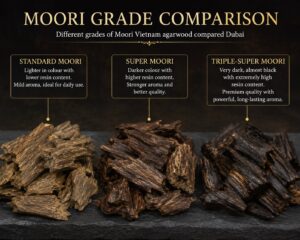
Because weight is such a reliable test, it helps to handle a few chunks before buying. Shops with a dedicated Moori Vietnam Agarwood selection, like Rose Valley Perfumes in Deira, let you pick pieces up and compare density directly, which is harder to judge from a photo when shopping online.
Oud Suyufi vs Moori Dubai: The 5 Key Differences Explained
The comparison table gives you the facts. This section gives you the reasoning behind each one. Each difference below includes the practical implication – because knowing that Suyufi has “surface resin” is only useful once you understand what that means when you are seated in front of a glowing mabkhara.
Difference 1 – Shape and Cut Philosophy: Engineered vs. Natural
How do Suyufi Flat and Moori differ in physical form?
Suyufi Flat is precision-cut into uniform thin slices. Moori retains the natural irregular chunk shape of the harvested agarwood. This single difference reflects two entirely different philosophies in how the wood reaches the buyer.
Suyufi’s flat cut is a deliberate manufacturing decision. Slicing the wood horizontally exposes the resin on the outer surfaces and standardises burn behaviour – each chip performs similarly because they share the same geometry. This consistency makes Suyufi commercially reliable: the chips stack neatly, transport efficiently, and deliver a predictable burn experience in every session.
Moori’s irregular chunk form is intentional in the opposite direction. It preserves the wood’s natural resin distribution and avoids any processing step that could disturb the volatile aromatic compounds embedded within the heartwood. What you receive is the piece of agarwood essentially as it came out of the tree – cleaned of excess white wood, but structurally untouched.
The practical implication for buyers is this: Suyufi is easier to dose consistently. You pick up one chip, you know roughly what you are getting, and you place it with confidence. With Moori, you develop an eye for resin content over time – learning to judge a piece by its weight, its colour distribution, and its surface texture before placing it on the heat source.
Difference 2 – Resin Distribution: Surface vs. Core
Where exactly is the resin located in each type?
In Suyufi Flat, the oleoresin is concentrated on the exposed outer flat surfaces. In Moori, the resin is distributed throughout the dense interior core. This single structural difference explains most of the other differences between them.
The implications of surface resin (Suyufi):
- Hits heat instantly, with no wood buffer between the resin and the heat source.
- Produces a fast, high-intensity fragrance opening that peaks within 10 to 15 minutes.
- Session is shorter – once the surface resin clears, the remaining wood has little to offer.
- More sensitive to excessive heat because there is no wood mass to absorb and moderate it.
The implications of core resin (Moori):
- Requires heat to penetrate the outer wood layers before reaching the fragrant compounds.
- Creates a natural delay of several minutes before the fragrance begins to build.
- Session is longer – as the heat works progressively deeper, new layers of fragrance keep emerging.
- More tolerant of heat variation because the dense wood itself acts as a thermal buffer.
The simplest way to remember it: Suyufi is like an espresso – concentrated, fast, and immediately impactful. Moori is like a slow-drip coffee – layered, evolving, and best appreciated without rushing it.
Difference 3 – Burn Behaviour and Heat Management
Which oud is easier to burn – Suyufi or Moori?
Moori is significantly easier to burn due to its dense, heat-tolerant structure. Suyufi requires more precise charcoal heat control to prevent scorching. This is the single most practically important difference for anyone buying raw oud chips for the first time.
Suyufi Flat burn requirements:
- Charcoal must be fully ashed white before the chip is placed. An orange or red coal is too hot and will combust the surface resin instantly.
- Chip should be positioned at the outer edge or periphery of the heat zone – never directly above the charcoal’s centre.
- Reposition once during the session when one face of the chip has cleared, moving it slightly inward.
- Not suitable for electric mabkhara. Electric heat cannot generate the burst temperature that Suyufi’s surface resin requires to fully volatilise.
Moori burn requirements:
- More forgiving positioning – can be placed closer to the heat centre without the same scorching risk.
- Dense wood structure provides a natural buffer against heat spikes.
- Works effectively on both charcoal and electric mabkhara – the only raw oud form that performs well on both burning methods.
- Flip or reposition the chunk halfway through the session to expose a fresh interior surface.
Electric mabkhara note: If your only burner is electric, Moori is the correct choice every time. Electric burners operate at a lower, consistent temperature that is ideal for drawing out Moori’s interior resin, but insufficient for activating the surface resin compounds of Suyufi Flat.
Difference 4 – Scent Character and the Full Session Arc
Do Suyufi Flat and Moori Vietnam smell different?
Yes – they smell distinctly different at every stage of a burning session. This is not a subtle difference requiring a trained nose to detect. Anyone sitting in a room with Suyufi burning versus Moori burning will notice the contrast within five minutes.
| Burn Stage | Oud Suyufi Flat | Oud Moori Vietnam |
| First 5 minutes | Sharp, resinous, bold – room fills fast | Soft, sweet, and gently woody. |
| 10 to 30 minutes | Warm woody peak – second phase begins | Deep balsamic richness develops slowly. |
| 30 to 60 minutes | Fading and clean – chip is mostly spent | Rich, settled animalic oud character. |
| Post-burn | Light trace, fades within the hour | Heavy – lingers on fabrics for hours. |
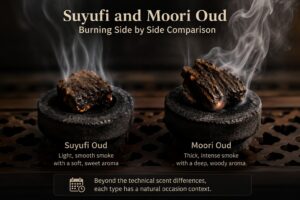
Beyond the technical scent differences, each type has a natural occasion context.
Occasions where Suyufi Flat excels:
- Welcoming guests at the front door or entrance of a home.
- Preparing a majlis or gathering space before visitors arrive.
- Friday pre-prayer home scenting rituals across Gulf households.
- Any event where you need immediate, bold fragrance presence in a large space.
Occasions where Moori excels:
- Evening wind-down in a bedroom or personal living space.
- Long sessions during reading, reflection, or meditation.
- Scenting soft furnishings – curtains, cushions, and upholstery – for a lasting fragrance that stays in the room for hours.
- Gifting, because its approachable, non-aggressive character suits most recipients.
Difference 5 – Price Logic and Authentic Value
Is Suyufi more expensive than Moori, or the other way around?
Price in raw agarwood is determined primarily by resin density, authenticity, and origin – not by the product name. That said, the two types have different price structures in the market, and understanding the logic behind them protects you from overpaying or being misled.
Suyufi Flat pricing:
- Generally more accessible in price because the flat-cut process is efficient and can be applied to wood at various resin levels.
- Even medium-resin wood produces a functional Suyufi chip – the cut exposes whatever resin is present, making mid-grade material perform reasonably well at a lower cost.
- Premium Suyufi made from high-resin wood commands significantly higher prices, but entry-level Suyufi is widely available across Dubai’s oud shops.
Moori Vietnam pricing:
- Wild-harvested, naturally resinous Moori from Vietnam occupies the higher end of the raw oud market.
- Natural resin formation in Aquilaria crassna takes years to decades. The supply of genuinely wild-origin, high-resin Moori does not grow at the same rate as demand.
- The global agarwood chip market is projected to reach over USD 17.6 billion by 2033, but the supply of authentic wild-origin material is constrained. This is what drives the premium on genuine Moori.
- If Moori Vietnam is priced similarly to standard commercial bakhoor or low-grade oud blends, the resin content is almost certainly low, artificially enhanced, or both.
How Suyufi and Moori Compare to Other Agarwood Sold in Dubai
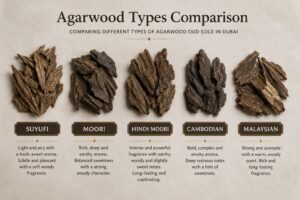
Suyufi and Moori are far from the only agarwood types you will come across while shopping in Dubai. Knowing where they sit alongside other common categories makes it easier to navigate a souk shelf or an online catalogue without feeling overwhelmed.
- Hindi Moori: A separate category from Vietnamese Moori, worth knowing about before you buy.
Many Dubai shops also stock Hindi Moori, an Indian-origin equivalent to Vietnamese Moori. It shares the natural chunk format but leans toward a bolder, more animalic scent profile rather than the smoother, sweeter character typical of Vietnamese wood – useful to know if a “Moori” label on a shelf does not specify origin.
Beyond Hindi Moori, a handful of other categories show up consistently across Dubai’s agarwood counters:
- Oud Hindi Super: A premium-grade Indian agarwood, typically pricier than standard Hindi cuts and sought after for its depth.
- Oud Indonesia Super: Indonesian agarwood with a distinct sharper, more medicinal note compared to both Indian and Vietnamese wood.
- Oud Sri Lanka: Less commonly stocked, but valued by collectors for a profile that sits between Indian boldness and Vietnamese smoothness.
- Dehn Oud (distilled oil): Not a chip or chunk at all – this is the distilled essential oil extracted from agarwood, worn on the skin rather than burned.
For a first-time buyer, the practical takeaway is simple: ask the seller to specify both the cut (flat Suyufi versus natural chunk) and the origin (Indian, Vietnamese, Indonesian, Cambodian) separately. Combining both pieces of information is what actually tells you what you are buying – neither term alone is enough.
Oud Suyufi or Moori? A Quick Decision Guide for Dubai Buyers
The answer to this question is never “it depends.” Every situation below has a clear, direct recommendation. Find yours, act on it, and stop second-guessing at the point of purchase.
| Your Situation | Choose | Why |
| New to burning raw oud | Moori | Forgiving heat tolerance, works on any burner, gentle learning curve. |
| Hosting guests or a majlis | Suyufi Flat | Bold, immediate fragrance fills the room within minutes. |
| Daily bedroom or personal use | Moori | Gentle opening, long session, does not overpower intimate spaces. |
| Buying a gift | Moori | Works on any burner type, presents beautifully, approachable scent. |
| Using an electric mabkhara only | Moori | Electric heat cannot fully activate Suyufi’s surface resin. |
| Building a serious oud collection | Both | They serve different occasions and complement each other perfectly. |
The Scenarios Explained in Full
If you want the brief answer, the table above is enough. If you want to understand the reasoning behind each recommendation, here it is.
- New to burning raw oud: Choose Moori. Its dense chunk form does not scorch instantly if your coal is slightly too hot. Its slow fragrance build gives you time to adjust the chip position before anything goes wrong. It works on an electric burner if you do not yet own a charcoal setup. There is no better entry point into raw agarwood burning.
- Hosting guests or preparing a majlis: Choose Suyufi Flat. Its bold, fast-releasing surface resin fills a room with immediate presence. Ten minutes after placing a chip on a properly ashed coal, the scent is in the air, on the curtains, and coating the clothing of every person in the space. That is the experience a host needs.
- Daily oud for a bedroom or personal space: Choose Moori. Its gentle, evolving character is suited to spaces where you are present for the full session and want the fragrance to accompany rather than announce itself. It does not overpower intimate environments.
- Buying oud as a gift: Choose Moori. It works on any burner the recipient owns. Its natural chunk form presents beautifully. Its scent profile is approachable and non-aggressive, meaning it is unlikely to overwhelm someone who may have limited experience with raw oud.
- Using an electric mabkhara exclusively: Choose Moori. Electric burners cannot generate the burst heat that Suyufi’s surface resin requires to fully release. You will burn the chip and get only a fraction of the fragrance it is capable of producing. On electric heat, Moori performs exactly as it should.
- Building a serious oud collection: Buy both. They are complementary, not competitive. Suyufi serves your social and ceremonial occasions. Moori serves your personal and contemplative ones. A complete oud collection has a place for each.
Whichever direction you lean, it helps to see and smell both before deciding. Rose Valley Perfumes in Murshid Bazar, Deira, keeps both types stocked side by side, which makes the comparison a lot easier than choosing from a screen.
How to Know If Your Oud Suyufi Flat or Moori Is Authentic
The Dubai agarwood retail market is one of the most active in the world – and one where quality inconsistency is a well-documented reality. Artificial resin injection, synthetic fragrance coating, dyed chips sold as high-resin material, and plantation wood presented as wild-origin stock are all practised and profitable in segments of the market. Global industry estimates suggest that around 39% of the agarwood market faces adulteration and quality standard issues at some level of the supply chain.
The checks below are what a knowledgeable buyer should run before committing to any raw oud purchase.
Four Checks for Oud Suyufi Flat Authenticity
- Verify irregular resin marbling. Hold the chip flat and examine both broad faces under good light. Natural resin distributes in organic, uneven patterns – patchy, streaked, and varied. If the colouring across the face looks uniform, painted, or suspiciously consistent, the chip has almost certainly been treated with dye, resin oil, or a synthetic coating.
- Perform the cold-sniff test. Hold the unburned chip close to your nose and inhale slowly. Authentic Suyufi has a faint, raw, earthy-resinous scent even before any heat is applied. It should smell of something natural and complex – wood, earth, and the very beginning of oud. If it smells of synthetic perfume or has no discernible scent at all, treat that as a red flag.
- Test the weight. Natural oleoresin adds real, measurable density to the wood. A Suyufi chip with genuine resin content feels noticeably solid for its size. If the chip feels unexpectedly light or hollow, it likely has minimal natural resin regardless of how dark it appears on the surface.
- Check the surface texture. Run a fingertip across the flat face. Authentic Suyufi feels firm and very slightly waxy – not dry, not dusty, and not crumbling. A powdery or chalky surface texture indicates either degraded wood or material that never had meaningful resin content to begin with.
Four Checks for Oud Moori (Vietnam) Authenticity
- Assess the weight-to-size ratio. This is the single most reliable test for Moori. Lift the chunk and hold it in your palm. Authentic, high-resin Moori should feel noticeably heavy relative to what you would visually expect. The oleoresin that saturates the heartwood is dense. If the chunk feels light or hollow for its size, the resin content is genuinely low.
- Examine the surface texture. Rub a small area of the chunk’s surface between your fingers. Authentic Moori should feel very slightly oily or waxy – this is the surface expression of the internal oleoresin. A completely dry, rough, or crumbling surface is a concern. Genuine Moori does not crumble under normal handling.
- Perform the cold-sniff test. Even before burning, authentic Moori carries a detectable raw complexity – a faint combination of earthiness, mild wood, and subtle sweetness. This pre-burn scent is not strong, but it is present. Complete absence of cold scent on a Moori chunk typically means very low resin content or artificial surface treatment masking the wood’s true character.
- Apply price as a quality signal. Wild-harvested, naturally resinous Vietnamese Moori cannot be priced at the same level as commodity bakhoor or standard commercial incense blends. The rarity of the source material, the cost of harvesting from wild Aquilaria trees, and the export and import compliance processes involved all have real costs. A suspiciously low price on something labelled premium Moori is not a bargain – it is a warning.
The simplest rule across both types: buy from a specialist with verifiable sourcing standards, not from a general retailer where oud is one product category among hundreds. The difference in quality assurance is significant and directly impacts what you bring home.
How to Store Suyufi and Moori So the Resin Stays Fresh
Raw agarwood is a natural product, and like any natural product, poor storage can quietly reduce its quality over months. Both Suyufi and Moori hold their fragrance for years when stored correctly, but a few habits make a real difference.
- Keep it in an airtight container. A sealed glass jar or a tightly closed tin prevents the resin’s volatile compounds from slowly evaporating into the surrounding air over time.
- Store away from direct sunlight. UV exposure gradually degrades oleoresin. A drawer or a cupboard works far better than a windowsill display, however attractive the chips look.
- Avoid humidity swings. Excess moisture can encourage mould on the wood surface, while overly dry air can cause the wood to crack. A stable room-temperature environment is ideal.
- Separate Suyufi from Moori. Storing different grades or types together can blur their distinct cold scents over time, especially in a shared sealed container.
- Handle with clean, dry hands. Skin oils and moisture can transfer onto the resin surface, slightly altering the scent profile of high-grade pieces over repeated handling.
Stored this way, both Suyufi Flat and Moori Vietnam Agarwood can comfortably last for years without losing their core character – and in the case of well-aged agarwood, many collectors believe the scent only deepens further with time.
Common Mistakes First-Time Oud Buyers Make in Dubai
Most disappointing oud purchases come down to a handful of avoidable mistakes rather than bad luck. Knowing these in advance will save both money and a few ruined charcoal sessions.
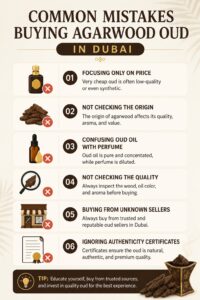
- Buying by colour alone. Dark colour alone does not confirm resin content – dye can fake colour, but it cannot fake weight or cold scent.
- Overheating the charcoal. Placing a chip on a red-hot, unashed coal is the single most common reason a first session disappoints – the resin combusts before it can release fragrance properly.
- Using too many chips at once. More chips does not mean more fragrance – it usually just means more smoke and a harsher, less refined scent.
- Skipping the cold-sniff test. A surprising number of buyers never smell a chip before burning it, missing one of the simplest authenticity checks available.
- Assuming all Moori is Vietnamese. Some sellers use “Moori” loosely as a generic term for any dense chunk, regardless of true origin – always ask directly.
- Not asking about sourcing. A seller who cannot or will not explain where their agarwood comes from is a signal worth taking seriously, especially at premium price points.
Where to Find Genuine Oud Suyufi and Moori in Dubai
Dubai has no shortage of places selling agarwood – from the open-fronted shops of the Gold and Spice Souk to Murshid Bazar in Deira, where oud trading has been a way of life for decades. The volume of choice is part of what makes the city special for oud lovers, but it also means the checks covered above are worth applying wherever you shop, not just at any single store.
In Deira specifically, Rose Valley Perfumes is one of the longer-running names in the area, with both Oud Suyufi Flat and Moori Vietnam Agarwood kept as separate, clearly labelled categories rather than lumped together as generic “oud chips.” That separation matters in practice – it means a buyer can ask specifically for one or the other and get a straight answer rather than whatever happens to be on the counter that day.
A few practical things worth knowing if you are buying agarwood anywhere in the city, whether in person or online:
- Ask whether the resin is natural or whether the wood has been treated. Most reputable shops will tell you directly and will not be defensive about the question.
- If buying online, look for clear close-up photography of the actual chip or chunk rather than stock imagery – this is one of the simplest ways to judge resin marbling before the product arrives.
- Shops that separate Suyufi by cut and Moori by origin, rather than selling everything under one vague “oud chips” label, tend to have a better handle on what they are actually selling.
- UAE delivery times for online agarwood orders are typically short given how local the supply chain is, so there is rarely a need to rush a decision out of urgency.
Rose Valley Perfumes lists both categories on its website with notes on burn method for each, which is useful if you are buying for the first time and want a quick reference before your chip or chunk arrives.
Frequently Asked Questions
What is the difference between Suyufi and Moori oud?
Suyufi is a flat, thin cut with resin on the surface. Moori is a natural dense chunk, usually from Vietnam, with resin inside the core. One is about shape, the other is about origin and quality.
Which oud is best, Suyufi or Moori?
Neither is objectively best. Suyufi suits gatherings and majlis settings with its bold, fast scent. Moori suits daily and personal use with its slow, smooth burn.
How do you burn oud chips at home?
Light a charcoal disc until it ashes over white, then place the chip at the edge of the heat. Wait for the smoke to rise naturally instead of forcing it with high heat.
Can Oud Moori be burned on an electric burner?
Yes. Moori works well on electric burners because its dense core releases resin gradually under steady, lower heat.
Is Vietnamese oud better than Indian oud?
Neither is “better” – they are different profiles. Vietnamese Moori tends to be smoother and sweeter, while Indian oud is typically bolder and more animalic.
How can you tell if agarwood is real?
Real agarwood feels heavy for its size, has a faint natural scent when unburned, and shows irregular resin marbling rather than a uniform dark coating.
How long does an oud chip burn for?
A Suyufi chip burns for around 30 to 45 minutes. A Moori chunk lasts longer, typically 60 to 90 minutes or more.
How much oud should I use per session?
One chip or chunk is usually enough for a medium-sized room. Start small and add more only if the fragrance feels too faint after ten minutes.
Does oud expire or lose its scent over time?
Properly stored agarwood does not really expire. Kept away from light and moisture, both Suyufi and Moori can hold their scent for years.
What is the difference between bakhoor and raw oud chips?
Bakhoor is wood soaked in fragrance oils and blends. Raw oud chips like Suyufi and Moori are unblended agarwood, valued for their natural, untreated scent.
Is Suyufi oud the same as oud perfume oil?
No. Suyufi typically refers to raw flat-cut agarwood chips for burning, while oud perfume oils and sprays are separate, wearable fragrance products, even when they share the same name.
Where can I buy authentic oud in Dubai?
Specialist agarwood shops in Deira, such as Rose Valley Perfumes, stock both Suyufi and Moori with sourcing details available on request.
Suyufi or Moori: The Right Oud for Every Moment
Oud Suyufi Flat and Oud Moori are not rivals in any meaningful sense. They are two expressions of the same ancient, extraordinary wood – each one shaped by a different intention and each one speaking to a different human moment.
Suyufi brings energy, presence, and immediacy. It is the oud of arrivals and gatherings – the fragrance that tells a room something is about to happen. Moori brings depth, patience, and quiet persistence. It is the oud of evenings and stillness – the fragrance that stays with the walls and the soft furnishings long after the session has ended and the burner has cooled.
Understanding that difference is what moves you from simply buying oud to actually knowing it. And knowing it is where the experience becomes genuinely personal.
If you are in Dubai and want to experience the difference for yourself, Rose Valley Perfumes in Murshid Bazar, Deira, is worth a visit – pick up a Suyufi chip and a Moori chunk in the same afternoon, and the difference described throughout this guide will make a lot more sense in person than it ever could on a page.