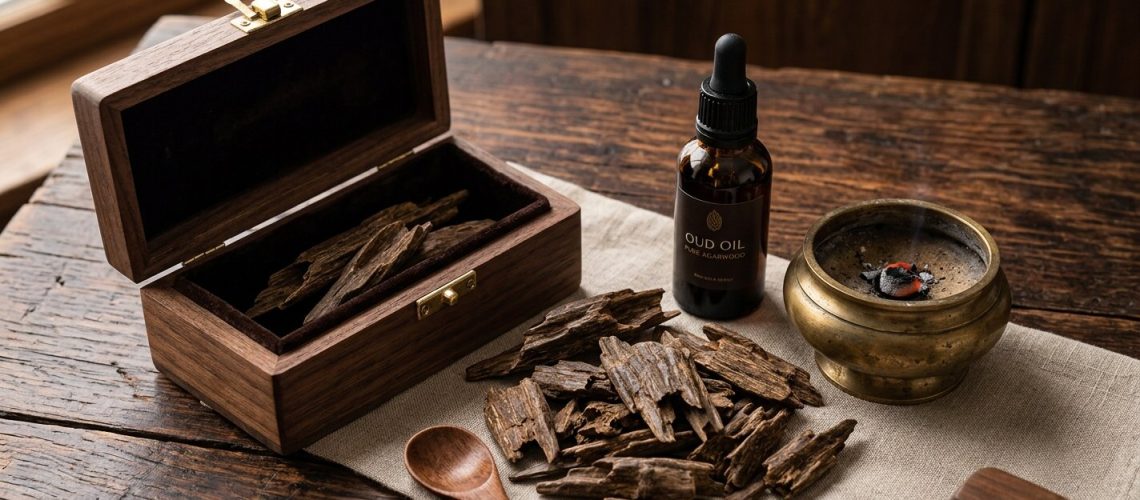
Agarwood should be stored in an airtight glass or wooden container, kept in a cool, dark place at roughly 15°C to 24°C with relative humidity between 40 and 60 percent. Keep it away from direct sunlight, water, strong chemicals, and household odours. Raw chips, oud oil, bukhoor, beads, and powder each behave differently once exposed to heat, air, and moisture, so the exact handling method changes slightly depending on the form of agarwood you own.
That is the short answer. The longer answer, and the reason most agarwood owners still end up with wood or oil that smells noticeably weaker after a year or two, has to do with what agarwood actually is at a chemical level, how differently each product format ages, and a handful of storage habits that feel harmless but slowly strip away the very fragrance people pay a premium for in the first place.
This guide walks through all of it: the science behind why agarwood degrades, format-by-format storage instructions, the specific climate challenges faced by owners in hot regions such as the UAE, how to physically check whether your agarwood is already deteriorating, and the mistakes that even long-time collectors make without realising it.
Agarwood has been traded, gifted, and burned for ceremonial purposes across the Arabian Gulf, South Asia, and East Asia for centuries, and the storage instincts passed down through generations in these regions often hold up well against modern chemical analysis. What this guide adds is the reasoning behind those inherited habits, along with the parts that generic, one-size-fits-all storage articles tend to miss entirely, particularly the differences between raw wood, oil, blended bukhoor, and worn beads.
Why Storing Agarwood Correctly Matters
How to Store Agarwood fragrance does not come from the wood fibre itself. It comes from a resin, sometimes called oleoresin, that forms inside certain Aquilaria and Gyrinops trees as a defensive response to fungal infection or physical injury. Healthy Aquilaria wood is pale, light, and almost odourless. It is only after infection triggers the tree’s resin-producing response that the dense, dark, fragrant material we know as agarwood begins to form, often over a period of years or decades.
This matters for storage because resin is chemically active. Researchers who analysed agarwood essential oil using gas chromatography found that the oil is dominated by sesquiterpenes and related compounds, groups of molecules known for being volatile and reactive to heat and oxygen. One laboratory study on Aquilaria malaccensis oil deliberately exposed samples to 40°C heat over periods ranging from three to thirty days and tracked how the chemical composition shifted throughout that window, confirming that heat exposure changes the oil’s makeup measurably and continuously, not just at extreme temperatures.
That specific study was actually examining a controlled industry technique used to mature and deepen the scent of oud oil on purpose. This is worth pausing on, because it explains a common point of confusion. Some heat and oxygen exposure, applied deliberately and briefly by producers, is part of how certain oud oils develop a deeper, more resinous character during processing.
That is an entirely different situation from a bottle of finished oil sitting on a warm windowsill for two years, where the same chemical reactions continue unchecked, past the point of improvement, into the territory of flattening and thinning the scent. Controlled maturation and uncontrolled decay are the same chemistry, applied at different intensities and for different lengths of time, with very different results.
Three environmental factors drive nearly all of the fragrance loss and physical damage seen in stored agarwood:
- Heat speeds up resin evaporation and, over time, can dry the wood out to the point of cracking.
- Light, particularly ultraviolet light, breaks down aromatic compounds even in rooms that never feel physically hot.
- Moisture instability damages agarwood in two opposite directions. Too little humidity causes brittleness. Too much creates conditions for mould.
We will refer to these three as the Three Enemies of Agarwood throughout this guide, because nearly every storage recommendation that follows exists to defend against one or more of them.
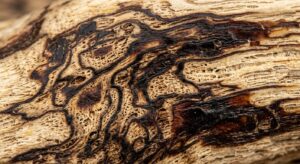
It helps to think of agarwood less like a finished, stable product and more like a living record of a chemical process that started years before it ever reached your hands. The resin took time to form inside the tree, and the compounds inside that resin continue reacting to their environment long after harvesting, processing, and sale. Correct storage does not stop that chemistry entirely, since some slow change is simply part of what agarwood is. What correct storage does is control the pace and direction of that change, keeping it slow, gradual, and in the case of oil, sometimes even beneficial, rather than fast and destructive.
It is also worth understanding why agarwood carries the price tag it does, since that context shapes how seriously storage should be taken.
- Industry market research estimates the global agarwood essential oil market at roughly 2.5 billion US dollars in 2025, with projections putting it near 4.1 billion dollars by 2034.
- A separate analysis of the agarwood oil segment specifically valued it at approximately 225 million dollars in 2026, forecasting growth toward 477 million dollars within a decade.
- Agarwood-producing species have been listed under Appendix II of CITES, the international convention regulating trade in endangered species, since the mid-1990s.
- Several of the primary agarwood-producing tree species are classified as Critically Endangered on the IUCN Red List.
None of this is trivia. It explains why agarwood, unlike a cheaper wood or synthetic fragrance, genuinely rewards careful storage, and why poor storage represents a real and often irreversible financial loss, not just a minor inconvenience.
How to Store Agarwood by Format
Most articles on this topic treat agarwood as a single, uniform product. It isn’t. Raw chips, oud oil, bukhoor, beads, and powder are physically different materials with different surface areas, different oil concentrations, and different points of vulnerability. Grouping them under one blanket storage rule is where a lot of well-intentioned owners go wrong.
Raw Agarwood Chips
How to Store Agarwood raw chips in a sealed glass jar or a wooden box, away from sunlight, in a stable environment with moderate humidity.
Raw chips are the least processed form of agarwood, which also makes them the most porous and reactive to their surroundings. The wood’s surface will absorb moisture from humid air and release it again in dry conditions, and it does this constantly, even sitting still in a drawer.
Practical points to follow:
- Choose a container that seals well but does not compress the chips under pressure, since crushing can damage the resin-bearing structure inside.
- Do not stack heavy objects on top of stored chips.
- Open the container occasionally to check for any change in scent strength, colour, or surface texture, roughly every few months for actively used pieces.
A mistake worth flagging specifically: displaying loose chips in an open decorative bowl. It looks attractive on a shelf or majlis table, but it leaves the wood constantly exposed to air and light, two of the Three Enemies working on it around the clock. If you are comparing raw agarwood chips from different regions before deciding what to store, resin density and grade are worth checking first, since denser pieces demand slightly more careful handling than lighter, lower-resin chips.
Agarwood Oil (Dehnal Oud)
How to Store Agarwood oud oil in a dark glass bottle, kept upright, in a cool and dark location, with as little empty air space inside the bottle as practical.
Oil behaves differently from solid wood. Instead of drying out, its primary risk is oxidation, driven largely by how much contact the oil has with the air inside its own container. Enthusiast communities that track long-term oud oil ageing have observed that oils stored in cool conditions with minimal headspace, meaning little empty air above the liquid, tend to mature more slowly and predictably than oils left in partially filled bottles exposed to warmth. This lines up with the basic chemistry: less oxygen contact means slower oxidation.
- Use dark amber or cobalt glass rather than clear glass. Clear glass allows UV light to reach the oil directly.
- Keep bottles as full as is practical for how often you use them, and consider transferring a fast-depleting bottle into a smaller container once it drops below roughly half full, to reduce the air-to-oil ratio.
- Store bottles standing upright rather than on their side.
A specific and easily avoidable mistake: decanting oil into a large new bottle “to look nicer” and then leaving that bottle mostly empty for months. The extra air space inside accelerates exactly the ageing process you are trying to slow down. This is one reason experienced Dehnal Oud buyers tend to purchase smaller bottles more often rather than one large bottle meant to last for years.
Bukhoor
How to Store Agarwood bukhoor in an airtight container, in a cool and dry spot, away from strong household odours.
Bukhoor typically combines agarwood with other aromatic oils and, in some blends, binding agents. That combination makes it more prone to two specific problems: clumping from moisture absorption, and softening or melting in heat.
- Keep bukhoor away from kitchens, where steam and cooking smells linger in the air and get absorbed into porous blends.
- Store different bukhoor blends in separate containers so their scents do not bleed into one another.
- If a bukhoor blend hardens slightly, resist the urge to soften it with direct heat such as a microwave, since this can damage or unevenly redistribute the aromatic oils inside.
A common cross-contamination mistake: keeping bukhoor in the same storage box as raw agarwood chips. The blended oils in bukhoor transfer onto pure chips far more easily than most people expect, altering the chips’ natural, unblended scent. Different bukhoor and oud muattar blends also vary in how much oil they carry, so it helps to check a blend’s oil content before deciding how airtight its storage container needs to be.
Agarwood Beads and Bracelets
How to Store Agarwood beads in an individual soft pouch inside a closed box, and give worn pieces regular rest periods away from direct skin contact.
Beads and bracelets face a storage challenge the other formats don’t: they are worn against skin, which means ongoing exposure to natural body oils, perspiration, lotion, and perfume residue.
- After wearing, wipe beads gently with a dry, soft cloth before returning them to storage.
- Store separate bracelets in separate pouches so beads do not knock against one another and scratch their surface.
- Allow a worn piece a day or two of rest between uses, giving accumulated skin oils time to settle rather than build up continuously on the surface.
A mistake seen often among owners with multiple bracelets: tossing them loosely into one drawer together. The beads scratch each other’s surface over time, dulling what should be a smooth, polished finish.
Agarwood Powder
How to Store Agarwood powder in a fully airtight, moisture-resistant container, and plan to use it within a shorter window than other formats.
Powder has by far the highest surface area of any agarwood format relative to its weight, and surface area is directly tied to how quickly a material loses volatile compounds to the surrounding air. This makes powder the fastest-degrading format if it is left exposed or opened too frequently.
- Use several small, tightly sealed containers instead of one large container opened repeatedly.
- Keep any desiccant packet near the container, never in direct contact with the powder.
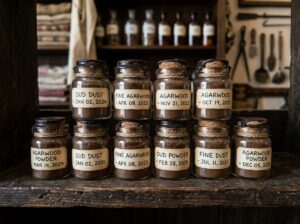
- Write the purchase date on the container. Powder does not hold its peak quality nearly as long as chips, oil, or beads.
A mistake specific to this format: buying powder in bulk and storing the entire quantity in one bag that gets opened every week. Every opening introduces fresh air and moisture, and with powder, that damage compounds quickly. Powder is often blended into other fragrance oil preparations, so keeping it fresh matters even if you rarely use it on its own.
How to Store Agarwood: Creating the Right Environment
Beyond the container itself, the surrounding room plays a major role in how well agarwood holds its fragrance over months and years.
Temperature
A stable range of roughly 15°C to 24°C (about 60°F to 75°F) is widely recommended for agarwood storage.
Above this range, resin evaporation accelerates, particularly noticeable in oil and bukhoor, which have more exposed aromatic surface area than solid chips. Consistency matters almost as much as the specific number. A room that swings repeatedly between warm and cool puts more stress on stored agarwood than one that sits at a slightly higher but stable temperature.
Quick temperature checklist:
- Keep the room between 15°C and 24°C wherever possible.
- Prioritise consistency over hitting an exact number every single day.
- Avoid rooms with large daily temperature swings, even if the average temperature looks acceptable.
Humidity Control
Relative humidity between roughly 40 and 60 percent is the commonly cited safe range for agarwood.
This is one of the most misunderstood parts of agarwood care, mainly because the risks run in two opposite directions.
On the dry side, agarwood that sits in low humidity for extended periods can lose surface moisture, becoming brittle and prone to cracking, along with a duller, thinner scent profile.
On the humid side, the concern is mould. The US Environmental Protection Agency identifies 60 percent relative humidity as the general threshold above which mould risk rises meaningfully on organic surfaces, with mould capable of germinating within 24 to 48 hours once humidity holds above that level for a sustained period. Since agarwood is an organic material, this same threshold applies directly. Keeping storage areas below that 60 percent mark, and ideally within a stable 40 to 60 percent band, meaningfully reduces the risk of mould developing on chips, beads, or bukhoor.
Two-sided humidity risk, at a glance:
- Below roughly 40 percent: increased risk of brittleness, cracking, and a duller, thinner scent.
- Above roughly 60 percent: increased risk of mould, which can germinate within 24 to 48 hours of sustained exposure.
- Between 40 and 60 percent: the generally recommended safe zone for most agarwood formats.
A basic digital hygrometer, inexpensive and easy to find, removes the guesswork here. If you use a desiccant packet to manage excess humidity, keep it positioned near the storage container rather than in direct contact with the agarwood, since direct contact can dry out localised patches of the wood unevenly.
It is worth noting that mould research on indoor environments has consistently found that moisture control matters more than temperature control when it comes to preventing mould from establishing itself, even though both factors play a role. This is a useful principle to keep in mind if you ever have to prioritise between the two, for instance in a storage space where perfect temperature control is not realistic but humidity can still be managed with a dehumidifier, air conditioning, or simple desiccant packets. Getting humidity right consistently matters more than getting temperature exactly right.
Light Exposure
How to Store Agarwood Keep away from both direct and indirect sunlight, including light filtering through glass windows or display cabinets.
Ultraviolet light degrades aromatic compounds even in rooms that never feel physically warm. A glass display cabinet positioned near a window can slowly damage stored agarwood purely through light exposure, even inside an air-conditioned room that otherwise meets the temperature guidance above.
Light exposure to avoid:
- Direct sunlight through an open window.
- Indirect sunlight filtering through glass, including display cabinets.
- Prolonged exposure to strong indoor lighting positioned very close to a storage shelf.
Storage Considerations in Hot Climates Like the UAE
In hot climates such as the UAE, indoor air conditioning frequently creates unexpectedly dry conditions, while areas near doors or windows can see the opposite problem during humid months.
This is a detail almost entirely missing from agarwood storage guides written with cooler, temperate climates in mind. Homes and shops across Dubai and the wider Gulf typically run strong air conditioning for most of the year, and that consistent cold, dry airflow can push indoor humidity below the ideal 40 to 60 percent range, especially during peak summer months when systems run continuously.
- Avoid positioning storage containers directly beneath air conditioning vents, where a steady stream of cold, dry air blows across them.
- Watch for humidity spikes near entryways, windows, or storage spots close to exterior doors, particularly during the more humid shoulder-season months.
- Interior rooms with steady, moderate air conditioning tend to hold more consistent conditions than rooms near frequently opened exterior doors.
Understanding Agarwood Grades and Why They Affect Storage Priority
Not all agarwood carries the same storage stakes, and understanding why helps explain some of the advice above.
Grading agarwood is not based on species alone. According to trade documentation compiled by TRAFFIC and reviewed under CITES processes, classification depends on a combination of factors:
- The size of the piece.
- Its resin content.
- The depth and complexity of its fragrance.
- Its colour.
- For oil specifically, its purity.
- Country of origin, which also plays a role in how a piece or oil is valued in the market.
This matters practically because resin content and storage sensitivity move together:
- Low-grade, low-resin chips are more forgiving of inconsistent storage, since there is less volatile material at risk in the first place.
- Dense, resin-heavy pieces from mature trees have far more to lose from careless handling.
- Higher grades, the ones commanding the steepest prices, are also the ones that reward the strictest storage discipline.
This is worth keeping in mind when deciding how much effort to put into storage for different pieces in a collection. A small utility-grade chip kept for everyday bukhoor use does not need museum-level conditions. A dense, aged, high-resin piece bought as an investment or family heirloom does. Browsing a full range of agarwood, oud, and perfume options side by side can also help with this, since seeing different grades next to each other makes it easier to judge which pieces in your own collection need the strictest storage attention.
A Brief Note on Authenticity and Storage
Because high-grade agarwood carries real financial value, it is also a frequent target for adulteration and mislabelling. Reports tracking online agarwood trade have documented widespread advertising of agarwood-adjacent products, seedlings, and unverified pieces at wildly inconsistent price points, reflecting how difficult quality verification can be for buyers without direct trade experience.
Storage plays an indirect but real role here. Authentic, high-resin agarwood behaves predictably under the storage principles in this guide, while synthetic or heavily adulterated products often behave unpredictably. Two informal signals worth watching for:
- Scent that fades unusually fast, even when storage conditions are correct, which can point to a synthetic or heavily diluted product rather than a storage mistake.
- A fragrance that never fades at all, since natural resin does soften gradually over long periods, unlike some artificial scent additives.
If a piece behaves strangely compared to the guidance in this article regardless of how well you store it, that inconsistency itself can be a useful, informal signal worth discussing with the seller. Buying from a source with a documented history in the Gulf fragrance trade makes this conversation easier, since long-established sellers are generally more transparent about origin and storage history than newer, unverified listings.
How to Store Agarwood the Right Way: Choosing a Container
The container you choose either works with the environmental factors above or actively undermines them.
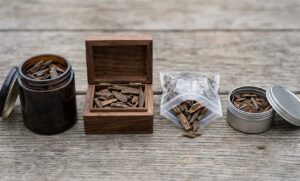
- Glass jars, ideally amber or dark-tinted rather than clear. Dark glass blocks UV light while still allowing a fully airtight seal, making it one of the more dependable long-term options for both chips and oil.
- Wooden boxes. A traditional and visually appealing choice, particularly for chips and beads. Choose a box made from a neutral, non-aromatic wood, since a strongly scented box material can transfer its own smell onto stored agarwood over time.
- Thick, odourless zip bags. Reasonable for short-term storage or travel, but not ideal as a long-term solution. Plastic can degrade slightly with age and offers less of a light and oxygen barrier than glass.
- Tin or metal containers. Workable for short stretches, but metal can encourage condensation if humidity fluctuates, which introduces moisture directly against stored agarwood.
One misconception worth clearing up directly: the idea that agarwood needs to “breathe” the way cigars, wine corks, or certain other organic materials do. It does not. The goal with agarwood is closer to the opposite: minimising oxygen and light contact, not encouraging airflow. Treating agarwood like a material that benefits from ventilation is one of the more persistent and damaging myths circulating among casual buyers. Suitable jars, boxes, and pouches are usually easy to find alongside other fragrance accessories, so it is worth picking these up at the same time as the agarwood itself rather than treating storage as an afterthought.
Container Size Matters More Than Most Owners Realise
A detail that rarely gets mentioned: matching container size to the actual quantity of agarwood inside it. A large jar holding a small amount of chips leaves excess air space inside, which works against you even if the jar itself is well sealed and made of the right material. As a general rule, choose a container only slightly larger than what you are storing, and consider downsizing containers as chips, powder, or oil get used up over time, rather than leaving a shrinking amount of agarwood inside an increasingly oversized space.
Where You Place the Container Inside a Room Also Matters
Even the right container in the wrong spot undermines its own purpose. Avoid placing storage containers:
- On windowsills or shelves that receive even brief periods of direct sun during the day.
- Directly above or beside heat-generating appliances, including ovens, heaters, or sunlit electronics.
- Inside bathroom cabinets, where humidity spikes sharply during showers regardless of overall room ventilation.
- On exterior-facing walls in older buildings, which can run several degrees warmer or cooler than interior walls depending on the season.
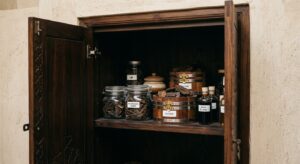
An interior cupboard, drawer, or closet, away from plumbing and direct sun, is almost always a better default choice than a display shelf, however visually appealing the shelf might be.
Protection and Handling Tips for Stored Agarwood
Avoiding Water and Chemicals
Never submerge agarwood in water, and keep it away from perfumes, soaps, detergents, and household cleaning products.
These substances can strip away or permanently alter agarwood’s natural aroma. Common everyday sources of chemical contamination include:
- Household cleaning products and detergents.
- Soaps and hand sanitisers used right before handling.
- Strong perfumes or colognes worn on the same wrist as a bracelet, or sprayed near open storage.
- Bathroom or laundry areas, where indirect chemical exposure can linger in the air even without direct contact.
Preventing Cross-Contamination Between Grades
Keep different grades or types of agarwood in separate containers instead of combining them.
This matters for two distinct reasons:
- Judging authentic aroma later. Scent transfer between grades makes it harder to judge each piece’s genuine, unblended aroma, which matters if you ever plan to sell, gift, or have the wood professionally evaluated.
- Physical protection. Contact between rougher and finer grades can scratch or otherwise damage more delicate pieces.
Everyday Handling Habits
Handle agarwood with clean, dry hands, and stay mindful of the everyday odours that transfer onto porous surfaces without you noticing.
- Avoid handling agarwood right after applying hand lotion, sunscreen, or perfume.
- Keep storage away from kitchens, where lingering cooking odours settle onto nearby porous materials.
- If you smoke, store agarwood in a separate room. Smoke odour is particularly stubborn and difficult to remove once it has been absorbed.
- Keep agarwood away from open bottles of incense oil or other strongly scented liquids stored in the same cupboard.
Cleaning Without Liquids
Clean agarwood using only a soft, dry microfiber cloth. Never use water or liquid cleaning products.
Agarwood’s surface oils are sensitive to both water and alcohol-based liquids.
- Do use a soft, dry microfiber cloth for surface dust.
- Do wipe gently, without pressing hard enough to compress the resin-bearing surface.
- Don’t use water, alcohol, or any liquid cleaning product, since these strip away the very oils that carry the fragrance.
Adjusting Agarwood Storage Across the Seasons
Storage conditions are not static throughout the year, particularly in climates with pronounced seasonal shifts, and agarwood owners rarely account for this until something has already gone wrong.
During hot, high-air-conditioning months:
- Indoor air tends to run drier than usual, sometimes dropping below the 40 percent humidity mark discussed earlier.
- Watch most closely for brittleness, particularly in raw chips and beads.
- Dry, cracking wood is the more likely risk during this stretch, rather than mould.
During humid, transitional months:
- Indoor humidity can climb toward or past the 60 percent mould threshold, especially where air conditioning use is inconsistent.
- Check desiccant packets and verify hygrometer readings more often.
- Be more cautious about which room agarwood is stored in during this period.
A simple habit that solves most seasonal problems: check your hygrometer reading at the start of each season, not just when something already looks or smells wrong. A five-minute check twice a year catches problems long before they become visible or, worse, irreversible.
Packing and Traveling with Agarwood
Agarwood often needs to move, whether that is a gift being carried to another country, a piece taken along for travel, or stock being transported between a warehouse and a retail counter. Short-term travel storage follows slightly different priorities than long-term home storage.
- Use a padded, rigid case rather than a soft pouch alone when transporting chips or beads, since impact and pressure during travel pose a bigger short-term risk than humidity over a few days.
- For oil, always transport in the original tightly sealed bottle, packed upright and cushioned, since spillage risk during transit is a bigger concern than the oxidation risk from a short period of travel.
- Avoid checking agarwood into aircraft cargo holds where temperature and pressure are less predictable than in the cabin, where possible and where airline regulations allow it.
- Once you arrive at your destination, return agarwood to proper long-term storage conditions as soon as practical, since travel packaging is designed for durability during transit, not extended storage.
Short-Term vs. Long-Term Agarwood Storage
Storage duration changes what “correct” actually looks like, and this distinction rarely gets addressed directly in existing guides.
Short-term storage, covering roughly a few weeks to a few months, allows for a bit more flexibility. Temporary display, travel, or short-term gifting situations don’t demand the same strict environmental discipline as long-term storage, though the core principles of avoiding heat, light, and moisture swings should still be followed as closely as reasonably possible.
Long-term storage, particularly for collector-grade pieces, inherited agarwood, or anything purchased with resale or investment value in mind, calls for tighter and more consistent conditions.
- Inspect long-term stored pieces every three to six months, checking for any change in scent, texture, or surface appearance.
- Occasionally rotate stored chips, particularly oil-dense pieces, so resin does not settle unevenly within the wood over extended periods.
- Keep a simple written or photographic log for long-term pieces, noting purchase date and any observed changes. This becomes genuinely useful for anyone managing multiple pieces across different grades.
Signs Your Agarwood Storage Isn’t Working
How do you actually know whether agarwood has started losing quality? Watch for changes in scent, surface condition, and physical texture.
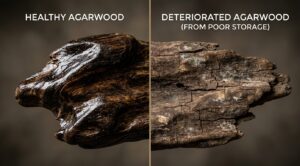
- Fading or flattening scent. A once-rich, layered aroma turning faint, flat, or slightly sour is usually the earliest indicator of resin breakdown.
- Surface dampness or discolouration. White, grey, or greenish spotting often signals mould growth, particularly in pieces stored above that 60 percent humidity threshold discussed earlier.
- Brittleness or cracking. Wood that has dried out excessively becomes fragile and can crack or splinter when handled.
- Oil separation or colour shift, relevant specifically to oud oil. Cloudiness, unusual darkening, or visible layering within the oil can point to oxidation.
If you notice any early signs, move the affected piece to a more suitable environment right away, and avoid attempting DIY chemical treatments or applying heat in an effort to “fix” it. In most cases, correcting the storage environment is the safest path, and further intervention beyond that can cause additional damage that cannot be reversed.
Common Agarwood Storage Mistakes to Avoid
- Storing agarwood near the kitchen. Heat and cooking odours, two of the most damaging factors, are both concentrated in this one part of the home.
- Keeping agarwood near scented drawer liners or sachets. These transfer artificial fragrance onto natural agarwood and permanently alter its scent profile.
- Handling pieces too often out of curiosity. Frequent handling transfers skin oils and moisture, and this adds up meaningfully over time, particularly with beads.
- Assuming any sealed container is automatically safe. Sealing in excess humidity is often worse for the wood than leaving a container slightly open in a genuinely stable, dry room.
- Applying the same storage method to every format. As the earlier section on chips, oil, bukhoor, beads, and powder makes clear, one size does not fit all here.
- Buying oversized containers “for the future.” As covered earlier, extra empty air space inside a container works against preservation rather than helping it, even with a good seal.
- Forgetting about seasonal humidity shifts. Conditions that were fine in one season can quietly drift outside the safe range a few months later, particularly in climates with strong seasonal swings between air-conditioning-driven dryness and natural humidity.
None of these mistakes are dramatic on their own. What makes them worth listing is how ordinary and easy to overlook each one is, and how, stacked together over months or years, they account for most of the fragrance loss agarwood owners eventually notice and struggle to explain.
How Proper Agarwood Storage Affects Value and Longevity
Agarwood occupies an unusual position among natural materials. Rather than simply degrading with age the way most consumables do, well-preserved agarwood, particularly oil, can retain or even develop its aroma further over time, provided storage conditions stay controlled and stable. Poorly stored agarwood moves in the opposite direction, and that depreciation is frequently permanent.
This distinction matters most for anyone treating agarwood as a long-term purchase, whether that is a ceremonial piece, a gift meant to be kept for years, or something bought with resale value in mind. Given how tightly regulated and genuinely scarce high-grade agarwood has become, with primary source species listed under CITES protection since the 1990s and several classified as Critically Endangered, the market has grown accustomed to treating storage history as part of a piece’s overall value, not a side detail.
If you are evaluating a purchase, reasonable questions to ask a seller include:
- How has this specific piece been stored since it arrived in the shop?
- Has it been kept away from direct sunlight and humidity swings?
- How long has it been in stock?
Retailers with deep roots in traditional fragrance trade, including long-established names working out of Dubai’s historic Deira district, typically maintain controlled storage conditions for exactly this reason, because they understand how directly it affects the quality of what eventually reaches the customer. If you would like a second opinion on how a specific piece has been stored before you buy it, most established fragrance sellers, including those reachable directly through WhatsApp, are happy to walk you through it.
There is also a practical, everyday version of this same logic that applies even outside formal buying or reselling situations. A gift of agarwood, whether given for a wedding, a religious occasion, or simply as a gesture of respect, carries more weight when it arrives, and continues to be kept, in a condition that reflects its actual quality.
Poor storage after the fact can quietly undo the value of a genuinely well-sourced gift within a year or two, which is part of why storage guidance like this matters even for people who never intend to resell or formally appraise what they own. The scarcity driving agarwood’s market value, reflected in a global essential oil market moving toward the four billion dollar range within the next decade according to current industry forecasts, is not something storage can influence. How long that value and fragrance survive in your own home, however, is almost entirely within your control.
Quick Reference: Do’s and Don’ts
| Do | Don’t |
| Store in airtight glass or wooden containers | Leave agarwood in open, decorative bowls |
| Keep in a cool, dark location | Place near windows or in direct sunlight |
| Maintain humidity around 40 to 60 percent | Let humidity swing above 60 percent or below 30 percent |
| Clean with a dry microfiber cloth only | Use water, alcohol, or liquid cleaners |
| Store different formats and grades separately | Mix chips, oil, bukhoor, and beads together |
| Inspect long-term pieces every few months | Leave collector-grade pieces unchecked for years |
| Handle with clean, dry hands | Handle right after applying lotion or perfume |
| Keep away from kitchens and smoking areas | Store near cooking odours or cigarette smoke |
| Keep oil bottles as full as practical | Leave oil bottles mostly empty for long stretches |
Frequently Asked Questions
What is the best way to store agarwood?
Keep it in an airtight glass or wooden container, in a cool, dark place, with humidity between 40 and 60 percent.
What temperature should agarwood be stored at?
Roughly 15°C to 24°C (60°F to 75°F) is the widely recommended range, with a stable temperature mattering more than hitting an exact number.
Can agarwood get mouldy if stored incorrectly?
Yes. Humidity above roughly 60 percent creates conditions where mould can develop on chips, beads, or bukhoor within a couple of days.
How long does agarwood last if stored properly?
High-grade agarwood can hold its fragrance for many years, sometimes decades, when kept cool, dark, and away from humidity swings.
Can you store agarwood in a plastic zip bag?
Only short-term. Thick, odourless zip bags work fine for travel, but glass or wood offer better long-term protection.
Does agarwood need to breathe when stored?
No. Unlike some other organic materials, agarwood preserves better with minimal air exposure, not more airflow.
Is it okay to store agarwood oil and chips in the same container?
It is better to keep them separate, since scent transfer and spillage risk both increase when different formats are mixed together.
Conclusion
Correct agarwood storage comes down to consistently protecting the wood against its three enemies: heat, light, and moisture instability. Whether you own raw chips, oud oil, bukhoor, beads, or powder, that underlying principle stays the same, even though the specific handling details shift slightly from one format to the next.
None of this requires overhauling your entire storage setup in one go. Start with whichever risk is currently biggest in your own home, whether that’s direct sunlight hitting a display shelf, an overly dry air-conditioned room during summer, or simply storing different formats together in one box out of convenience. Small, consistent adjustments made now will noticeably extend the life and fragrance of agarwood you plan to keep, wear, or pass on for years to come.
Agarwood has survived centuries of trade, ceremony, and careful handling precisely because the people who valued it most treated storage as part of ownership, not an afterthought to it. A jar, a cool cupboard, and a bit of consistency go a long way toward making sure whatever you own today still smells the way it should the next time you open the container, whether that is next month or several years from now. If you have a specific piece and want tailored storage advice for it, feel free to get in touch and describe what you have.