Walk through the alleys of Murshid Bazar in Deira on a Friday evening, and you will smell it before you see it. A warm, woody, slightly sweet trail drifting from a shopkeeper’s testing strip. Ask what it is, and more often than not, the answer is the same: Oud Ma Attar Dubai.
If you have ever stood in front of a perfume counter overwhelmed by rows of amber-coloured bottles with no alcohol, no spray nozzle, and a scent that seems to change the longer you wear it, you have likely encountered this exact category. It is not quite oud oil. It is not quite attar. It is something more layered, and for many perfume lovers across the UAE, it is the most honest expression of what Arabian perfumery is meant to be.
You can browse the full range of ready-made combinations in the perfumes collection while you read, or keep going for the complete picture first.
What Is Oud Ma Attar Dubai?
Oud Ma Attar is an Arabic phrase that translates roughly to “oud with attar.” The word ma (مع) simply means “with” or “and.” So at its core, this is a fragrance category built on combining pure agarwood (oud) oil with a traditional attar – usually a botanical or animalic essence such as rose, saffron, amber, or musk – into a single, unified oil-based perfume.
It is best understood as a compound fragrance oil, not a single-note oil. Where pure Dehnal Oud is prized for showcasing the raw, resinous character of agarwood alone, an Oud Ma Attar blend is deliberately crafted to soften that intensity, add depth, and introduce a secondary personality to the scent.
A few defining characteristics set it apart:
- Oil-based, not alcohol-based. Like all attars, it is applied directly to skin or clothing, not sprayed.
- Blended intentionally, rather than left as a single distillate.
- Layered scent profile that often opens woody and resinous, then softens into floral, spicy, or musky undertones.
- Higher perceived complexity than either component would offer alone.
For newcomers, the easiest way to think about it: pure oud oil is a single instrument playing solo. An Oud Ma Attar blend is a small ensemble, where the oud provides the bassline and the attar adds melody.
Why “Oud Ma Attar” Is Often Misunderstood
If you have spent any time browsing fragrance forums or shopping online, you may have noticed the term used inconsistently. Some sellers use it loosely to describe any oud-adjacent oil, regardless of whether a genuine second attar was ever blended in.
Before trusting a label, it helps to ask:
- What is the named attar in the blend? Rose, saffron, amber, and musk should each be identifiable, not vague.
- Can I test it on skin, not just a paper strip?
- Does the seller know the oud’s country of origin?
A true Oud Ma Attar Dubai blend should have a clearly identifiable secondary attar component. If a seller cannot answer these questions, it is worth looking further – or simply requesting to smell a few options side by side within a proper agarwood and oud selection, where staff can usually walk you through the difference on the spot.
The History Behind Oud Ma Attar in Dubai
Understanding why this fusion exists requires a short detour into the history of Gulf perfumery itself. Three separate traditions converged to create what we now call Oud Ma Attar:
- Attar-making, which predates modern perfumery by centuries. Long before alcohol-based fragrances became common in the Arabian Peninsula, perfumers used hydro-distillation – steaming flowers, resins, herbs, or spices and capturing the aromatic compounds in a carrier oil, most traditionally sandalwood. This is where the word “attar” (from the Persian itr, meaning essence) originates.
- Oud itself, which has an even older lineage. Agarwood has been documented in Gulf, South Asian, and East Asian cultures for over a thousand years – referenced in early Islamic texts, used in religious and royal ceremonies, and traded along maritime routes connecting the Arabian Peninsula to Southeast Asia.
- Gulf trade networks, which brought the two together. As oud became more accessible through trade with regions like Assam, Cambodia, and the Indonesian archipelago, Gulf perfumers began pairing it against attars that were already regional staples: rose from Taif, saffron from Persia, amber compounds developed locally.
What resulted was a category of fragrance that felt distinctly Emirati and Gulf-Arab in identity: bold enough to carry the weight of oud, but refined enough to wear at close range, in a majlis, or at a wedding.

A Living Tradition, Not a Museum Piece
It would be a mistake to treat Oud Ma Attar as a purely historical curiosity. Unlike some heritage crafts that survive mainly through nostalgia, this category is still actively evolving. Perfumers in Dubai today continue to experiment, for example by:
- Combining oud with saffron-amber hybrid attars for a more layered warmth
- Introducing subtle spice notes like cardamom and clove into the base attar before blending with oud
- Creating lighter, more contemporary interpretations aimed at younger buyers, while still preserving the traditional attar-making DNA
The result is a fragrance category that honours its roots without being frozen in time, which is a large part of its enduring appeal both locally and among international visitors.
How Oud Ma Attar Dubai Blends Are Made
Producing a genuine Oud Ma Attar is a multi-stage, labour-intensive process. Understanding it helps explain both the price variation you will see in the market and how to judge quality.
Step 1: Sourcing and Distilling the Oud
The process begins with agarwood chips, harvested from Aquilaria trees that have developed a fungal infection response, producing the fragrant resin collectors are after. These chips are:
- Soaked, sometimes for weeks, to prepare the wood
- Steam-distilled using traditional copper stills or modern hydro-distillation equipment
- Distilled slowly, often over several days, to extract the oud oil
The origin of the agarwood – commonly Indian (Assam), Cambodian, Malaysian, or Indonesian – significantly shapes the final aroma, ranging from barnyard-animalic to sweet-woody to smoky-medicinal.
Step 2: Producing or Sourcing the Attar
Meanwhile, the complementary attar is either produced separately or sourced from specialised attar houses. Common bases include:
- Rose attar, distilled from Damask or Taif roses
- Saffron (zafaran) attar, prized for its warm, slightly leathery sweetness
- Amber attar, often a resin-based blend rather than a single botanical
- Musk attar, historically animalic, now typically produced with sustainable or synthetic musk compounds due to conservation restrictions
Step 3: The Blending Process
This is where craftsmanship matters most. A skilled perfumer will:
- Test multiple ratios of oud to attar – ranging from light infusions to near-equal blends
- Allow the blend to mature and settle, sometimes for weeks, so the notes integrate rather than sit side by side
- Adjust for skin-testing feedback, since oil-based fragrances behave differently on different skin types
The ratio is everything. A blend heavy on attar with a whisper of oud will smell floral-forward with woody depth underneath. A blend heavy on oud with a touch of attar will smell resinous and smoky, with only a hint of sweetness. Anyone comparing a few bottles from the fragrance oil range will notice this variation immediately – it is one of the easiest ways to find the balance that suits your own taste.

Why Maturation Time Changes the Final Scent
One detail that separates a well-crafted Oud Ma Attar from a rushed one is how long the blend is allowed to rest before bottling. Over several weeks of maturation:
- The sharper top notes of the oud gradually soften
- The attar’s sweetness becomes less isolated and more integrated
- A single, unified scent character starts to emerge, rather than two separate smells sitting side by side
This is one of the reasons genuine Oud Ma Attar tends to cost more than a quickly assembled imitation. Time is a real production cost, and it is one that cannot be shortcut without a noticeable drop in how the final fragrance smells and wears. It is also why browsing a well-curated shop selection, rather than the cheapest listing you can find, tends to pay off in the long run.
Oud Ma Attar Dubai vs Pure Oud, Attar, and Eau de Parfum
Because these terms are often used loosely, a direct comparison helps clarify exactly what you are buying. The table below can be pasted directly into WordPress.
| Feature | Oud Ma Attar | Pure Dehnal Oud | Standalone Attar | Alcohol-Based EDP |
| Composition | Oud blended with attar | Single-note oud oil | Botanical/floral oil, no oud | Synthetic + natural, alcohol carrier |
| Base | Oil | Oil | Oil (often sandalwood) | Alcohol |
| Complexity | High – layered scent | Moderate – showcases oud alone | Moderate – showcases single note | High – but chemically engineered |
| Longevity on skin | 8–12+ hours | 8–14+ hours | 6–10 hours | 4–8 hours |
| Sillage (projection) | Moderate to strong | Strong, close-range | Moderate | Strong, wide-reaching |
| Typical use case | Daily wear, gatherings, gifting | Ceremonial, majlis, special occasions | Religious/cultural settings, subtle wear | Everyday Western-style wear |
| Skin reaction risk | Low (oil-based, few additives) | Low | Low | Higher (alcohol can irritate sensitive skin) |
The most important distinction for first-time buyers: an Oud Ma Attar Dubai blend is designed to be more wearable and versatile than pure oud on its own, without sacrificing the depth that makes oud so distinctive in the first place.
Why Some Buyers Choose Oud Ma Attar Over an Eau de Parfum
For those accustomed to Western-style alcohol-based fragrances, the appeal is not always immediately obvious. A few practical reasons consistently come up among buyers who make the switch:
- No alcohol dryness on skin. Oil-based formulas tend to be gentler on sensitive or dry skin, since there is no alcohol to strip natural oils during application.
- A scent that evolves with you, not around you. Because it releases gradually with body heat, it tends to feel more personal and less like a cloud that fills a room the moment you walk in.
- Longer wear without reapplication. Many wearers find they need to apply an alcohol-based EDP two or three times throughout a long day, while a well-chosen Oud Ma Attar can comfortably last from morning to evening.
- A stronger connection to place. For many, wearing an authentic Oud Ma Attar Dubai blend is also about carrying a piece of the region’s craft and identity, something a mass-produced Western fragrance cannot replicate.
Why Dubai Is the Global Capital for Oud Ma Attar
If you search specifically for “Oud Ma Attar Dubai” rather than a generic global search, there is a reason the city dominates results. Dubai’s position as a historic trading port made it a natural convergence point for raw materials – Indian and Cambodian agarwood, Taif roses, Persian saffron, and Omani frankincense all passed through or near its markets for generations.
Several factors continue to reinforce this today:
- Murshid Bazar in Deira remains one of the most concentrated perfume markets in the world, with generations-old family businesses specialising in oud and attar blending.
- Access to raw agarwood from multiple source countries gives Dubai perfumers a wider palette than most other cities.
- A deeply fragrance-literate customer base. Locals and long-term residents in the UAE grow up with a refined sense of what “authentic” oud and attar should smell like, which keeps quality standards high.
- Cultural demand for gifting. Fragrance is a central part of Emirati hospitality and gift-giving, from weddings to Eid to business relationships, sustaining continuous demand for premium blends.
- A tourism economy that draws international buyers specifically seeking authentic Gulf perfumery, unavailable in the same form elsewhere.
This combination of heritage, raw material access, and consumer expertise is difficult to replicate outside the region, which is why Dubai continues to set the benchmark for what a well-made Oud Ma Attar should smell and feel like.
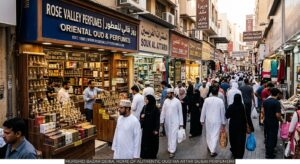
The Role of Family-Run Perfume Houses
A large portion of Dubai’s most respected Oud Ma Attar comes not from large commercial fragrance brands, but from family-run businesses that have operated in the same neighbourhoods for generations. This matters for a few reasons that go beyond simple nostalgia:
- Recipe continuity. Blend ratios and sourcing relationships are often passed down directly, preserving specific scent profiles that would otherwise be lost.
- Direct relationships with agarwood suppliers. Long-standing houses frequently maintain sourcing relationships built over decades, giving them more consistent access to quality raw material even during supply fluctuations.
- In-person expertise. Staff at these establishments are often able to guide a customer through dozens of combinations based on subtle cues – skin type, intended occasion, even the season. If you would rather talk this through directly, reaching out through WhatsApp is usually the fastest way to get a real answer from someone who works with these blends daily.
This is part of why so many long-term Dubai residents remain loyal to a single perfumer for years, rather than switching between brands the way they might with mainstream Western fragrances. You can read more about the people behind this kind of long-standing expertise on our about us page.
Popular Oud Ma Attar Dubai Combinations
Not all Oud Ma Attar blends are created equal, and different combinations suit different personalities, occasions, and climates. Here are the most established pairings you will encounter in Dubai’s fragrance houses.
Oud and Rose Attar
Perhaps the most iconic combination in Gulf perfumery. The rose softens the smokiness of oud, introducing a romantic, slightly powdery sweetness. This pairing is often chosen for:
- Weddings and engagement ceremonies
- Formal evening gatherings
- Gifting to a partner or close family member
Oud and Saffron (Zafaran) Attar
Saffron brings a warm, slightly leathery, honeyed quality that pairs remarkably well with oud’s natural depth. This combination tends to read as:
- Bold and masculine-leaning, though genuinely unisex
- Suited to cooler evenings and winter wear
- A favourite for business and formal daytime settings
Oud and Amber Attar
Amber attar adds resinous warmth and sweetness, often with vanillic or balsamic undertones. This is one of the most versatile pairings because:
- It works well across seasons
- It has broad appeal for both men and women
- It tends to have excellent longevity due to amber’s naturally heavy, slow-evaporating molecules
Oud and Musk Attar
A more animalic, skin-close combination, historically associated with intimacy and comfort. This pairing:
- Reads softer and more personal, with less projection
- Is often preferred for daily wear rather than special occasions
- Works particularly well in warmer months, since musk tends to “bloom” with body heat
Oud and Mukhallat Blends
Some perfumers go further, combining oud with a mukhallat – a multi-ingredient blend that may already contain rose, spices, amber, and musk together. This produces some of the most complex Oud Ma Attar profiles available, often reserved for premium or limited-batch releases and worth exploring in person within the wider perfumes selection.
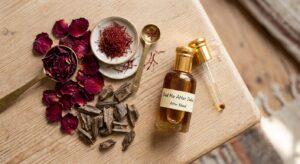
Regional Oud Character and How It Shapes Each Blend
The specific origin of the agarwood used in an Oud Ma Attar has a noticeable effect on the final scent, even when the attar component stays the same:
- Indian (Assam) oud tends toward deep, animalic, barnyard-like notes with significant intensity – often paired with rose or saffron to balance its boldness.
- Cambodian oud is prized for a sweeter, more rounded profile, sometimes described as having notes of dark fruit or honey, making it a natural match for amber attars.
- Malaysian and Indonesian oud frequently carries a smokier, more medicinal character, which some perfumers pair with musk to create a grounded, skin-close finish.
Buyers who are new to oud sometimes assume “oud” is a single, uniform smell. In practice, the region of origin can change the character of a blend as much as the attar choice itself – something worth checking directly against the agarwood and oud range before assuming two bottles with the same combination name will smell identical.
How to Choose the Right Oud Ma Attar Dubai Blend
With so many combinations available, choosing the right one comes down to three practical factors.
1. Match It to the Occasion
- Daily wear: Lighter oud ratio, musk or subtle amber base
- Business meetings: Balanced oud-saffron or oud-amber, moderate projection
- Weddings and celebrations: Bold oud-rose or oud-mukhallat, higher projection
- Religious or reflective settings: Traditional oud with a light attar, understated presence
2. Understand Your Skin Chemistry
Oil-based fragrances interact with skin differently than alcohol-based ones. A few practical points worth knowing:
- Drier skin tends to hold fragrance oils longer but may mute top notes slightly.
- Oilier skin can amplify sweetness and projection but may shorten how the scent evolves over the day.
- Body temperature plays a bigger role with Oud Ma Attar than with sprays, since oils release scent gradually as skin warms.
If possible, test a small amount on your wrist and wait at least 20–30 minutes before judging the fragrance. It almost always smells different in the first five minutes than it does after it has settled.
3. Decide on Concentration Level
Most reputable Dubai perfumers offer the same combination at different concentrations:
- Light concentration: Subtle, ideal for enclosed spaces or sensitive individuals
- Medium concentration: The most common everyday choice
- High concentration: Strong projection, best reserved for outdoor or well-ventilated occasions
Oud Ma Attar Across Dubai’s Seasons
Dubai’s climate plays a genuine role in how Oud Ma Attar performs, and adjusting your choice seasonally can make a noticeable difference to how the fragrance is experienced.
- Summer months: Heat intensifies projection and speeds up how quickly top notes bloom. Lighter concentrations, or musk and rose-forward blends, tend to feel more comfortable in high temperatures without becoming overwhelming.
- Cooler winter evenings: Lower humidity and cooler skin temperatures mean fragrance releases more slowly, letting bolder oud-saffron or oud-amber blends unfold gradually rather than blooming all at once.
- Indoor, air-conditioned settings: Since much of daily life in Dubai happens indoors, moderate concentrations generally perform best.
Keeping two or three different concentrations or combinations on hand – one lighter, one bolder – allows for this kind of seasonal flexibility without needing to build an extensive collection.
How to Apply Oud Ma Attar for Maximum Longevity
Because it is oil-based, application technique matters more here than it does with sprays. A few habits make a measurable difference:
- Apply to pulse points – inner wrists, behind the ears, base of the throat, and inner elbows – where body heat naturally amplifies scent release.
- Use minimal amounts. A single drop per pulse point is typically enough; Oud Ma Attar is concentrated and easily over-applied.
- Avoid rubbing wrists together after application, as friction can break down the oil’s molecular structure and dull the top notes.
- Apply to freshly washed, slightly damp skin for better absorption and longer wear.
- Layer strategically. Some wearers apply a lighter attar first, then a small touch of pure oud oil over it, to build the same effect as a pre-blended Oud Ma Attar with more personal control.

Pairing With Bukhoor
Many in the UAE complement their Oud Ma Attar with bukhoor, the practice of burning scented wood chips in a mabkhara to scent clothing and hair before wearing perfume. A simple version of this ritual looks like:
- Light the charcoal or electric burner and add a small piece of bukhoor
- Pass clothing and hair briefly through the rising smoke
- Wait a few minutes for the smoke to settle into the fabric
- Apply Oud Ma Attar to pulse points as the final layer
This layered approach – bukhoor first, Oud Ma Attar second – is a long-standing Gulf tradition that intensifies and extends the overall scent experience, particularly for special occasions. A traditional mabkhara or incense accessory makes this ritual considerably easier at home.
Layering Oud Ma Attar With Other Fragrances
Some of the most memorable, signature scent combinations in Gulf perfumery culture come from intentional layering, rather than relying on a single bottle alone. A few approaches worth experimenting with:
- Bukhoor, then Oud Ma Attar. As above, scenting clothing and hair with bukhoor smoke before applying Oud Ma Attar creates a richer, more enveloping overall effect.
- A light attar underneath, Oud Ma Attar on top. Applying a subtle rose or amber attar to the torso, then a small amount of Oud Ma Attar to pulse points, can create additional depth without overwhelming intensity.
- Pairing with a complementary body oil. Some wearers use an unscented or very lightly scented body oil as a base layer, which can help extend how long the top notes remain noticeable.
The key principle behind successful layering is restraint. Each layer should be applied sparingly, since Oud Ma Attar is already a concentrated, complex fragrance on its own.
Authenticity: How to Spot Genuine Oud Ma Attar in Dubai
As demand for oud-based fragrances has grown globally, so has the market for synthetic or heavily diluted imitations. Knowing what to look for protects both your money and your experience.
Signs of Genuine Quality
- Complex scent evolution. Real Oud Ma Attar changes character over several hours – opening resinous, settling into its attar notes, and finishing with a warm, skin-close dry-down. Synthetic versions tend to smell flat and unchanging throughout.
- No harsh chemical sting. Genuine oud has a rich, sometimes barnyard-like or smoky depth, but it should not smell sharp or artificial on first application.
- Appropriate pricing for ingredients. Genuine oud is a genuinely expensive raw material. A price that seems far too low for the stated oud content is a red flag.
- Willingness to test. Reputable perfumers will always let you test on skin, not just on a paper strip, since oil-based fragrances behave differently on each person.
CITES and Sustainability
Agarwood-producing trees are protected under CITES (the Convention on International Trade in Endangered Species), because unsustainable harvesting has placed pressure on wild agarwood populations. When buying oud or Oud Ma Attar, particularly for international travel:
- Ask whether the oud is sustainably sourced or plantation-grown
- Understand that cross-border travel with oud oil may require documentation in some cases, particularly for larger quantities
- Favour retailers who are transparent about sourcing, rather than vague about origin
Simple Tests You Can Do Yourself
While nothing replaces the judgement of an experienced perfumer, there are a few basic checks any buyer can perform before committing to a purchase:
- The evaporation test. Apply a small amount to skin and observe how it changes over two to three hours. Genuine Oud Ma Attar should shift noticeably in character, not simply fade evenly like many synthetic oils do.
- The colour consistency check. Natural variation is normal, but dramatic, unexplained colour shifts between batches can sometimes indicate inconsistent sourcing.
- The price-per-gram sanity check. If a bottle claims a high percentage of rare Cambodian or Indian oud but costs a fraction of what comparable products sell for elsewhere, treat that as a signal to ask more questions rather than an unexpected bargain.
If you are ever unsure about a specific bottle, it is worth getting in touch directly with questions before buying – a genuine perfumer will always be happy to explain exactly what is in a blend.
Price Ranges and What Affects the Cost of Oud Ma Attar Dubai Blends
Prices for Oud Ma Attar vary widely, and understanding why helps set realistic expectations. Key factors that influence price:
- Oud origin. Wild Cambodian or aged Indian agarwood oils command significantly higher prices than farmed or younger-tree oils from other regions.
- Oud-to-attar ratio. A blend with a higher proportion of oud will cost more than one where attar dominates.
- Attar quality. Genuine Taif rose or true saffron attar costs considerably more than synthetic floral or spice substitutes.
- Batch age and maturation. Blends that have been allowed to mature for weeks or months often carry a premium, reflecting the added production time.
- Bottle size and concentration. Naturally, smaller bottles of a highly concentrated blend can cost more per millilitre than larger bottles of a lighter version.
As a general guide, entry-level Oud Ma Attar blends are considerably more accessible than pure high-grade Dehnal Oud, making this category a practical way to experience authentic oud character without the cost of a single-note premium oil. Browsing the full shop is the easiest way to compare sizes and concentrations side by side.
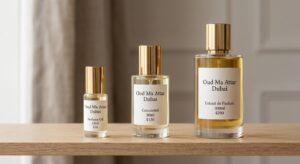
Storage, Shelf Life, and Travelling With Oud Ma Attar
Proper storage significantly extends how long a bottle retains its quality:
- Keep away from direct sunlight and heat, which can degrade both the oud and attar components over time.
- Store bottles upright to prevent oil from seeping into the cap mechanism.
- Keep the cap tightly sealed between uses to limit oxidation.
- Avoid extreme temperature fluctuations, such as leaving a bottle in a hot car – a genuine risk in Dubai’s climate.
When stored correctly, high-quality Oud Ma Attar can maintain its character for several years, and in some cases, like fine wine, the oud component may deepen and mellow further with age.
Traveling With Oud Ma Attar
Many visitors to Dubai choose to bring a bottle home, and a few practical points can help avoid complications:
- Check airline liquid restrictions for carry-on luggage, since Oud Ma Attar, like any liquid, is subject to standard volume limits in cabin baggage.
- Keep bottles well-sealed and upright inside checked luggage, ideally wrapped to prevent leakage from affecting other items.
- Retain proof of purchase, particularly for higher-value bottles, in case of customs questions in your destination country.
- Ask your retailer about export documentation if you are purchasing a large quantity or a particularly high-value bottle containing rare agarwood.
Most travelers bringing home a single bottle for personal use encounter no issues whatsoever, but a little preparation avoids any unnecessary complications at the airport.
Oud Ma Attar in Dubai’s Gifting Culture
Fragrance holds a central place in Emirati hospitality, and Oud Ma Attar in particular carries cultural weight that goes beyond simple scent preference. Common gifting occasions include:
- Weddings, where oud-rose blends are traditionally exchanged between families
- Eid celebrations, often alongside bukhoor and dates as part of a broader gift set
- Business relationships, where a well-chosen Oud Ma Attar signals respect and thoughtfulness
- Housewarmings, paired with a mabkhara for burning bukhoor in a new home
When selecting a gift, a balanced, moderately projecting blend – such as oud with amber or oud with a light rose – tends to suit the widest range of recipients, since it avoids being too subtle or overwhelmingly strong for someone whose preferences you may not know in detail.
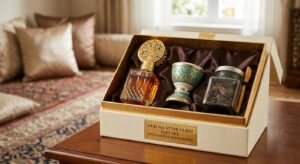
Presentation Matters as Much as the Scent Itself
In Gulf gifting culture, how a fragrance is presented is treated with nearly as much care as the fragrance itself. A few conventions are worth knowing:
- Ornate glass or crystal bottles are commonly chosen over plain packaging for gifting purposes, reflecting the value placed on the item inside.
- Pairing with bukhoor and a small mabkhara is a traditional and well-received combination, particularly for housewarming or wedding gifts.
- Wrapping and presentation boxes matter considerably, and are worth asking about at the time of purchase.
- Avoid overly personal or unusual combinations for gifts intended for acquaintances or business contacts, since more universally appealing blends are generally the safer choice.
If you are choosing a gift and want a second opinion, reaching out over WhatsApp with the occasion and recipient in mind usually gets you a quick, practical recommendation.
Common Mistakes to Avoid When Buying Oud Ma Attar Dubai Blends
Even experienced fragrance buyers make a few recurring errors when it comes to Oud Ma Attar:
- Judging the scent too quickly. Oil-based fragrances need time to develop; the first two minutes rarely represent the final character.
- Over-applying. More is not better with concentrated oils – a little genuinely goes a long way.
- Ignoring skin testing. Paper strip testing alone can be misleading, since attars and ouds interact differently with individual body chemistry.
- Assuming darker colour means higher quality. Colour can vary due to the specific agarwood source or attar used, and is not a reliable quality indicator on its own.
- Buying based on price alone. Extremely cheap “Oud Ma Attar” is very often diluted or entirely synthetic, particularly outside verified retailers.
- Storing bottles incorrectly. Leaving a bottle in direct sunlight, a hot car, or a humid bathroom cabinet can noticeably shorten its usable life and dull its complexity over time.
- Expecting identical results every time. Because oud is a natural material, subtle batch-to-batch variation is normal, even within the same combination from the same trusted perfumer – it is a sign of authenticity, not a flaw. If a bottle ever seems off, it is always worth asking directly rather than assuming the worst.
Final Thoughts on Oud Ma Attar Dubai
Oud Ma Attar represents something that pure single-note fragrances often cannot: a genuine dialogue between two of Arabian perfumery’s most important traditions. To recap the essentials before you buy:
- Understand the blend – know which attar (rose, saffron, amber, or musk) is paired with the oud.
- Match it to your occasion and season – lighter for daily wear, bolder for weddings and winter evenings.
- Test before you commit – on skin, not paper, and give it 20–30 minutes to develop.
- Check for authenticity signs – scent evolution, appropriate pricing, and a seller willing to explain sourcing.
- Store and apply it correctly – pulse points, minimal amounts, away from heat and sunlight.
Whether you are drawn to a rose-forward blend for its romance, a saffron pairing for its warmth, or an amber combination for its versatility, understanding how these fragrances are made – and how to judge their authenticity – puts you in a far better position to choose a bottle that will genuinely reward you over months and years of wear, not just the first ten minutes on a testing strip.
For those exploring this category further, browsing a dedicated selection of agarwood and oud fragrances or comparing options within Dehnal Oud blends offers a practical way to compare concentrations and combinations side by side before committing to a bottle.
Building Your Own Oud Ma Attar Collection Over Time
For those who develop a genuine interest in this category, it rarely stops at a single bottle. Many long-term enthusiasts gradually build a small, curated collection over months or years, following a similar path:
- Start with one balanced, versatile blend – often an oud-amber or oud-rose combination – that can be worn across most occasions while you learn how it develops on your own skin.
- Add a bolder, special-occasion blend once you understand your baseline preferences, such as a saffron or mukhallat-based Oud Ma Attar reserved for weddings or formal events.
- Introduce a lighter, everyday option last, once you have a clearer sense of which attar profiles genuinely suit you.
This gradual, experience-led approach mirrors exactly how many Dubai locals build their own personal fragrance wardrobes. Visiting the full perfumes collection remains the most reliable way to compare blends side by side, and if you have any questions along the way, our contact page is always open.
Frequently Asked Questions
What is Oud Ma Attar?
Oud Ma Attar is an oil-based fragrance made by blending pure agarwood (oud) oil with a traditional attar, such as rose, saffron, amber, or musk, into one combined scent.
Is Oud Ma Attar the same as pure oud oil?
No. Pure oud oil contains only agarwood distillate, while Oud Ma Attar blends oud with a second attar ingredient for a softer, more layered scent.
How long does Oud Ma Attar last?
A genuine Oud Ma Attar typically lasts 8 to 12 hours on skin, thanks to its oil base and slow-evaporating natural ingredients.
Is Oud Ma Attar suitable for daily use?
Yes. Lighter concentrations, especially musk or amber-based blends, are well suited to everyday wear, while bolder blends suit special occasions.
How can I tell if Oud Ma Attar is authentic?
Genuine Oud Ma Attar evolves in scent over several hours rather than smelling flat, has no harsh chemical sting, and the seller will let you test it on skin.
What is the price range for Oud Ma Attar in Dubai?
Prices vary based on oud origin, attar quality, and concentration, ranging from affordable everyday blends to premium bottles made with rare aged agarwood.
Can men and women both wear Oud Ma Attar?
Yes. Oud Ma Attar is largely unisex, with rose, amber, and musk blends worn widely by both men and women across the Gulf region.
How should Oud Ma Attar be applied?
Apply a small amount to pulse points such as the wrists, neck, and behind the ears, and allow 20 to 30 minutes for the scent to fully develop.