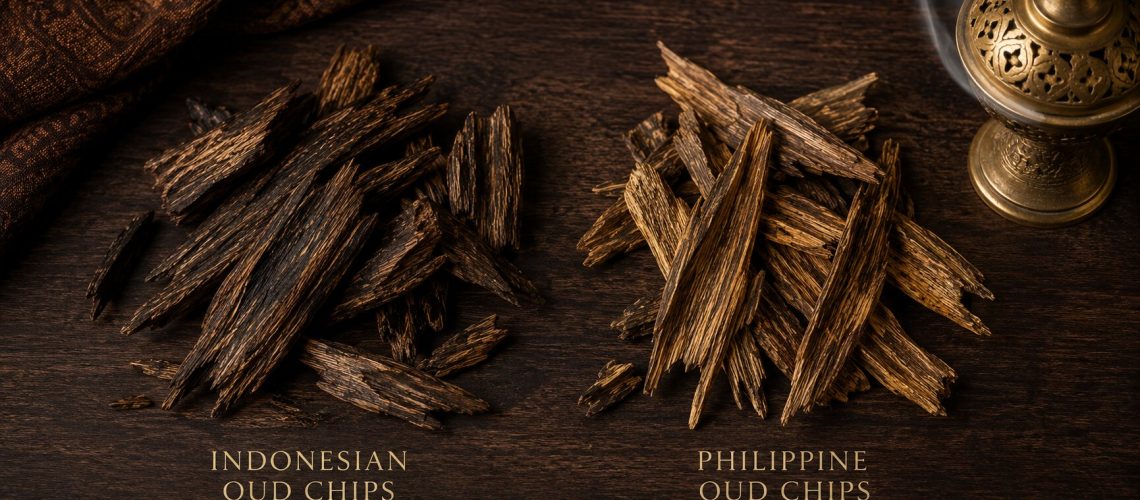
a soft, honeyed sweetness wrapped in creamy balsamic depth, soft leather, and a refined, quiet smoke. Indonesia offers wide availability and dependable quality across several islands, while the Philippines produces one of the rarest and most expensive agarwoods in the world because of strict harvesting limits and a shrinking supply of old, resin-rich trees.
- Choose Indonesian oud if you want an accessible, versatile everyday oud with a green, earthy character and dependable availability.
- Choose Philippine oud if you want a rare, archival-grade piece with a sweet, creamy, refined profile worth building a collection around.
- Buy both over time if you’re a serious collector – the full reasoning, regional breakdown, and buying framework are explained in detail below.
Both origins are treasured for the same underlying reason. People have chased agarwood for well over a thousand years because of its depth, its complexity, and the way it keeps changing the longer you sit with it. Once you smell Indonesian and Philippine oud side by side, the differences are impossible to miss, and this guide is built to walk you through every part of that comparison rather than stop at surface-level scent notes.
What Is Oud, and Why Does Origin Change Its Scent?
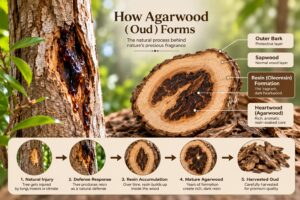
Oud, agarwood, and aloeswood all refer to the same material – the dark, fragrant resin that forms inside certain Aquilaria and Gyrinops trees after the tree is wounded or infected. This article uses all three terms interchangeably, exactly as traders and collectors do.
The resin itself is not a fixed substance. It forms as a defence response, and several factors shape how it develops chemically:
- The specific fungal strain involved in the infection.
- The age of the tree at the time of infection.
- The surrounding soil composition and mineral content.
- Local humidity, rainfall, and altitude.
- How long the resin is left to mature inside the tree before harvest.
Two trees of a similar species growing a few hundred kilometres apart can produce noticeably different oud, because the infection process and the surrounding environment are never identical. That is the real reason Indonesian oud vs Philippine oud smell so different from each other. It is not branding or marketing. It is biology responding to two very different environments.
The Chemistry Behind the Scent Difference
This is a detail most articles on this topic skip entirely, yet it explains almost everything about why oud smells the way it does. Agarwood’s aroma comes primarily from two chemical families: sesquiterpenoids, which give agarwood its woody, spicy, and earthy character, and chromones – specifically a compound called 2-(2-phenylethyl) chromone – which is largely responsible for the lasting, complex aroma released when agarwood is burned or heated. Researchers studying agarwood chemistry have identified specific compounds tied to specific smells, and the exact ratio of these compounds in a given piece of agarwood depends entirely on the tree’s species, its infection history, and its growing environment.
- Alpha-bulnesene and delta-guaiene contribute a woody note.
- Elemol and hinesol bring a spicier character.
- Alpha-guaiene adds a fuller, fatty richness.
- Viridiflorol contributes a subtle, fruity edge.
- 2-(2-phenylethyl) chromone drives the lasting aroma when burned.
In practical terms, this means the green, herbaceous quality collectors associate with Indonesian oud and the honeyed, creamy quality associated with Philippine oud are not just subjective impressions. They correspond to genuinely different underlying chemical profiles, shaped by two very different island ecosystems, which is exactly why the regional differences discussed throughout this guide are consistent and repeatable rather than a matter of personal taste.
Indonesian Oud – Profile, Regions, and Sourcing
Indonesian oud tends to open green and slightly damp, like forest floor after rain, with a herbaceous, almost medicinal edge and a woody, resinous base. It is one of the most widely produced and traded oud origins in the world, largely because Indonesia’s geography supports it – a sprawling archipelago of more than seventeen thousand islands means the country hosts far more growing microclimates than most other producing nations.
Botanical Source
Most Indonesian agarwood comes from Aquilaria filaria and Aquilaria microcarpa, though the country is genuinely unusual in how many resin-producing species it hosts across its islands.
- Aquilaria filaria, common across several central and eastern islands.
- Aquilaria microcarpa, widespread across Kalimantan and Sumatra.
- Several Gyrinops species, found predominantly in Indonesia’s eastern islands, including parts of Papua and the smaller Nusa Tenggara islands.
Geographic Regions and Their Distinct Profiles
Indonesian oud is really a category with several sub-personalities inside it, not one single scent. Buyers who only ask for “Indonesian oud” without specifying a region are leaving quality and character almost entirely up to the seller, which is why experienced collectors always ask for the island of origin before anything else.

- Kalimantan (Borneo). Dry, herbaceous, and balsamic-woody, with a grassy, slightly medicinal opening that settles into a cinnamon-like spice and a long, earthy base. Considered one of the more complex and collectible Indonesian profiles.
- Papua and Merauke. Wilder and more intense than Kalimantan, with a jungly, deeply earthy character and medicinal, almost truffle-like undertones.
- Sumatra. Comparatively softer and rounder than Kalimantan, with less of the sharp green edge – a profile that receives far less attention in most oud writing.
- Sumbawa and Lombok, in the Nusa Tenggara island chain. Smaller-volume regions producing both wild and artisanal grades, often prized by specialist collectors.
Within the trade itself, Kalimantan wood is further broken down into named sub-varieties such as Malino, Pontianak, Tiger Pontianak, and Ant Nest Pontianak – terms worth recognising when dealing with specialist traders.
Overall Scent Signature
Burn a piece of Indonesian oud chip and it often smells close to raw agarwood incense itself. That is part of the appeal. It does not feel manufactured or polished. It feels like the source material, which is exactly why so many perfumers reach for it as a base note rather than trying to disguise it.
- Opening character: green, moist, and woody, with a slightly herbaceous edge that reads more like a forest than a finished perfume.
- Overall impression: closer to raw incense than to a refined, blended fragrance.
- Comparative accessibility: more approachable to Western noses than the deep, barnyard-style profile associated with some Indian ouds.
- Best suited for: collectors moving from commercial fragrance into serious niche perfumery.
Why Collectors Choose Indonesian Oud
- Variety – multiple islands and species mean real choice between dry, wild, or soft profiles.
- Consistency – established supply chains keep quality dependable between batches.
- Value – genuine quality is available without needing a specialist’s budget.
- Blending versatility – a common base in attars and mukhallats.
- A gentle learning curve – one of the easiest origins for a new collector to appreciate quickly.
Anyone building a starting collection of raw agarwood and attars will find the range easiest to explore through a dedicated agarwood and oud selection.
Philippine Oud – Profile, Rarity, and Collector Status
Philippine oud sits at the opposite end of the spectrum from Indonesia’s green intensity. Where Indonesian oud smells like raw incense, Philippine oud smells refined – soft, sweet, and quiet, like something that has already been polished by time.

Botanical Source and Scarcity Drivers
The Philippines is home to at least eight recognised Aquilaria species, six of which are found nowhere else, according to the country’s Department of Environment and Natural Resources. Several factors combine to make genuine Philippine oud one of the scarcest agarwoods on the planet:
- Slow resin formation. A tree can take upward of two decades to develop resin worth harvesting.
- Decades of unregulated wild collection. Historical harvesting has already reduced the pool of mature, resin-bearing trees.
- Legal restriction. Harvesting and trading wild Philippine agarwood without a government permit is illegal under Republic Act 9147.
- International controls. Every Aquilaria and Gyrinops species has been listed under CITES Appendix II since 2005.
- Limited cultivation success. No Philippine farm has yet matched wild-resin quality at scale.
In practical terms, this means legitimate Philippine oud reaching the international market has already passed through export permits, non-detriment findings, and CITES documentation. That is real regulatory friction that Indonesian oud, produced in far greater volume, does not face to the same degree, and it is the single biggest reason the two origins sit so far apart on price.
Scent Signature and How It Evolves
- Opening: honeyed sweetness, immediately soft rather than sharp.
- Middle: creamy, balsamic depth begins to surface, often paired with a gentle warmth.
- Base: soft leather and a quiet, resinous smoke that never turns sharp or medicinal.
On skin, as an oil or attar, that opening sweetness settles into something deeper and slightly resinous over the following hour – part of why collectors treat it as a scent worth sitting with rather than judging in the first few minutes.
Why It Is Considered the Collector’s Holy Grail
Rarity and price move together here in a very direct way. Wild-harvested, high-grade agarwood can fetch extraordinary prices on the global market once quality and provenance are confirmed, and documented reporting on the Philippine trade has cited premium-grade agarwood reaching valuations in the tens of thousands of dollars per kilogram at the top end.
- That price ceiling exists because supply is genuinely constrained, not because of clever marketing.
- Nearly everything of real quality still comes from old-growth wild trees under legal protection.
- Owning a confirmed piece is closer to owning a rare vintage than making a routine purchase.
- Because cultivation hasn’t caught up with wild quality, this scarcity is unlikely to ease soon.
A Brief Cultural and Historical Context Most Articles Skip
Understanding why collectors care so much about origin in the first place helps explain the entire market around Indonesian and Philippine oud.
- Oud has been traded along maritime routes connecting Southeast Asia to the Arabian Peninsula, India, and East Asia for well over a thousand years, long before modern shipping or CITES regulation existed.
- In Arabian culture specifically, oud and bukhoor are tied to hospitality, worship, and major life events such as weddings, guest visits, and religious occasions, which is part of why origin and quality carry so much social weight, not just personal preference.
- Traders in Dubai and across the Gulf built entire reputations on being able to source specific regional profiles – the same instinct that drives today’s collectors to specify Kalimantan over generic Indonesian oud, or genuine Philippine oud over a vague, unverified origin claim.
- As wild sources across South and Southeast Asia have come under increasing regulatory protection, the trade has gradually shifted its attention toward Indonesia’s scale and diversity, and the Philippines’ extreme scarcity, as two very different answers to the same underlying demand.
It is also worth noting that neither origin’s reputation formed overnight. Indonesia’s position as a dependable, high-volume source developed over decades of steady export activity across multiple islands, while the Philippines’ reputation for scarcity is a far more recent development, shaped largely by regulatory tightening over the past two decades rather than by any change in the underlying quality of the wood itself. It’s the same instinct that has shaped Rose Valley’s own history in Dubai’s oud trade since 1990, where knowing a piece’s origin has always mattered as much as the scent itself.
Indonesian Oud vs Philippine Oud – Full Comparison Table
| Feature | Indonesian Oud | Philippine Oud |
| Primary Scent Notes | Green, mossy, earthy, camphoraceous | Honeyed, creamy balsamic, soft leather |
| Smoke Character | Resinous, herbaceous, close to raw burning wood | Smooth, delicately sweet, tranquil |
| Scent Evolution | Fairly stable from first burn to last | Opens sweet, deepens into resin and leather over time |
| Availability & Rarity | Widely available across several islands | Extremely rare and tightly export-restricted |
| Legal Sourcing Complexity | Moderate, standard CITES documentation | High, plus Philippine wildlife permits |
| Market Position | Reliable staple with strong value | Premium holy grail with a high price ceiling |
| Aging Potential | Stable, moderate development over years | Develops noticeably deeper complexity with age |
| Best Use Case | Bukhoor burning, blending, everyday wear | Attar wearing, archival and gift-grade collecting |
| Ideal Collector Profile | Beginners and everyday wearers | Serious collectors and investors |

How Do These Two Origins Compare to Other Major Oud-Producing Countries?
Most comparison articles stop at Indonesia and the Philippines, but a collector’s understanding of these two origins is genuinely sharper once you can place them against the other major producing countries.
Versus Indian Oud
- Indian oud, particularly from regions associated with a heavier, animalic style, tends to be deeper and more intense than either Indonesian or Philippine oud.
- Indonesian oud is often a gentler, more approachable middle ground for collectors who find classic Indian oud too heavy at first.
- Philippine oud shares almost nothing in common with heavy Indian styles – its sweetness and restraint make it a completely different experience.
Versus Cambodian Oud
- Cambodian oud is generally sweeter and warmer than most Indonesian regions, sitting closer to Philippine oud in overall character, though still distinct from it.
- Where Cambodian oud leans toward a rounder, more general sweetness, Philippine oud brings a more delicate, honeyed quality alongside its leather note.
Versus Malaysian Oud
- Malaysian oud, largely sourced from Aquilaria malaccensis, often sits between Indonesian and Indian profiles, with a resinous, slightly sweeter character than typical Kalimantan wood.
- Indonesia and Malaysia share overlapping species, which is part of why some traders describe Kalimantan oud as a bridge between Malaysian and true Indonesian island profiles.
Why This Broader View Matters
- It helps you describe what you actually want to a seller, rather than relying only on a country name.
- It clarifies that rarity and price are driven by regulation and tree availability as much as by scent quality.
- It positions Indonesian oud correctly as the most versatile entry point into serious oud collecting, precisely because it sits in the middle of the wider spectrum rather than at either extreme.
How Is Oud Actually Graded in the Trade?
Grading is one of the most confusing parts of buying oud for newer collectors, mainly because there is no single universal standard used across every origin and every trader. Terms like “super grade” or “royal grade” are used inconsistently between sellers, which means the label alone tells you very little without understanding the criteria behind it. That said, most legitimate sellers assess quality against a similar set of criteria.
- Resin density – higher resin content generally means a heavier, darker piece and a richer scent.
- Wild versus cultivated origin – wild-harvested resin is almost always graded above plantation-grown material.
- Colour and marbling – darker, more evenly marbled wood typically signals a longer, more complete resin formation.
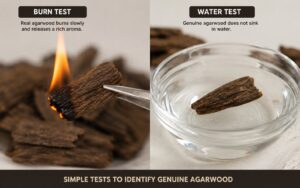
- Water sink test – higher-grade agarwood is dense enough to sink or partially sink in water.
- Scent complexity on burning – graders assess how the aroma develops across the burn, not just the first few seconds.
- Age of the resin – aged agarwood and aged oud oil are typically graded higher than freshly distilled material.
This is exactly why buying from a catalogue that lists grade and origin clearly matters more than chasing the lowest price available.
How Much Do Indonesian and Philippine Oud Cost?
Oud pricing almost never follows a clean formula, and anyone who gives you a single fixed number for either origin without asking about grade, age, and distillation method is not giving you the full picture. What follows are realistic price bands rather than fixed quotes, since the same origin can span a huge range depending on how it was harvested and processed.
Indonesian Oud Pricing
- Entry-level chips and commercial-grade oils are priced accessibly, often by the gram.
- Wholesale Kalimantan oud oil has been priced by the tola (roughly 11.66 grams) in the low hundreds of dollars for commercial-grade material.
- Rare, aged, wild single-origin oils from regions like Kalimantan or Papua can run into the thousands of dollars for a small bottle.
Buyers looking for distilled oil rather than raw chips typically search for Dehnal Oud, the term commonly used across the Gulf for pure agarwood oil, whether Indonesian, Philippine, or another origin.
Philippine Oud Pricing
- Documented trade research has recorded general agarwood prices ranging from roughly forty thousand to three hundred thousand Philippine pesos per kilogram, depending on grade.
- Government sources on premium, wild-harvested grades have pointed to figures reaching tens of thousands of US dollars per kilogram for the very top quality.
What Actually Moves the Price
- Wild-harvested versus cultivated – wild resin from mature trees is consistently valued higher.
- Distillation method – hydro-distilled oils extracted slowly typically cost more and smell richer.
- Age of the resin and oil – both origins develop more depth over time.
- Grade and hand-selection – hand-sorted, high-resin chips always outprice mixed-grade material.
- Documentation and legal sourcing – fully permitted, traceable stock commands a premium, especially for Philippine oud.
How Can You Tell If Oud Is Authentic? A Step-by-Step Check
With prices this high, especially for Philippine oud, knowing how to verify authenticity matters as much as knowing what it should smell like. Work through these checks in order before any serious purchase, rather than relying on a single test in isolation.
- Check the visual density. Genuine high-grade chips feel heavy for their size, with visible dark resin marbled through the wood.
- Run the water test where possible. Higher-resin pieces tend to sink or sit low in water.
- Do a small burn test. Genuine oud releases a complex, layered smoke that shifts character as it burns.
- Assess oil viscosity and behaviour on skin. Genuine oud oil tends to be thick and slow-moving, evolving over the first hour.
- Ask for provenance and paperwork. For Philippine oud specifically, ask for evidence of legal sourcing.
- Treat unusually low prices as a warning sign, not a bargain.
- Buy from sellers who are transparent about grade and region.
Is Oud a Good Investment? What Collectors Should Realistically Expect
Serious collectors increasingly talk about rare oud, and Philippine oud in particular, in the same language used for fine watches or vintage wine. That comparison is useful, but it is worth grounding in realistic expectations rather than treating oud purely as a speculative asset.
- Scarcity supports long-term value, but liquidity is limited. There is no centralised exchange for reselling rare oud.
- Provenance drives resale value more than almost anything else.
- Condition and storage directly affect resale value.
- Indonesian oud is a poor speculative asset but a strong practical one – its value lies in everyday enjoyment rather than appreciation.
- Philippine oud’s investment case rests almost entirely on continued scarcity.
If you’re weighing a higher-value purchase, it’s worth speaking with our team directly before committing, particularly for rarer Philippine pieces.
Are Indonesian and Philippine Oud Sustainably Sourced?
Every Aquilaria and Gyrinops species has been listed under CITES Appendix II since 2005, which means legitimate international trade in both Indonesian and Philippine oud requires export permits and evidence that the trade will not harm wild populations.
- In the Philippines specifically, wild harvesting without a government permit is illegal under Republic Act 9147.
- Conservation groups have documented ongoing illegal collection pressuring the country’s remaining wild Aquilaria stands, particularly across the Bicol Peninsula, Eastern Visayas, and Mindanao.
- Indonesia’s larger, more established trade faces less acute pressure, but the same CITES framework still applies to every shipment that crosses a border.
- Efforts to develop regulated Philippine agarwood cultivation, through mechanisms such as Wildlife Culture Permits, aim to ease pressure on wild trees over time, though the industry is still in an early stage.
For a collector, this is a practical detail rather than a footnote. You can read more about how we approach sourcing on our about us page.
Where Buyers in Dubai Typically Source Indonesian and Philippine Oud
Dubai has long been one of the world’s most established markets for genuine Arabian perfumery, and this exact comparison comes up constantly among buyers browsing the city’s oud houses. Deira’s Murshid Bazar area in particular has functioned as a trading hub for agarwood, Dehnal Oud, and bukhoor for decades, with generations of traders building reputations on being able to source specific regional profiles rather than generic, unlabelled stock.
- Buyers shopping in person tend to favour Deira for the ability to smell wood and oil side by side before committing.
- Online buyers across the UAE increasingly look for sellers who list clear regional origin, grade, and sourcing details.
- Whether shopping in Deira or browsing online, the same fundamentals apply: ask about origin, ask about grade, and ask how the piece was sourced.
If you’re based in Dubai or shopping from elsewhere in the UAE, our two branches in Murshid Bazar, Deira, along with our online catalogue, carry a full range of Indonesian regional profiles alongside genuine Philippine and other rare origins.

Which Oud Is Right for You? A Decision Framework
Rather than treating this as a single either-or choice, it helps to match the origin to the actual use case in front of you.
- New to oud collecting? Start with Indonesian oud – accessible, versatile, and a genuine introduction without specialist-level spending.
- Building an archival or investment-grade collection? Prioritise Philippine oud – its scarcity means genuine pieces are unlikely to become easier to find.
- Daily attar wear? Reach for Philippine oud if you’re drawn to sweetness, or Indonesian oud if you prefer a greener, earthier character.
- Bukhoor and home fragrance? Indonesian oud generally performs better for room-filling scent.
- Gifting for special occasions? Philippine oud carries more prestige specifically because of its rarity.
- Blending and mukhallat creation? Indonesian oud’s versatility makes it the more practical base.
How to Wear or Burn Each Type for Best Results
Attar Application Tips
Both origins are potent in attar or pure oil form, so a light hand goes further than most new wearers expect.
- Start with a single small dot of oil, no larger than a grain of rice.
- Apply to pulse points – inner wrists, behind the ears, base of the throat.
- Avoid rubbing wrists together after application.
- Give the scent fifteen to twenty minutes before judging it.
Bukhoor Burning Tips
- Use a small, controlled piece of charcoal rather than a large one.
- Let the bukhoor smoulder on top of the charcoal rather than sitting in an open flame.
- Keep the room ventilated, particularly with Indonesian oud.
- Reserve rarer Philippine bukhoor for smaller, more intimate settings.
If you don’t already own a proper burner, a good bukhoor and oud muatter setup, along with the right accessories, makes a noticeable difference.
Blending Suggestions
- Indonesian oud’s green intensity works well cut with lighter woods.
- Philippine oud pairs beautifully with rose or amber attars.
- Avoid blending two strong oud profiles together without testing first.
Building a Collection: Practical Steps for Getting Started
Collectors who get the most long-term value out of oud tend to follow a similar approach, regardless of budget. The pattern below applies whether you are spending fifty dollars on a first sampler or several thousand on an archival Philippine piece.
- Start with a small sampler of different Indonesian regional profiles before spending heavily on any single origin.
- Keep a simple log of what you’ve tried, including origin, grade, and your own impressions.
- Store raw chips in an airtight container, away from direct sunlight and humidity.
- Store oud oils upright, tightly sealed, and away from direct light.
- Only move toward Philippine oud once you’re confident judging quality and authenticity.
- Buy from sellers willing to answer detailed questions about origin, grade, and sourcing.
None of this needs to happen quickly. A well-built oud collection is typically assembled over years rather than months, and the collectors who enjoy it most tend to be the ones who treated the early stages as genuine learning rather than a race to acquire the rarest piece possible.

Common Mistakes Collectors Make With These Two Origins
A number of avoidable mistakes come up repeatedly, whether someone is buying their first piece of oud or their fiftieth.
- Assuming country of origin alone guarantees quality.
- Judging a scent too quickly, before it has had time to evolve.
- Overpaying for vague “rare” labelling without documentation.
- Storing oud carelessly, exposed to humidity or direct sunlight.
- Jumping straight to Philippine oud before learning to judge quality.
- Ignoring legal sourcing questions.
- Over-blending rare material instead of letting it stand on its own.
If you’re ever unsure about a piece before buying, it’s always worth messaging us on WhatsApp with a photo and a few questions rather than guessing.
A Quick Glossary for New Collectors
| Term | What It Means |
| Aquilaria | The genus of tree that produces agarwood resin after injury or infection. |
| Gyrinops | A related genus, common in eastern Indonesia, that also produces fragrant resin. |
| Bukhoor | Wood chips soaked or treated with fragrance oils, burned as household incense. |
| Attar | A concentrated, oil-based perfume, traditionally alcohol-free. |
| Tola | A traditional unit of weight in the oud trade, equal to roughly 11.66 grams. |
| CITES | An international treaty regulating trade in species at risk of overexploitation. |
| Non-Detriment Finding | A formal assessment confirming a trade will not harm a wild population. |
| Distillation Grade | A classification based on how an oil was extracted and how pure it is. |
Frequently Asked Questions
What is the difference between Indonesian and Philippine oud?
Indonesian oud is green, earthy, and smoky, while Philippine oud is sweeter, creamier, and more refined. Indonesian oud is also far more widely available.
Which oud is more expensive, Indonesian or Philippine?
Philippine oud is significantly more expensive, reflecting genuine scarcity and strict harvesting laws.
Why is Philippine oud so rare?
Wild harvesting is tightly regulated, resin takes decades to form, and no cultivated alternative has matched wild quality yet.
What does Indonesian oud smell like?
Green, damp, and woody, often compared to a forest floor after rain, with a smoky, resinous finish.
Is it legal to buy Philippine oud?
Yes, provided it’s sourced through a seller who can show proper permits and legal documentation.
Which oud is best for beginners?
Indonesian oud – more affordable, widely available, and easier to appreciate early on.
How can you tell if oud is real or fake?
Genuine oud feels dense, smells layered rather than flat as it burns, and evolves noticeably on skin.
What is Kalimantan oud known for?
A dry, herbaceous, balsamic-woody profile considered one of the more complex Indonesian expressions.
Can you wear oud oil directly on skin?
Yes, traditionally applied to pulse points in small amounts, since it’s highly concentrated.
How should you store agarwood chips?
In an airtight container away from sunlight and humidity – moisture and heat are the biggest threats.
Does Indonesian oud age as well as Philippine oud?
Indonesian oud is generally more stable over time, developing gradually, while Philippine oud tends to show a more noticeable deepening of complexity with age.
Can Indonesian and Philippine oud be blended together?
Yes, but carefully. Because the two profiles sit at opposite ends of the spectrum, small test batches are the safest way to find a balance that actually works.
Final Thoughts – Building a Well-Rounded Oud Collection
Indonesian and Philippine oud aren’t really competing for the same spot in a collection. They’re answering two different questions. One gives you range, accessibility, and a dependable everyday character. The other gives you scarcity, refinement, and a scent that’s genuinely difficult to obtain through legal channels. Weighing Indonesian oud vs Philippine oud is ultimately less about which is superior and more about which story you want in your collection. Most serious collectors end up wanting both, not because one is a compromise, but because the contrast between them is exactly what makes a collection interesting.
- Choose Indonesian oud for accessibility, variety, and everyday versatility.
- Choose Philippine oud for rarity, refinement, and long-term collectible value.
- Always verify grade, origin, and legal sourcing before paying a premium price.
- Store both origins properly to protect their scent and their resale value over time.
If you’re ready to start exploring either profile, you can browse our full range of raw agarwood and oud, visit our shop for the wider catalogue, or get in touch or message us on WhatsApp if you’d like guidance on choosing a piece suited to your collection.