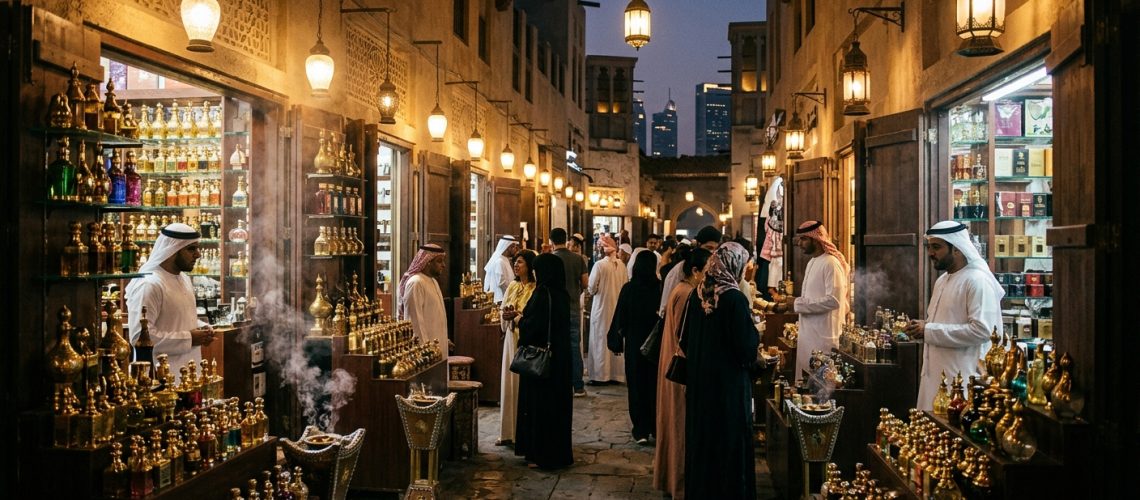
Walk through any souq in Dubai at dusk, and the air itself will tell you something no guidebook can. Oud smoke curls from a brass mabkhara outside a shopfront. A saffron-and-rose blend drifts from an open perfumery door. Somewhere behind a glass counter, a perfumer is pressing a testing strip into your hand before you’ve even said a word.
This is not marketing. This is muscle memory, built over centuries.
If you have ever typed “why is Dubai the perfume capital of the world” into a search bar, you already sense the answer lies somewhere between history, trade, and culture. You are right. Dubai did not earn its reputation as the perfume capital of the world by accident or by tourism-board decree. It earned the title through a thousand years of trade routes, a desert culture that treats scent as identity, and a modern economy built to move rare ingredients across the globe faster than anywhere else on Earth.
We have watched this story unfold from inside two shopfronts in Dubai’s Deira district, in the historic Murshid Bazar area, since 1990. We have sold oud to third-generation collectors and to first-time visitors who didn’t know attar from alcohol-based perfume. We have restocked saffron-laced mukhallats during Ramadan rushes and shipped oud chips to customers who found us because nowhere else could source what they needed. This article is written from that vantage point, a working account of why Dubai deserves its place as the world’s perfume capital, and what that means for anyone who loves fragrance.
Why Dubai Is Considered the Perfume Capital of The World
Before going deep into the history, here is the direct answer for anyone short on time.
Dubai is widely regarded as the perfume capital of the world because it combines:
- A centuries-old trade legacy as the meeting point between the incense routes of Arabia, the spice routes of India, and the oud forests of Southeast Asia.
- Cultural devotion to scent, where fragrance is tied to hospitality, identity, religion, and daily ritual, not treated as an occasional luxury.
- Unmatched access to rare raw materials, particularly agarwood (oud), Taifi roses, ambergris, and saffron, sourced through trade networks few other cities can match.
- A modern perfume industry infrastructure, including free zones, specialized souqs, global logistics, and a manufacturing base that serves both artisanal and mass markets.
- A blending tradition, Arabian perfumery (attar and oud-based scents), that predates modern Western perfumery by centuries and still shapes global fragrance trends today.
Every one of these threads still runs through the city’s fragrance district today. If you want to see the raw material behind this reputation up close, browsing our agarwood and oud collection is a good starting point before reading further.
A Fragrant History: How Dubai Earned the Perfume Capital of The World Title
The Incense Route and Arabia’s Ancient Relationship With Scent
Long before Dubai existed as a city, the Arabian Peninsula was already the epicenter of the global fragrance trade. The Incense Route, one of the ancient world’s most important trade corridors, ran through southern Arabia carrying frankincense and myrrh from Oman and Yemen toward Egypt, the Levant, and the Mediterranean.
This mattered for reasons beyond commerce:
- Frankincense was burned in temples across Egypt, Greece, and Rome.
- Myrrh was used in embalming, medicine, and religious ceremony.
- Traders who controlled these routes controlled enormous wealth, and the Arabian Peninsula sat directly on top of that wealth.
By the time Islam spread across the region in the 7th century, fragrance had already become deeply woven into Arabian identity:
- The Prophet Muhammad is widely reported in Islamic tradition to have loved perfume, with his comfort reportedly placed in prayer alongside a love of fragrance.
- This religious and social esteem given to scent is one reason perfume in the Gulf was never treated as frivolous.
- It was, and remains, a mark of respect, cleanliness, and hospitality.
Dubai, positioned on the Arabian Gulf coastline, was never isolated from this history. As a natural harbor city, it absorbed centuries of trade traffic moving between Africa, India, Persia, and the Far East, long before oil, and long before skyscrapers.

Dubai’s Position on the Ancient Trade Winds
Geography did the early work.
Dubai sits almost exactly where the monsoon trade winds, known to Arab sailors as the mawasim, made it possible to sail from the Gulf to India and back within a single season. This meant merchants operating from Gulf ports, including the small fishing and pearling settlement that would become Dubai, had direct maritime access to:
- Indian sandalwood and spices from Malabar and Gujarat ports.
- East African resins and ambergris carried up from Zanzibar and the Swahili coast.
- Persian rosewater and floral distillates from across the Gulf.
- Southeast Asian agarwood, transported along secondary routes through Indian trading posts.
Long before the words “supply chain” existed, Gulf traders had built one, using nothing but wind, dhows, and generational knowledge of the sea. A rough timeline of how this trade access built up:
- Pre-19th century – Gulf ports, including Dubai’s early settlement, rely on dhow trade and monsoon winds to reach India and East Africa.
- 19th century – The wider Gulf region, including Sharjah and Dubai, becomes known for pearling and general trade.
- Early 20th century – Dubai’s port grows under the Al Maktoum rulers, who actively encourage free trade policies and reduce tariffs to attract merchants.
- Result – Dubai builds a reputation as a place where goods, including rare aromatics, move with minimal friction, a reputation that still defines its trade economy today.
The Souq Era: Where Perfume Became a Dubai Institution
If you want to understand Dubai’s fragrance identity, you need to understand the souq.
Deira, on the northern bank of Dubai Creek, became the commercial heart of the city long before glass towers arrived. Traders from Persia, India, and East Africa settled here, building narrow lanes of shopfronts that still exist today. Deira, and specifically the historic Murshid Bazar area, has functioned as a fragrance trading hub for generations, because this is where the raw materials, the buyers, and the trade routes all converged.
Inside these souqs, a distinct retail culture developed that still defines Emirati perfume shopping today:
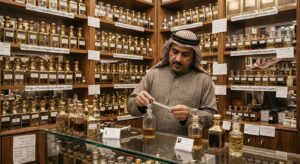
- Open testing culture. Customers are invited to smell everything before buying. There is no sealed shrink-wrap standing between a buyer and a scent.
- Bespoke blending. Perfumers mix oils on the spot, adjusting a mukhallat’s rose, oud, or amber ratio to a customer’s preference.
- Multi-generational trust. Many Dubai perfume houses have operated from the same neighborhood for decades, building relationships that pass from father to son, both among sellers and buyers.
- Raw material transparency. Serious perfume houses in Dubai will show you the oud chips, the resin, the actual ingredient, not just the finished bottle.
This is a fundamentally different retail experience from a department store fragrance counter in London or New York, where a sealed bottle sits behind glass and a sales associate reads from a script. In Dubai, perfume shopping is participatory, sensory, and personal. That difference alone explains much of why visitors leave calling Dubai the world’s perfume capital.
Why Fragrance Runs So Deep in Emirati and Gulf Culture
Perfume as Hospitality, Not Accessory
In much of the Western fragrance market, perfume is personal and often private. You wear your signature scent; other people notice it or they don’t.
In the UAE and across the Gulf, fragrance operates on a different social logic entirely:
- Guests are perfumed, not just greeted. It is common practice in Emirati homes to offer guests oud smoke (bukhoor) or a dab of attar before they leave, as a gesture of respect and hospitality.
- Bukhoor is burned communally. Agarwood chips or scented wood are burned in a mabkhara and passed around gatherings, weddings, and even business meetings, so the scent becomes part of the shared social memory of the event.
- Scent marks life events. Weddings, Eid celebrations, and religious observances all have associated fragrance rituals, often involving oud, rose, and saffron-based blends.
- Layering is standard practice. Many Emiratis apply multiple fragrance products in a single routine, attar, oud oil, and bukhoor smoke, building a scent profile that Western “one spray of EDT” habits simply do not match in intensity or intention.
A customer buying oud for a wedding is not buying a gift; they are buying a piece of the ceremony itself. Someone stocking up before Ramadan is not shopping casually; they are preparing their home and body for a month of heightened spiritual and social significance. Anyone who wants that same ritual at home usually starts with a proper bukhoor and oud muatter selection, since the burning tradition is really where Gulf hospitality begins.
Attar and Oud: The Original Luxury Perfumery
Long before French perfume houses formalized modern perfumery in the 18th and 19th centuries, Arabian and Persian perfumers had already developed sophisticated techniques for extracting and blending scent.
- Attar (also called ittar) refers to natural oil-based perfumes, traditionally distilled from flowers, herbs, spices, or wood using steam distillation into a base like sandalwood oil. This technique dates back over a thousand years and predates the alcohol-based perfumery that dominates Western markets. Our Attar Bakhoor blend is a good example of how this traditional style still translates into a modern bottle.
- Oud, the resinous heartwood of the Aquilaria tree, has been treasured across the Middle East and Asia for centuries, valued for a scent profile that is simultaneously smoky, sweet, animalic, and woody, unlike anything synthetic perfumery can fully replicate.
- Ambergris, a rare substance historically found washed ashore on Gulf and East African coasts, was prized as a fixative that could make a fragrance’s other notes last for hours longer.
These are not niche ingredients in Dubai. They are the mainstream:
- Alcohol-free, oil-based attars remain a dominant category in Dubai’s perfume market.
- Many Muslims prefer alcohol-free fragrance for prayer, which keeps demand for oil-based scents consistently high.
- Oil-based perfumes project and last differently on skin than alcohol-based sprays, particularly in the intense heat of the Gulf climate.
This is exactly why concentrated dehnal oud, including options like Dehnal Oud 21, has stayed a bestselling category here for generations, while lighter alcohol sprays play more of a supporting role.
If you want to understand the foundation of this category, our guide on what agarwood and oud actually are breaks down the botany, harvesting, and grading behind the ingredient that defines Gulf perfumery more than any other.
Dubai’s Modern Perfume Economy: From Souq to Global Industry
Free Zones and the Business Infrastructure Behind the Scent
Dubai’s fragrance dominance is not purely cultural or historical. It is also a matter of deliberate economic strategy.
Since the 1980s and accelerating through the 2000s, Dubai has built free trade zones specifically designed to attract manufacturing, warehousing, and export businesses, including cosmetics and fragrance. Jebel Ali Free Zone (JAFZA), one of the largest of its kind in the world, hosts fragrance manufacturers, packaging companies, and distribution hubs that supply markets across the Middle East, Africa, and South Asia.
This matters practically:
- Zero or low import duties on raw fragrance materials in designated zones make Dubai cheaper to manufacture and re-export from than most competing hubs.
- Proximity to Jebel Ali Port, one of the busiest container ports in the world, means finished perfume products can reach Africa, South Asia, and Europe faster than from most other manufacturing centers.
- Dubai International Airport’s cargo capacity allows time-sensitive, high-value shipments, including rare oud and attar, to move globally within days.
- UAE’s re-export economy has long made Dubai a middleman hub, goods arrive, get processed or repackaged, and leave again, and perfume is one of the sectors that benefits most from this model.
This infrastructure is why so many international fragrance brands choose to headquarter their Middle East and Africa distribution out of Dubai, and why smaller, artisanal perfume houses can source rare raw materials that would be difficult or prohibitively expensive to access from almost anywhere else.
Dubai as the World’s Oud Trading Hub
Agarwood, the source of oud, is one of the most geographically constrained luxury materials on Earth. Wild agarwood trees, primarily found across Southeast Asia (Cambodia, Laos, Vietnam, Indonesia, Malaysia, and parts of India and Bangladesh), only produce the resin that creates oud’s distinctive scent in response to fungal infection or physical damage, a slow, unpredictable, and increasingly rare natural process.
Dubai has positioned itself as the central marketplace where this rare material meets global demand:
- Traders and brokers from Southeast Asia bring raw agarwood chips, oil, and processed oud to Dubai’s markets, where buyers from across the Gulf, Europe, and beyond come to purchase.
- Dubai perfume houses grade, blend, and re-export oud oil and oud-based fragrances to international markets that have no direct trade relationship with the source countries.
- The city’s reputation for authenticity, hard-won through decades of trader relationships and buyer trust, means Dubai-sourced oud commands a premium and a credibility that unverified sources cannot match.
Grading is where this becomes tangible for a buyer:
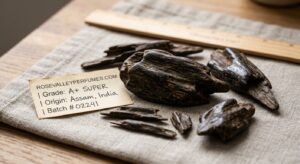
- A piece like our Hindi MSY Super reflects exactly this kind of Dubai-based grading and sourcing chain.
- A distilled option like SRL D-Super shows how the same raw material can be processed into oil form for a different use case.
- Origin, resin density, and processing method all factor into what ends up on the shelf, which is why grading names sound so specific.
If you’re curious how different regional oud profiles compare, our breakdown of Hindi oud versus Cambodian oud explains the scent, origin, and quality differences that matter most to serious buyers.
The Rise of Homegrown Emirati and Gulf Perfume Houses
While Dubai has long been a trading hub for raw materials and international fragrance brands, the past two decades have seen an explosion of homegrown Gulf perfume houses building global reputations of their own.
Brands originating from the UAE and neighboring Gulf states have grown from local family businesses into internationally recognized names, exporting oud-based and Arabian-style fragrances to Europe, North America, and Asia. This matters for Dubai’s perfume capital of the world reputation in two ways:
- It proves that Arabian perfumery is not just a historical curiosity being preserved for tourists. It is a living, growing, commercially significant global category actively shaping mainstream fragrance trends, including the rise of oud notes in Western designer perfumes over the past fifteen years.
- It demonstrates two-way cultural influence. Where Western perfumery once dominated global fragrance trends, Gulf-style perfumery, rich, long-lasting, oud and amber-forward, is now influencing how international perfume houses formulate their own bestsellers.
Walk down the fragrance aisle of any major Western retailer today, and you will find “oud” listed as a note on bottles from brands that would never have used the word two decades ago. That shift did not happen in Paris or New York. It happened in Dubai first, and it is part of why our own perfumes collection blends both traditions, Western-style bottles built around genuinely Arabian ingredients.
Dubai vs. Grasse and Paris: Two Different Perfumery Traditions
This is a question we hear constantly from visitors and international customers: if Paris and Grasse are the historic centers of Western perfumery, why does Dubai claim the perfume capital of the world title?
The honest answer is that Dubai and Grasse represent two different perfumery traditions entirely, and comparing them requires understanding what each city actually specializes in.
| Factor | Dubai | Grasse / Paris |
| Core tradition | Attar and oud-based oil perfumery, alcohol-free | Alcohol-based eau de parfum and eau de toilette |
| Signature ingredients | Oud, saffron, ambergris, Taifi rose | Jasmine, lavender, bergamot, synthetic aromachemicals |
| Shopping culture | Open testing, bespoke blending, souq bargaining | Sealed retail, branded counters, fixed pricing |
| Historical role | Trade hub connecting Asia, Africa, and Arabia | Manufacturing and formulation center since the 1700s |
| Cultural role of scent | Religious, social, hospitality-driven, daily ritual | Personal expression, fashion-linked, often occasional |
| Modern strength | Raw material trade, re-export, oud sourcing | Brand development, formulation science, luxury marketing |
Neither city is more correct than the other:
- Grasse earned its reputation as the birthplace of modern French perfumery through centuries of flower cultivation and formulation expertise.
- Dubai earned its reputation as the trading, sourcing, and cultural heart of a completely different, and arguably older, perfumery tradition.
- What gives Dubai a legitimate claim to the broader title is scale and convergence, it is where both traditions now meet, with international luxury brands and traditional attar houses often operating blocks apart.
No other city on Earth hosts this level of overlap between ancient Arabian perfumery and modern global fragrance commerce.
What It’s Actually Like to Shop for Perfume in Dubai
Numbers and trade history only tell part of the story. If you have never shopped for perfume in Dubai, here is what the experience actually involves.
The Souq Walk
Entering a fragrance souq in Deira is a full sensory event before you have spoken to anyone:
- Layered scent trails hang in the air, rose, oud, amber, musk, overlapping from shop to shop.
- Brass and glass perfume bottles, some ornately shaped, line window displays.
- Bukhoor smoke drifts from doorways, some shops burning it continuously to draw customers in.
- Merchants greet customers warmly, often offering a seat and a testing strip before any sales pitch begins.

The Testing Ritual
Unlike sealed Western retail, Dubai’s perfume culture is built around direct experience before purchase:
- A merchant will apply oil directly to a testing strip or your wrist, never just spray from a distance.
- You are encouraged to wait, ten, twenty, even sixty minutes, to smell how the fragrance develops on skin, since oil-based perfumes evolve dramatically over time.
- Blending is common. If you like two attars but neither alone, an experienced perfumer can combine them into a custom mukhallat on the spot.
- Bargaining, particularly in traditional souq settings, is often expected and part of the cultural exchange, not a sign of disrespect.
Why This Builds Genuine Trust
This hands-on approach is not just charming, it is functionally important:
- Oil-based Arabian perfumes behave differently from alcohol-based Western fragrances.
- They often smell stronger and more concentrated straight from the bottle, but develop into something entirely different after twenty or thirty minutes of skin contact.
- A customer who only smells the bottle, without testing on skin, is not getting an accurate impression of what they are buying.
This is also why so much of Dubai’s fragrance trade still happens through trusted relationships rather than blind purchases, and why we put real effort into detailed, honest descriptions for customers shopping our fragrance oil range remotely. If you’re exploring where to buy with confidence while visiting, our guide to finding authentic perfumes in Dubai walks through what separates a trustworthy source from an inflated tourist-trap price tag, and our about us page shares more on the family history behind that approach.
The Raw Materials That Define Dubai’s Fragrance Identity
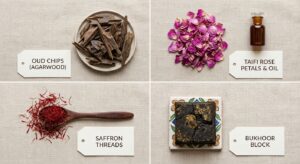
Oud (Agarwood)
Already covered in depth above, oud remains the single most important material associated with Dubai’s global perfume reputation:
- Its rarity, complexity, and cultural significance make it the anchor ingredient of Gulf perfumery.
- No other single raw material carries as much weight, financially or culturally, in the region’s fragrance identity.
Taifi Rose
Named for the Ta’if region of Saudi Arabia, this rose variety produces one of the most prized rose oils in the world:
- Its scent profile is deeper, spicier, and more complex than many European rose varieties.
- It is a common pairing with oud in traditional mukhallat blends.
Saffron
Beyond its use in cuisine, saffron is a significant fragrance ingredient in Gulf perfumery:
- It contributes a warm, slightly leathery, honeyed note.
- It appears frequently in premium mukhallats and oud blends.
Ambergris
Historically sourced from sperm whale secretions found washed ashore, genuine ambergris is now exceptionally rare and heavily regulated:
- Modern Gulf perfumery largely relies on synthetic or plant-derived alternatives that replicate its fixative and musky-sweet qualities.
- Vintage and rare genuine ambergris still commands extraordinary prices among collectors.
Bukhoor
Not a perfume worn on the body, but a scented wood chip or compressed fragrance block burned as incense:
- Bukhoor is central to Gulf hospitality culture, used to scent homes, clothing, and gathering spaces.
- It remains one of the most distinctly “Dubai” fragrance experiences a visitor can bring home.
Our incense oil selection covers this same ritual for anyone who prefers a liquid form over burning chips.
Sandalwood and Supporting Notes
While oud, rose, saffron, and ambergris dominate the conversation, sandalwood plays a quieter but essential role:
- It works as a carrier and base note in countless Gulf blends.
- Its smooth, creamy woodiness helps ground sharper top notes like saffron or citrus.
- It has been used as an attar base for centuries because it holds other oils well without fading quickly in heat.
- Musk, both natural and modern synthetic alternatives, fills a similar supporting role, adding warmth and skin-like depth.
Dubai’s Climate: An Unlikely Ally in Perfume Craftsmanship
There is a practical, often overlooked reason Dubai’s fragrance culture developed the way it did: heat.
The Gulf’s intense desert climate shapes fragrance behavior in ways that fundamentally differ from the cooler, temperate conditions of Grasse or Paris:
- Alcohol-based perfumes evaporate faster in high heat, losing projection and longevity within an hour or two, sometimes less.
- Oil-based attars and oud oils are formulated to withstand heat, clinging to skin and clothing far longer, which is precisely why oil-based perfumery became the dominant tradition across the region rather than a stylistic footnote.
- Heavier, resin-based notes (oud, amber, musk) perform better in warm climates, holding their structure and depth instead of thinning out the way lighter citrus or aquatic notes tend to under intense sun.
- Bukhoor and incense-based scenting solves a practical problem too. Burning fragrance directly into fabric and hair provides a depth and longevity that topical application alone cannot achieve in extreme heat.
Dubai’s fragrance identity was never purely aesthetic. It was, in part, engineered by necessity. Centuries of trial and error in a punishing climate taught Gulf perfumers which materials and techniques actually survive contact with desert heat, and that hard-won knowledge is exactly what gives Emirati perfumery its distinctive strength and staying power today.
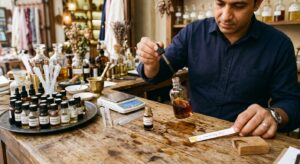
The Craft Behind the Bottle: How Mukhallats Are Actually Made
Understanding why Dubai’s perfumers command such respect requires understanding what actually goes into a traditional mukhallat, the blended oil perfume that anchors most attar houses’ offerings.
Unlike mass-produced alcohol-based perfumes, which are typically formulated in a lab using standardized aromachemical formulas, a mukhallat is often built by hand, batch by batch, guided as much by a perfumer’s trained nose as by any written recipe.
- Base selection comes first. A perfumer chooses a carrier, often a neutral oil or a lighter oud oil, that will hold the blend without overpowering it.
- Layering happens in stages. Top, heart, and base notes, rose, saffron, amber, oud, are added progressively, with the perfumer testing on skin at each stage rather than relying purely on measured ratios.
- Maturation matters. Many high-quality mukhallats are left to rest for days or weeks after blending, allowing the individual oils to fully integrate rather than sitting as separate scents layered on top of one another.
- Small-batch consistency is a skill, not a given. Because natural raw materials vary slightly from harvest to harvest, an experienced perfumer must adjust each batch to maintain a consistent house scent, a skill that typically takes years to develop.
This is precisely why an experienced Dubai perfumer is often treated with the same respect given to a master tailor or a skilled chef. The craft cannot be fully automated, and the quality difference between an experienced blender’s work and a rushed, formulaic imitation is immediately obvious to anyone with a trained nose.
Dubai’s Perfume Trade in the Global Economy
A Re-Export Powerhouse
The UAE’s broader trade identity, built on re-exporting goods rather than solely producing them domestically, applies directly to fragrance:
- Dubai imports raw aromatics and finished perfumes from dozens of countries.
- It then re-exports significant volumes onward to markets across Africa, South Asia, the wider Middle East, and increasingly Europe and North America.
- This re-export role means Dubai’s influence on global fragrance trends extends far beyond what is sold within the city itself.
A bottle of oud-infused perfume purchased in London or Lagos may well have passed through Dubai’s trade networks, been graded by Dubai-based brokers, or been formulated using raw materials sourced through Dubai intermediaries, even if the label never mentions the city at all.
A Talent and Formulation Hub
Beyond raw trade, Dubai has increasingly attracted perfumers, formulators, and fragrance entrepreneurs from across the world:
- The city’s access to rare materials draws in serious formulators.
- Its concentration of high-spending fragrance consumers supports niche and luxury launches.
- Its business-friendly regulatory environment makes it easier to set up and scale a fragrance brand.
- Training programs, trade exhibitions, and specialized fragrance business networks have grown alongside this, cementing Dubai’s role as a center of expertise, not just a marketplace.
Duty-Free and Airport Retail Influence
Dubai International Airport’s duty-free fragrance retail operates at a scale that shapes global purchasing behavior:
- Millions of transiting passengers each year encounter Arabian oud and attar brands, often for the first time.
- The retail environment is specifically designed to showcase Gulf perfumery alongside international designer names.
- For many travelers, this first impression, formed in a Dubai departure lounge, shapes fragrance preferences for years afterward.
Dubai’s Shopping Culture and the Perfume Souq as a Destination
The Dubai Shopping Festival and Fragrance Retail
Dubai’s broader retail tourism strategy, anchored by events like the Dubai Shopping Festival, has long positioned perfume and oud as signature souvenir categories for international visitors:
- Duty-free shopping at Dubai International Airport regularly ranks among the highest-grossing fragrance retail environments in the world.
- This is driven partly by the sheer volume of international transit passengers.
- It is also driven by the specific draw of Arabian oud and attar as products unavailable, or far more expensive, elsewhere.
The Perfume Souq as a Tourist Destination in Its Own Right
Deira’s Perfume Souq, along with Bur Dubai’s fragrance shopping streets, has become a genuine tourism destination, not just a local shopping district:
- Travel guides across the world now list Dubai’s perfume souqs alongside the Gold Souq and Spice Souq as essential Dubai experiences.
- Millions of visitors leave with a bottle of oud or attar, wear it back home, and become informal ambassadors for Dubai’s fragrance identity.
- This tourism dimension reinforces Dubai’s reputation as the perfume capital of the world in a self-perpetuating way.
Modern Malls and the Luxury Fragrance Ecosystem
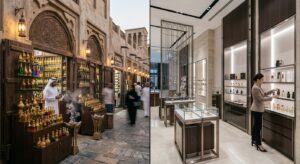
Alongside the traditional souqs, Dubai’s modern shopping malls, including The Dubai Mall and Mall of the Emirates, host flagship boutiques for essentially every major international fragrance house, alongside homegrown Gulf perfume brands:
- This dual retail ecosystem, ancient souq alongside modern luxury mall, is part of what makes Dubai’s perfume identity so complete.
- A visitor can experience the entire history of perfumery, from centuries-old attar-blending traditions to the newest niche fragrance launches, within a single afternoon in this city.
Common Misconceptions About Dubai’s Perfume Industry
It’s worth directly addressing a few misunderstandings we hear often from customers:
- “All oud smells the same.” Oud’s scent profile varies dramatically based on region, tree species, age, and processing method. Cambodian oud tends toward sweet, fruity, and resinous notes. Indian (Hindi) oud is often deeper, more animalic, and intensely smoky. Treating oud as a single, uniform scent misses the entire point of what makes this category so prized among collectors.
- “Attar is just cheap perfume oil.” Genuine attar, particularly oud and rose-based mukhallats crafted from real raw materials, can be significantly more expensive than mainstream Western designer perfumes, precisely because the raw materials, particularly wild or aged agarwood, are so rare and labor-intensive to source and process.
- “Dubai perfume shops are all tourist traps.” While tourist-oriented pricing certainly exists, particularly in high-traffic mall locations, Dubai’s serious perfume trade is built on multi-generational trust relationships between family-run houses and their customers. Established shops with decades of operating history, verifiable sourcing, and transparent grading are fundamentally different from souvenir kiosks selling diluted or synthetic imitations.
- “Oud is only relevant in the Middle East.” Global fragrance sales data over the past fifteen years tells a different story. Oud has become one of the most influential notes in international perfumery, appearing in bestselling fragrances from major Western houses, precisely because Dubai’s trade networks made this once-obscure Southeast Asian material accessible to a global formulation industry for the first time.
Regional Rivals: How Dubai Compares to Other Middle Eastern Fragrance Hubs
Dubai is not the only Gulf city with a strong fragrance tradition, and a fair account of its reputation should acknowledge that:
- Jeddah and Ta’if in Saudi Arabia are historically significant, particularly Ta’if for its prized rose harvest, and Jeddah for its long-standing perfume trading families.
- Sharjah, directly neighboring Dubai, shares much of the same Gulf perfumery tradition and has its own respected oud and attar markets.
- Muscat in Oman remains closely tied to the original frankincense trade, given Oman’s historic role as a major source of the resin.
What distinguishes Dubai from each of these is not necessarily deeper cultural roots, several of these cities can claim equally old or older traditions, but scale, accessibility, and infrastructure:
- A major international airport connects Dubai to the entire world within hours.
- A global re-export economy moves goods in and out with minimal friction.
- An enormous tourism base creates constant demand and exposure.
- A retail culture built for both locals and visitors makes the trade accessible rather than closed-off.
A rose grown near Ta’if or oud graded near Muscat very often still passes through Dubai’s trade networks before reaching a global customer, which is a large part of why the city, rather than any single competitor, carries the perfume capital of the world reputation internationally.
Sustainability and the Future of Dubai’s Perfume Trade
No honest account of Dubai’s fragrance industry can ignore the sustainability pressures now facing its core raw material.
Wild agarwood-producing Aquilaria trees are listed under CITES (the Convention on International Trade in Endangered Species), reflecting genuine conservation concern over decades of overharvesting across Southeast Asia. This has real consequences for Dubai’s oud trade:
- Cultivated agarwood plantations, particularly across Southeast Asia, are increasingly supplying the market as wild sourcing becomes more restricted and expensive.
- Inoculation techniques, artificially triggering resin production in cultivated trees, have made oud production more sustainable and predictable, though purists still debate whether cultivated oud matches the complexity of wild-harvested material.
- Reputable Dubai traders increasingly emphasize traceability, sourcing documentation, and CITES compliance, both to protect the long-term supply of the material and to meet growing international regulatory requirements for import and export.
Sourcing responsibly is not a marketing talking point in this trade, it is a practical necessity for staying in business long-term in a category where the core raw material is genuinely finite. The future of Dubai’s claim as the perfume capital of the world depends significantly on how well the industry manages this transition from wild harvesting toward sustainable cultivation, without losing the quality that built its reputation in the first place.
What to Know Before Shopping for Perfume in Dubai
Based on decades of direct experience serving both walk-in customers and international buyers, here is practical guidance we consistently give people new to Gulf perfumery:
- Test on skin, not just from the bottle. Oil-based fragrances develop over time. A first impression straight from the bottle rarely reflects the true dry-down scent.
- Ask about origin. A trustworthy seller will tell you exactly where their oud, rose, or saffron comes from, not just describe it as “premium” or “luxury” without specifics.
- Understand that price reflects rarity, not just brand name. Genuine aged or wild oud can cost significantly more than synthetic alternatives, and that price difference is usually legitimate, not inflated.
- Don’t assume louder is better. High-quality attars are often more complex and longer-lasting, not simply stronger-smelling, than cheaper synthetic imitations.
- Ask about concentration and dilution. Pure oud oil, mukhallats (blended oils), and alcohol-based sprays all behave very differently on skin and in longevity.
- Buy from houses with a track record. Longevity in this trade, decades of operating in the same district, serving repeat customers, matters enormously in an industry where authenticity can otherwise be difficult to verify from the outside.
If you’re shopping for a source you can trust, whether visiting Dubai in person or buying internationally, our guide on choosing a trusted oud shop covers exactly what separates reliable sourcing from inflated tourist pricing. Our full shop is organized the same way a good souq visit would be, by material, strength, and origin, so you can compare before deciding, and our contact page is the fastest way to reach our team directly if you’d like a personal recommendation first.

Conclusion: A Living Fragrant History, Not Just a Title
Dubai’s claim to being the perfume capital of the world is not a slogan invented for tourism campaigns. It is the accumulated result of a thousand years of trade geography, a culture that has always treated scent as sacred and social rather than optional, and a modern economy deliberately engineered to move rare materials across the globe faster and more efficiently than almost anywhere else.
From the ancient incense routes that first brought frankincense and myrrh through the Arabian Peninsula, to the monsoon trade winds that connected Gulf ports with Indian and East African markets, to the souqs of Deira where oud, rose, and saffron have been tested, blended, and sold for generations, Dubai’s fragrance identity was built layer by layer, exactly the way a great perfume is built.
Whether you are planning a visit to Dubai’s fragrance souqs, researching the history behind the oud in your collection, or simply trying to understand why this city holds the title it does, the answer comes down to the same thing every time: Dubai didn’t just adopt perfume culture. It has been perfume culture’s home for centuries, and it shows no sign of relinquishing that role.
Frequently Asked Questions
Why is Dubai called the perfume capital of the world?
Dubai combines centuries of Arabian trade history, deep cultural devotion to scent, access to rare materials like oud and Taifi rose, and a modern free-trade economy built around fragrance, which together earned it the title.
What is the most famous perfume ingredient from Dubai?
Oud, also called agarwood, is the ingredient most closely associated with Dubai. It’s a resinous wood prized for its smoky, complex scent, and Dubai is a major global trading hub for it.
Where is the best place to buy perfume in Dubai?
The Deira Perfume Souq, including the Murshid Bazar area, is widely considered the best place for authentic attar and oud, offering direct testing and bespoke blending alongside modern mall boutiques.
What is the difference between attar and regular perfume?
Attar is a natural, oil-based perfume applied directly to skin, while regular Western perfume is alcohol-based and sprayed, meaning the two behave very differently in scent development and longevity.
Why is oud perfume so expensive?
Genuine agarwood, especially wild or aged oud, is naturally rare and slow to produce, and increasingly regulated for sustainability, which drives up the cost compared to synthetic alternatives.
Why do people in the Gulf use so much perfume?
Fragrance is tied to hospitality, religion, and social ritual in Gulf culture, so it’s used far more frequently and layered more heavily than in many Western cultures.
Can you test perfume before buying it in Dubai?
Yes. Testing on a strip or on skin, and waiting to see how the scent develops, is standard practice in Dubai’s souqs before any purchase is made.
What should a first-time oud buyer know?
Ask about the ingredient’s origin, test it on skin rather than judging from the bottle, and buy from an established seller with a verifiable track record.