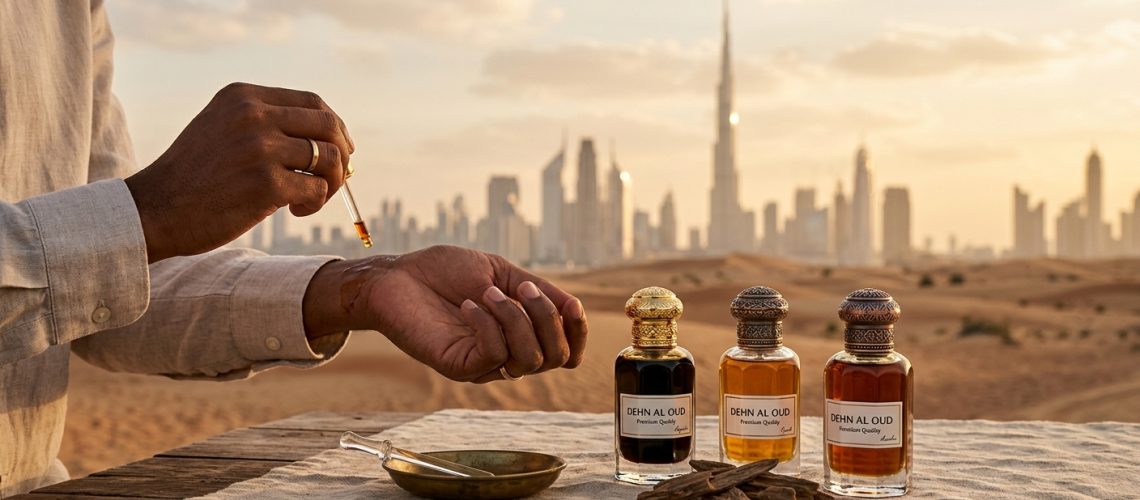
If you have ever stepped out of an air-conditioned Dubai mall into the afternoon heat and felt your perfume completely change character within minutes, you already understand the real challenge behind this topic. Dehnal oud scents for Dubai weather are not a one-size-fits-all category. What smells rich, warm, and grounding in a cool December majlis can turn heavy, cloying, and almost suffocating on a July afternoon with 95% humidity.
So, heavy or light? The honest answer is: it depends on the season, the time of day, and how your body chemistry reacts to heat – but there are clear, practical rules you can follow to get it right every single time.
This guide breaks down exactly how Dubai’s climate interacts with dehn al oud, which weight works for which month, how skin and body chemistry change the outcome, how to apply it so it lasts without overwhelming a room, and which mistakes even experienced wearers keep making.
By the end, you will know exactly which dehnal oud scent suits Dubai weather depending on the month, the occasion, and your own skin type – and why a single “perfect bottle” almost never exists for someone who lives in this city year-round. Everything here comes from real experience testing oud with customers who live and work in this exact climate, not generic advice copied from cooler markets.
What Is Dehnal Oud, Exactly?
Dehn al oud (also spelled dehnal oud, dehn oud, or oud oil) is the pure distilled oil extracted from agarwood – the resin-infused heartwood of the Aquilaria tree. Unlike alcohol-based perfumes, dehn al oud is an oil-based fragrance, which fundamentally changes how it behaves on skin and in heat.
A few things worth knowing before we get into heavy vs light, since these fundamentals shape everything else in this guide:
- It is oil, not alcohol. Oil sits on the skin and evaporates far more slowly than an alcohol-based spray, which is exactly why heat and humidity affect it so differently.
- It is highly concentrated. A single drop can project for hours, which is exactly why choosing the wrong weight in Dubai’s heat becomes a real problem rather than a minor inconvenience.
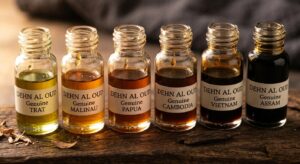
- It is graded by origin and density. Hindi oud, Cambodi oud, and Taifi grades all carry naturally different weights – some inherently heavy and resinous, others naturally lighter and greener, and you can see this range across a full dehnal oud collection side by side.
- It is extracted through hydro-distillation, a slow process that can take weeks for a single batch, which is part of why genuine dehn al oud carries a meaningful price and why quality varies so widely between suppliers.
Understanding this oil-based nature is the key to the entire heavy-versus-light discussion, because oil behaves completely differently in 25°C air-conditioned comfort versus 45°C outdoor heat. It is worth comparing this directly against Dubai’s other popular fragrance style, since alcohol-free perfumes follow a similar oil-based logic but with a lighter overall base.
It also helps to know that “dehn al oud” is not a single fixed scent, in the way a branded perfume is. It is closer to a category – the way “olive oil” describes a spectrum from mild to intensely peppery depending on where and how it was produced. Two bottles both labelled “dehn al oud” can smell, and behave in heat, almost nothing alike depending on the region the agarwood came from, how it was aged, and how it was distilled.

Why Dubai’s Weather Changes How Dehnal Oud Scents Perform
Dubai is not a “normal” fragrance market, and treating it like one is the single biggest mistake people make when choosing dehnal oud scents for Dubai weather.
The Heat Factor
Fragrance molecules evaporate faster as temperature rises. This is basic chemistry, but it has a huge practical effect:
- Heavy, resinous ouds release their aromatic compounds much faster in high heat, which means a scent that feels moderate indoors can become overwhelming within 20–30 minutes outdoors.
- Top and heart notes burn off quickly in extreme heat, leaving only the deep base notes – which is why heavy oud in summer heat often smells muddier or hotter than intended.
- Skin temperature itself rises in Dubai’s climate, and warmer skin amplifies oil-based fragrance projection significantly more than it does alcohol-based spray.
- Direct sunlight accelerates the process further. A heavy oud can peak in intensity within minutes outdoors rather than the gradual hour-long build-up it would experience indoors.
The Humidity Factor
Humidity is the part most people overlook entirely, and it may matter even more than heat itself in Dubai specifically.
- High humidity traps scent molecules closer to the skin and surrounding air, intensifying how a fragrance is perceived by others nearby.
- Combined with heat, humid air makes heavy oud smell thicker and less refined than it would in a dry, cool environment.
- This is precisely why an oud that performs beautifully in a drier climate can feel completely different – and often too intense – in Dubai’s coastal humidity, which regularly sits above 60–70% for much of the year.
Indoor-Outdoor Temperature Swings
Life in Dubai is a constant cycle of extreme air conditioning and extreme outdoor heat, and this swing directly affects how dehnal oud scents for Dubai weather perform:
- Indoor spaces stay cool year-round. Malls, offices, cars, and homes are typically kept between 20–23°C.
- Outdoor spaces swing to extreme heat. Streets and outdoor gatherings can reach 45°C or higher for most of the year, especially in summer.
- A single fragrance has to perform in both environments within the same hour – leaving an office, walking to a car, arriving at a restaurant – which few fragrance markets in the world demand this consistently.
This is exactly why dehnal oud scents for Dubai weather deserve more thought than the “just pick your favourite” approach that works in cooler markets.
The Coastal Factor
Dubai’s proximity to the Gulf coastline adds another layer worth understanding:
- Salt-air humidity builds up along the coast in a way that inland desert cities do not experience in quite the same intensity.
- Oil-based fragrance feels “closer” to the skin in this coastal humidity, rather than airy or diffused.
- Lighter oud profiles tend to perform more comfortably for daily outdoor wear in Dubai specifically, compared to inland Gulf regions.
Why This Matters More for Dehn Al Oud Than Other Fragrances
- Alcohol-based perfumes are built to evaporate quickly, so heat mostly just shortens their wear time rather than changing their character dramatically.
- Dehn al oud depends on slow, gradual release – precisely the mechanism that Dubai’s heat and humidity interfere with most.
- A fragrance built to unfold over 8–10 hours in a temperate climate can compress that entire journey into 30 minutes outdoors in July.
- This is why weight selection carries far more weight, so to speak, for dehn al oud specifically than it does for a typical eau de parfum.

How Skin Type Affects Dehnal Oud Scents in Dubai’s Heat
Climate is only half the equation. Individual skin chemistry plays a significant role in how heavy or light an oud actually feels.
- Oily skin tends to hold fragrance longer and amplify projection, because oil-based dehn al oud blends more readily with natural skin oils. Someone with naturally oily skin may find that even a “light” oud performs closer to a “medium” weight in Dubai’s heat.
- Dry skin tends to absorb fragrance faster and release it more quickly, meaning a heavy oud may not last as long as expected, and a light oud might fade sooner than anticipated in air-conditioned settings.
- Body temperature and metabolism affect projection. People who naturally run warmer will experience stronger, faster-developing scent throw, particularly with heavier ouds.
This is exactly why two people can wear the same bottle in the same Dubai afternoon and have completely different experiences – a topic covered in more depth in this breakdown of how skin chemistry changes the way perfume smells. It is also exactly why a seasonal rotation approach, covered later in this guide, works better than chasing a single “universally correct” oud weight.
A few additional factors worth keeping in mind:
- Hydration levels affect how a scent develops. Well-hydrated skin tends to hold fragrance oil more evenly, while dry, dehydrated skin – common in Dubai’s air-conditioned indoor environments – can cause a scent to fade unevenly across the day.
- The area of application matters as much as the skin type itself. Warmer areas of the body, such as the neck and inner wrists, will always project a scent more strongly than cooler areas, regardless of whether the oud is heavy or light.
- Age and long-term skin condition can subtly shift how oud is perceived. Many long-time wearers report that their preferred weight changes gradually over the years, which is simply another reason to keep both a heavy and a light option on hand rather than assuming today’s favourite will always be the right fit.
Heavy Dehnal Oud Scents: What They Are and When They Work Best
Heavy dehn al oud refers to deep, resinous, high-density oud oils – typically aged Hindi oud, Cambodi oud, or blended attars with a strong woody-animalic base. These are the ouds associated with tradition, depth, and long-lasting projection.
Characteristics of Heavy Oud
- Dark, resinous base notes – leathery, woody, sometimes slightly sweet or medicinal depending on origin
- Very high projection and sillage – a small amount fills a room
- Long-lasting on skin and fabric, often detectable 8–12 hours later
- Complex, evolving character that changes over several hours as it dries down
Notable Heavy Profiles Worth Knowing
- Hindi oud carries a deep, earthy, sometimes barnyard-like intensity that softens into a rich, leathery sweetness over time. A Hindi Maliki dehn al oud or a Hindi Syufi grade are good examples of this traditional, full-bodied character.
- Rose-infused Hindi blends, such as a Rohul Ward Hindi dehn al oud, soften the rawness slightly with a floral sweetness while keeping the depth intact.
- Aged agarwood in general develops a rounder, less sharp profile over time, making it feel heavy but refined rather than simply intense – something explored further in this guide to Hindi Sollah oud chips.
- Cambodi-style oud tends to sit slightly between the two, offering a smoother, sweeter resinous character that many wearers find easier to manage while still delivering strong projection than a pure Hindi grade.
It is worth noting that “heavy” does not automatically mean “harsh.” A well-aged, high-quality heavy oud should feel rich and rounded rather than sharp or medicinal – sharpness is more often a sign of a younger, less refined oil than of the weight category itself.
When Heavy Oud Actually Works in Dubai
- Winter evenings (November–February). Lower temperatures slow evaporation, letting the full complexity of the scent unfold properly rather than burning off within minutes.
- Indoor gatherings and majlis settings. Air-conditioned indoor spaces neutralize the heat problem entirely.
- Weddings, Eid, and formal occasions. These events are almost always indoor or evening-based in Dubai, making them ideal for heavier, more traditional oud profiles.
- Fabric scenting with bukhoor. Heavy oud applied to clothing rather than skin, through a bukhoor and oud muatter session, is far less affected by outdoor heat exposure.
A first-hand observation worth sharing: customers who complain that “oud smells too strong in Dubai” have almost always applied a heavy Hindi or Cambodi oud during a hot afternoon, in direct sunlight, in a quantity meant for a cool evening. The oud itself was not wrong – the timing and quantity were.
Who Heavy Oud Suits Best
- People who spend most of their day indoors – offices, retail, home-based work
- Evening and night-time wearers
- Those attending formal, traditional, or ceremonial occasions
- Anyone who genuinely loves a deep, traditional Gulf-style oud character and is willing to apply it sparingly and strategically

Light Dehnal Oud Scents: What They Are and When They Work Best
Light dehn al oud refers to oud oils with a brighter, greener, or more refined profile – often from Taifi (Saudi) sources, lightly aged agarwood, or blended oud attars cut with lighter floral or spice notes.
Characteristics of Light Oud
- Brighter top notes – sometimes green, slightly sweet, floral, or spiced
- Moderate projection – noticeable up close without dominating a room
- Shorter but more comfortable wear time, typically 4–6 hours
- Cleaner, more wearable character for daytime and professional settings
Notable Light Profiles Worth Knowing
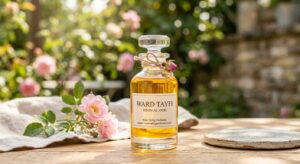
- Taifi oud is generally regarded as one of the lightest and most refined oud profiles. A Ward Tayfi dehn al oud – a rose-infused Taifi blend – is a good example, smoother and less animalic than a Hindi grade.
- Southeast Asian light grades, including many from Malaysia and Indonesia, often carry a sweeter, fruitier edge with lower intensity, as explained in this comparison of Malaysian agarwood and this look at Indonesian oud versus Philippine oud.
- Blended oud attars, combining oud with rose or musk, can soften the overall weight of the scent while retaining its woody core.
Light does not mean weak, either. A well-made light oud still carries the unmistakable character of genuine agarwood – it is simply built for restraint rather than dominance, which is exactly the quality that makes it work so well against Dubai’s heat.
When Light Oud Actually Works in Dubai
- Daytime and outdoor use, year-round. Light oud handles heat far more gracefully because it has less dense resinous material to “cook” in the sun.
- Summer months (May–September). During Dubai’s most intense heat and humidity, light oud is almost always the smarter choice.
- Office and professional environments. Air-conditioned workplaces with close human proximity call for a lighter, more considerate projection.
- First-time oud wearers. Light oud is a gentler introduction to dehn al oud for people used to Western alcohol-based perfumes.
- Travel and errands throughout the day. For anyone moving frequently between shops, cars, and outdoor walkways, light oud adapts more predictably across changing environments.
Who Light Oud Suits Best
- People who commute, walk outdoors, or spend significant time outside air conditioning
- Daytime professionals in shared office spaces
- Younger wearers or those newer to traditional oud fragrances
- Anyone applying scent for personal, close-range enjoyment rather than heavy room-filling projection
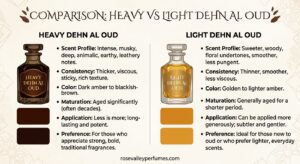
Heavy vs Light Dehnal Oud Scents for Dubai Weather: Quick Comparison
| Factor | Heavy Dehnal Oud | Light Dehnal Oud |
| Best season in Dubai | November–February (cool months) | May–September (hot months) |
| Best setting | Indoor, evening, formal | Outdoor, daytime, casual/professional |
| Projection | Very strong, room-filling | Moderate, close-range |
| Longevity | 8–12+ hours | 4–6 hours |
| Character | Deep, resinous, traditional | Bright, refined, wearable |
| Ideal quantity | 1 small dot, applied sparingly | 1–2 dots, can reapply midday |
| Common origins | Hindi, Cambodi, aged agarwood | Taifi, lightly aged, blended attars |
| Risk if misapplied | Overwhelming in heat/humidity | May fade too quickly in cooler AC settings |
A Deeper Look at Projection and Sillage in Humid Air
Projection (how far a scent travels from the body) and sillage (the trail it leaves behind) behave differently in humid air compared to dry climates, and this matters more than most buyers realize.
- In humid conditions, heavy oud’s sillage tends to feel “closer” and denser rather than spreading widely, which can make it feel more intense to people standing nearby even if the overall scent has not technically gotten stronger.
- Light oud’s projection in humidity tends to feel cleaner and more contained, which is often exactly what is desired in shared spaces like offices, cars, or family gatherings.
- This is a large part of why Gulf fragrance culture has historically developed strong customs around how much to apply and where, rather than avoiding heavier ouds altogether – the culture evolved alongside the climate, not despite it.
Dehnal Oud vs Other Fragrance Formats for Dubai Weather
Dehn al oud is not the only fragrance format available, and it helps to understand how it compares to alcohol-based perfume and bukhoor specifically for Dubai’s climate.
Dehnal Oud vs Alcohol-Based Perfume
- Alcohol-based perfumes evaporate quickly, which feels “safer” in heat since they burn off faster and rarely become overwhelming, but this also means far more frequent reapplication throughout a hot Dubai day.
- Dehn al oud lasts significantly longer but requires careful calibration of quantity and placement, since it does not evaporate away on its own the way alcohol does. This trade-off is explored in more detail in this guide on applying fragrance oil for maximum longevity.
- For someone who wants a low-maintenance option for a single hot day, an alcohol-based light fragrance may be simpler. For someone who values longevity and traditional character, a correctly chosen light dehn al oud remains the better long-term choice.
Dehnal Oud vs Bukhoor
- Bukhoor is oud wood scented indoors and worn into the heat afterward, rather than applied to skin, which makes it far less affected by outdoor heat and humidity.
- Many experienced wearers in Dubai use bukhoor for garments in summer and dehn al oud on skin more sparingly, getting the best of both traditions without the heat-related drawbacks of applying heavy oil directly onto skin on a hot day.
Dehnal Oud vs Attar Blends
- Attars are often oud-based but diluted or blended with other oils such as rose, amber, or musk, which naturally softens their weight and makes them more forgiving in heat than pure, undiluted dehn al oud.
- Attars can be an excellent middle-ground option for someone who wants oud character without committing fully to either a heavy or extremely light pure oud oil, particularly during Dubai’s transitional spring and autumn seasons.
There is no single winner – each format has a role depending on the day and the occasion. What matters most is understanding that dehn al oud’s strength, its longevity and depth, is exactly what makes weight selection so important in this specific climate, unlike lighter, faster-evaporating formats where the stakes of choosing “heavy or light” are simply lower.
Choosing Dehnal Oud Scents for Dubai Weather by Season
If there is one core piece of expertise worth taking from this guide, it is this: the smartest oud wearers in Dubai do not pick one oud and stick with it year-round – they rotate.
Treating dehn al oud selection like a wardrobe makes this easier to understand. You would not wear a heavy wool abaya in July or a light cotton kandura in January – oud works the same way.
Winter (December–February)
- Weather: Roughly 18–25°C during the day, sometimes lower at night, with lower humidity and more outdoor evening activity such as desert gatherings, weddings, and family visits.
- Best choice: Heavy oud. This is genuinely the best window in the entire year to enjoy traditional Hindi or Cambodi oud at full strength, both indoors and during cooler outdoor evenings.
- Try: A Hindi Maliki dehn al oud for full-bodied winter evening wear.
Spring (March–April)
- Weather: Transitional, warming quickly, with humidity beginning to climb as the season progresses toward summer.
- Best choice: Medium-weight oud – not the heaviest resinous grades, but not the lightest either.
- Try: A moderately aged oud or a lighter Cambodi-style blend, especially for daytime wear that still needs to hold up into warmer afternoons.
Summer (May–September)
- Weather: Extreme heat, frequently exceeding 40°C, combined with high humidity that can sit above 70% for extended stretches.
- Best choice: Light oud. Heavy oud in this season almost always becomes overwhelming within minutes outdoors, and even indoors it can feel disproportionately strong.
- Try: A Ward Tayfi dehn al oud for comfortable daytime wear.
Autumn (October–November)
- Weather: Cooling down again, with humidity gradually easing as the season shifts toward winter.
- Best choice: Medium-to-heavy oud, especially for evening wear as temperatures drop after sunset.
- Try: Reintroducing a richer profile such as Hindi Syufi ahead of the winter season.
This rotation approach is exactly how experienced oud collectors and daily wearers in Dubai manage their fragrance wardrobe:
- Keep at least one heavy oud for cooler months and indoor occasions.
- Keep at least one light oud for hot months and outdoor wear.
- Optionally, keep a third medium-weight bottle for the transitional spring and autumn months, so you are never stuck reaching for an extreme when the weather itself is somewhere in between.

Best Dehnal Oud Scents for Different Dubai Lifestyles
Beyond season, lifestyle plays a significant role in determining which weight of dehnal oud actually makes sense day to day.
Office Professionals
- Best choice: Light to medium oud, almost always, regardless of season.
- Why: Enclosed meeting rooms and close desk proximity mean that heavy oud, even applied sparingly, can become noticeable to colleagues in a way that feels inconsiderate.
- Try: A Ward Tayfi dehn al oud for a refined, office-appropriate presence.
Outdoor and Field-Based Workers
- Best choice: Light oud almost exclusively during the hotter half of the year.
- Why: Heat exposure combined with physical activity accelerates fragrance breakdown and projection simultaneously.
Event-Goers and Evening Socialites
- Best choice: Keep both a heavy and a light option on hand.
- Why: Evening events, even in summer, often take place indoors or in cooled outdoor setups, so heavier oud can still be worn appropriately.
- Pair with: A traditional Arabic perfume for men in Dubai worn on clothing, with a heavier dehn al oud reserved for skin – a common combination for weddings and formal gatherings.
Home-Based and Remote Workers
- Best choice: A lighter daytime oud, even for a fully indoor routine.
- Why: A heavy oud worn all day in an air-conditioned home office can still linger noticeably once you step out for an errand or a school pickup in the afternoon heat. Save heavier ouds for evenings when the mood genuinely suits them.
Newcomers to Dubai and to Oud
- Best choice: A lighter or medium profile.
- Why: It gives you time to learn how your own skin and the local climate interact before investing in heavier, more traditional grades.
Retail, Hospitality, and Customer-Facing Roles
- Best choice: Light to medium oud, almost year-round.
- Why: Close, repeated interactions with colleagues and customers in shared indoor spaces make a lighter, more considerate projection the more professional choice. Save heavier ouds for personal time outside of work hours.
Frequent Travelers
- Best practice: Re-test a favourite oud locally, on a warm Dubai day, before assuming it will perform exactly as it did abroad.
- Why: An oud purchased or tested in a cooler or drier climate may not behave the same way once back in Dubai’s heat and humidity.
Layering Dehnal Oud Scents for Balanced Wear in Dubai Weather
Layering is a technique experienced oud wearers use to fine-tune weight and character without needing an entirely separate bottle for every season.
- Layering light oud with a touch of rose or amber attar can add warmth for cooler evenings without moving all the way to a heavy Hindi profile – the same principle behind blends like rose oil in Arabian perfumery.
- Layering heavy oud with a small amount of rose attar can soften its intensity slightly, making it more approachable for semi-formal daytime indoor events during transitional seasons.
- Applying oud to one pulse point and a lighter attar to another allows the two to blend naturally on the skin as body heat activates them.
- Avoid layering two heavy, high-projection scents together in Dubai’s heat. This is one of the fastest ways to create an overwhelming result.
How to Apply Dehnal Oud Scents in Dubai Heat Without Overwhelming Anyone
Even the right oud, applied incorrectly, will underperform or overpower.
1. Apply to Pulse Points, Not Fabric, in Summer
Apply directly to skin at the wrists, behind the ears, or the inner elbow rather than clothing. Skin releases scent more evenly in heat than fabric, which can trap and then unpredictably release oud once you enter an air-conditioned space.
2. Use Less Than You Think You Need
A single small dot, roughly the size of a grain of rice, is enough for most oils, especially heavy grades. This is the single most common mistake: applying “perfume-level” quantities of an oil that is far more concentrated than a standard spray.
3. Time Your Application Around Your Environment
Heading outdoors in summer? Apply light oud 10–15 minutes before leaving an air-conditioned space, giving it time to settle before heat exposure. Staying indoors for an evening event? Heavier oud can be applied closer to when you arrive, since projection builds gradually in cooler air rather than peaking immediately. For a deeper walk-through of technique, this guide on how to apply fragrance oil for maximum longevity covers the same principles in more detail, including how moisturised skin changes the outcome.
4. Layer Strategically, Not Heavily
In transitional seasons, a light dab of heavier oud combined with a lighter oud on a different pulse point can create a more balanced, weather-appropriate profile without needing to buy a completely different bottle.
5. Give It Time to Develop Before Judging It
Oil-based fragrance can take 15–20 minutes to fully reveal its character on skin. Avoid judging strength immediately after application, since the true profile only emerges once body heat activates it fully.
6. Carry a Light Option for Full-Day Events
For an event with both indoor and outdoor portions, consider carrying a small light oud vial for a midday touch-up rather than over-applying a heavy oud at the start of the day.

Storing Dehnal Oud Scents to Survive Dubai’s Climate
Dubai’s heat affects the oil in the bottle just as much as it affects the oil on your skin, and storage habits matter more here than in cooler climates.
- Keep dehn al oud away from direct sunlight and heat sources. A cool, dark drawer is ideal, not a car glovebox or a warm windowsill.
- Avoid leaving bottles in a parked car, even briefly during peak summer, as in-car temperatures can exceed 60–70°C and permanently alter the oil.
- Keep the cap tightly sealed between uses to prevent oxidation, which can shift a light oud toward a heavier, less refined character over time.
- Store heavy and light ouds separately where possible, since cross-contamination from shared applicators can subtly blend their profiles over months.
The same principles apply to raw agarwood, and the full method is laid out in this guide on how to store agarwood to preserve quality and fragrance.
Gifting Dehnal Oud Scents in the UAE: Weight Considerations
Oud remains one of the most respected and commonly given gifts across the UAE, whether for weddings, Eid, business relationships, or hosting guests – and weight is worth considering here too.
- Heavier, traditional grades are generally the safer gifting choice for formal occasions, weddings, and older generations, since they align with long-established cultural expectations around oud as a symbol of respect and generosity. A Hindi Syufi dehn al oud works well here.
- Lighter oud makes a thoughtful gift for younger recipients or newcomers to Gulf fragrance culture, offering an accessible entry point without overwhelming someone unfamiliar with traditional dehn al oud.
- Matching the oud’s weight to the likely wearing conditions – a winter wedding versus a summer housewarming, for example – shows a level of thoughtfulness that recipients genuinely notice.
- Presentation matters as much as weight. A well-packaged, clearly labelled bottle with origin and grade information reflects the same care as the fragrance choice itself, particularly for business or formal social gifting.
Common Mistakes to Avoid With Dehnal Oud Scents in Dubai Weather
- Wearing heavy Hindi or Cambodi oud during outdoor summer events. This is by far the most common complaint, and it is almost always a seasonal mismatch rather than a problem with the oud itself.
- Over-applying because “it doesn’t smell strong yet.” Oil-based fragrance needs a few minutes to warm on the skin and reveal its true projection.
- Buying only one oud for the entire year. This almost guarantees the wrong choice for at least half the calendar.
- Assuming “expensive” always means “better for the weather.” Price reflects agarwood quality and rarity, not climate suitability.
- Ignoring humidity when choosing between two similar-weight ouds. Two ouds that smell nearly identical in a dry testing room can perform very differently once humidity is factored in.
- Storing oud carelessly in heat. Leaving bottles in cars or near windows gradually degrades the oil, regardless of how well it was chosen initially.
- Testing oud only in an air-conditioned shop before buying. Since shops are almost always cool, it is easy to underestimate how a heavy oud will perform once exposed to outdoor heat later in the day.
- Layering two heavy ouds together thinking it will “cancel out.” In practice, this usually intensifies the overall effect rather than balancing it, especially once heat is added to the equation.
- Applying oud to clothing in summer and forgetting it is still there the next day. Fabric holds oud far longer than skin does, and a heavy oud on an abaya or kandura worn again the following day can smell far stronger than intended, especially once humidity reactivates it.
Buyer’s Checklist for Choosing Dehnal Oud Scents for Dubai Weather
- What season will I mostly wear this in? For a single year-round bottle, lean toward a medium-weight oud rather than an extreme on either end.
- Will I wear it mostly indoors or outdoors? Indoor-dominant lifestyles can handle heavier oud comfortably.
- Am I new to dehn al oud, or an experienced wearer? New wearers generally do better starting with lighter, more approachable profiles.
- Am I buying for myself or for gifting? Traditional heavy oud remains a very popular, respected gifting choice for formal occasions in the UAE.
- Do I already own a heavy or light oud? If one end of the spectrum is already covered, prioritize the other to build a proper seasonal rotation.
How to Test Oud Before Committing to a Bottle
- Test on skin, not on paper. Oud behaves very differently on a paper strip than it does once body heat activates it, so a paper test alone will not tell you how a scent will actually perform in Dubai’s climate.
- Wait at least 20 minutes before judging. The opening notes of dehn al oud are rarely representative of how it will smell an hour later.
- If possible, test in both an air-conditioned space and briefly outdoors. This is the single best way to understand whether a given oud leans heavy or light for your own skin, rather than relying on a general description.
If it helps to compare a few grades side by side before deciding, browsing a full range of dehnal oud or the wider agarwood collection is a useful next step. A few practical tips for building your collection over time:
- Start with one solid, versatile grade and live with it through a full season before adding a second bottle.
- Decide whether you need a heavier or lighter companion bottle based on what that first season taught you about your own preferences and skin.
- Test a small sample on skin, ideally at different times of day, since this tells you far more than reading a description ever will.
Why Authentic Dehnal Oud Matters More Than Weight or Price
One point worth being direct about: no amount of seasonal knowledge will help if the oud itself is not genuine. A large portion of oud sold in tourist-heavy areas of Dubai is synthetic or heavily diluted, and synthetic oud behaves very differently in heat – often becoming sharp or chemical-smelling, regardless of how carefully it is applied.
Signs of genuine dehn al oud worth knowing:
- A complex, evolving scent that changes over several hours, rather than smelling identical from first application to last trace.
- Natural color variation – genuine oud oil ranges from golden amber to deep brown-black depending on origin and age.
- A price that reflects agarwood rarity – genuinely aged, high-grade oud is never sold at bargain prices.
- A scent that develops rather than simply fades. Synthetic oud tends to lose intensity in a flat, linear way, while genuine oud shifts in character as it dries down.
A few practical ways to confirm authenticity before buying:
- Browse a full range of dehnal oud from a source that lists origin and grade clearly for each bottle.
- Ask for a small sample to test on skin over a few hours rather than judging from a paper strip alone.
- Where possible, visit in person – seeing and smelling heavy and light grades side by side, such as at our Deira branches in Murshid Bazar, tends to make the decision far easier than choosing from a description alone.
Heavy or Light: A Final, Direct Recommendation
If you only take one thing from this entire guide, let it be this:
- Keep one heavy oud – such as a Hindi Maliki dehn al oud – for winter and formal, indoor occasions.
- Keep one light oud – such as a Ward Tayfi dehn al oud – for summer, daytime, and outdoor wear.
- Apply sparingly, on skin, and adjust timing based on where you’re headed.
- Store both correctly, away from heat and direct sunlight.
- Prioritize authenticity over both weight and price, because a genuine oud in the “wrong” season still outperforms a synthetic oud in the “right” one.
Dubai’s climate is demanding, but it is not unpredictable – and once you understand how heat and humidity interact with oil-based fragrance, choosing between heavy and light dehnal oud scents for Dubai weather becomes far less confusing and far more intuitive. With the right two bottles and a little seasonal awareness, oud stops being a gamble and becomes one of the most reliable, rewarding parts of getting dressed year-round in this city.
Frequently Asked Questions
Is heavy or light oud better for Dubai summer?
Light oud is better for Dubai summer. Heat and humidity make heavy, resinous oud evaporate faster and smell overpowering, while light oud stays comfortable outdoors.
Can you wear oud in hot weather?
Yes, oud can be worn in hot weather if you choose a lighter grade and apply it sparingly to skin rather than clothing.
How long does dehn al oud last on skin?
Heavy dehn al oud can last 8–12 hours or more, while lighter grades typically last 4–6 hours, depending on skin type and heat exposure.
Which oud is best for daily use in Dubai?
A medium-to-light dehn al oud, such as a Taifi grade or lightly aged oud, is best for daily use since it suits both office and outdoor conditions.
Does oud smell different in hot and humid climates?
Yes, humidity intensifies and thickens heavy oud’s projection, while heat speeds up evaporation, so the same oud can smell noticeably different in Dubai than in a cooler, drier climate.
How much dehn al oud should you apply?
A single small dot, about the size of a grain of rice, is enough, since dehn al oud is far more concentrated than regular perfume.
What is the difference between Hindi and Taifi oud?
Hindi oud is deeper, heavier, and more resinous, while Taifi oud is lighter, brighter, and more refined, making Taifi better suited to Dubai’s heat.
How can you tell if dehn al oud is authentic?
Authentic dehn al oud has a complex, evolving scent, natural color variation, and a price reflecting rare agarwood, unlike synthetic oud, which smells flat, chemical, and stays largely unchanged from first application to last trace.