To apply fragrance oil for the longest wear, moisturize your skin first, dab the oil onto pulse points and warm areas rather than rubbing it in, and add a light touch to your clothing or hair for extended wear. Attar and Dehnal Oud are alcohol-free and highly concentrated, so they respond even better to this method than regular spray perfume, often lasting 8 to 24 hours when applied correctly.
That is the short version. The longer version is more interesting, because most guides on how to apply fragrance oil stop at “moisturize and dab.” That advice is true, but it is incomplete if you are wearing attar, Dehnal Oud, or bukhoor rather than a Western-style oil roll-on. Arabian fragrance oils behave differently on skin. They are worn differently by tradition. Dubai’s climate changes the rules again. This guide covers all three, and it introduces two techniques you will not find in most fragrance blogs: Fabric Anchoring and the Base-Body-Breeze layering order, both explained in detail below.
Why Fragrance Oil Behaves Differently From Spray Perfume
Before getting into technique, it helps to understand why oil-based fragrance needs a different approach than the alcohol sprays most longevity advice online is written for.
- Spray perfume is built on an alcohol base. The alcohol evaporates within seconds of hitting your skin. It carries the top notes with it in a quick, noticeable burst, then leaves the heart and base notes to develop underneath. This is why a spray perfume smells strong the moment you apply it and then fades in stages over the next few hours.
- Fragrance oil has no alcohol to evaporate. The oil itself is the carrier, and it sits on the skin’s surface, releasing scent slowly as body heat gradually draws it out. There is no dramatic opening burst and no clean evaporation point. This is also why oil-based scents are generally considered longer-wearing than sprays of the same concentration.
This difference is the entire reason attar has remained the fragrance format of choice across the Gulf for over a thousand years: alcohol-free, slow-release, and skin-hugging by design. A technique built around “spray and let it evaporate” simply does not map onto a product that never evaporates in the first place. Knowing how to apply fragrance oil correctly starts with accepting that it plays by different rules from the very first drop.
The Molecular Reason This Actually Works
There is also a molecular side to this worth understanding, because it explains why the tips further down actually work rather than being repeated folklore. Fragrance is built from molecules of different weights and volatilities:
- Top notes are light and evaporate almost immediately. This is why you smell citrus or fresh green notes first, and lose them within minutes.
- Heart notes, often florals or spices, take over next and last a few hours.
- Base notes are the heavy, slow-moving molecules such as oud, amber, musk, and sandalwood. These are what remain hours later and are largely responsible for a fragrance’s overall longevity.
Attar and Dehnal Oud are typically weighted much more heavily toward these base notes than a Western eau de parfum is. That is part of why they last as long as they do, independent of application technique altogether. Good technique extends what is already a long-wearing format. It does not manufacture longevity out of a fragrance that was never built to hold it.
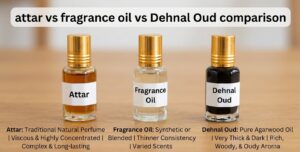
Attar, Fragrance Oil, and Dehnal Oud Are Not the Same Thing
These three terms get used interchangeably online, and that is part of why so much generic advice does not quite fit. A quick, honest breakdown:
| Term | What it actually is | Alcohol content |
| Attar | A concentrated perfume oil traditionally distilled from flowers, woods, spices, or resins (rose, saffron, musk, sandalwood) | None |
| Fragrance oil | A broader, often modern term covering any oil-based scent, natural or synthetic | Usually none, but varies by brand |
| Dehnal Oud | Pure oil distilled directly from agarwood (oud) resin, the most concentrated and expensive of the three | None |
If you are applying a light floral attar, the technique below still applies, but you will use more of it and reapply more often than you would with Dehnal Oud, which is so concentrated that a couple of drops can outlast an entire bottle of ordinary body spray.
It is worth understanding just how labor-intensive genuine attar production is, because it explains both the price and the potency you are working with:
- A single ounce of rose attar can require roughly sixty thousand rose blooms, harvested at dawn before the heat of the day breaks down their volatile oils, then slowly steam-distilled over hours rather than minutes.
- Aged agarwood, the raw material used to make Dehnal Oud, can take decades to develop naturally inside the tree before it is even harvested.
- The distillation process for oud itself is measured in days, not a quick industrial extraction.
None of this is marketing language. It is simply why a small bottle of the real thing costs what it does, and why using it sparingly is not a matter of being frugal. It is the correct way to wear something this concentrated.
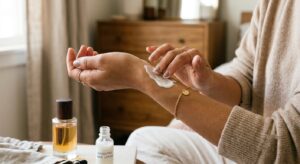
How to Apply Fragrance Oil: Skin Preparation Comes First
This is the step that decides more of your fragrance’s fate than any other, and it is also the step most people rush through or skip. Follow these three steps in order:
- Hydrate first. Fragrance oil clings to the natural lipids and moisture in your skin. Apply it to bone-dry skin, and a good portion of it gets absorbed almost immediately, which means less scent sitting on the surface where anyone, including you, can actually smell it. Apply an unscented lotion, a light layer of petroleum jelly, or a plain carrier oil like jojoba or coconut oil first, and the fragrance oil has something to hold onto instead of vanishing into thirsty skin.
- Time it right. The best time to apply fragrance oil is right after a shower, while your skin is still slightly warm and your pores are open. This is also, conveniently, when many people traditionally apply attar before heading to the mosque for prayer, a practice that traces back to the time of the Prophet Muhammad, who was known to have a deep fondness for fragrance and would apply scent regularly before attending prayers.
- Adjust for Dubai’s air conditioning. If you live or work in heavily air-conditioned spaces, which describes most homes, offices, malls, and cars across the city, your skin loses moisture faster than the international average these tips are usually written for. Cold, dry, recirculated air pulls hydration off the skin surface throughout the day, and less-hydrated skin holds onto fragrance oil for a shorter time. If you notice your attar or Dehnal Oud fading faster indoors than it did the last time you wore it outdoors, dry AC air is very likely the reason. The fix is simple: moisturize a little more generously than you think you need to before applying your fragrance.
Each of the three base options in step one works slightly differently, so pick based on what you are wearing:
- Unscented lotion absorbs quickly and will not compete with the fragrance’s own notes. It is the safest all-purpose choice, especially for lighter attars where you do not want anything else altering the scent profile.
- Petroleum jelly creates more of a barrier than a moisturizer, which slows absorption further. It is worth trying if you find your fragrance oil fading faster than it should despite hydrated skin.
- A natural carrier oil such as jojoba or fractionated coconut oil is the closest match to how attar is traditionally prepared and applied in the Gulf, since many perfumers already use these oils as a base for diluting stronger blends. A thin layer applied first can extend a concentrated Dehnal Oud without diluting the bottle itself.
Why Skin Type Changes the Outcome
Two people wearing the exact same attar can end up with noticeably different results, and skin type is usually why.
- Oilier skin naturally holds fragrance oil longer, since there is already a lipid layer for the scent to bind to. It also tends to amplify base notes like oud and musk a little more than average.
- Dry skin absorbs fragrance oil faster and can make a scent feel like it fades sooner, even though the same amount was applied.
If you have naturally dry skin, the moisturizing step above is not optional. It is the single adjustment that will make the biggest difference to how long your fragrance actually lasts. If you have oilier skin, you can generally use slightly less product to get the same wear time, since your skin is already doing some of the work.
A Quick Patch Test Is Worth the Thirty Seconds
Before applying any new attar or Dehnal Oud to a large area of skin for the first time:
- Dab a small amount on the inner forearm.
- Wait a few minutes and check how it settles.
- Note how the scent develops, since body chemistry can shift how a fragrance smells from one person to the next.
This is not just a caution for sensitive skin. It also tells you how the fragrance actually develops on you specifically. It is a small habit, but it saves you from discovering an unexpected reaction, or an unexpected note, in the middle of a busy day. If you are ever unsure which strength or blend suits your skin, this is exactly the kind of question the team at Rose Valley’s Deira stores helps customers work through in person before they commit to a full bottle.
How to Apply Fragrance Oil to Pulse Points

Target Pulse Points
Pulse points are the areas where blood vessels sit closest to the skin’s surface, generating a small but constant amount of warmth. That warmth is what activates fragrance oil and pushes its scent outward through the day rather than letting it sit inert. As Caroline Sabas, a senior perfumer at Givaudan, has explained, pulse points emit heat, and that heat is what enhances both a fragrance’s presence and its staying power.
The main pulse points to use are:
- Inner wrists. The most common and accessible point, offering steady, all-day diffusion.
- Neck and the base of the throat. Boosts projection, meaning the scent travels a bit further from your body. This is why it is a favorite spot for evening wear.
- Behind the ears. Subtle and close to the body, ideal if you prefer a quieter, more personal scent trail.
- Inner elbows. Good for longevity, because the constant bending motion of the arm helps release the scent gradually throughout the day.
You do not need to hit every single point. Two or three, chosen deliberately, work better than six applied halfheartedly.
Not All Pulse Points Suit Every Fragrance
Here is something that rarely gets mentioned: the best pulse point for you depends partly on what you are wearing.
- A heavy, oud-forward Dehnal Oud with strong base notes like agarwood, amber, or musk benefits from application closer to the body’s core warmth, the neck and chest area, where sustained heat helps the deeper, heavier molecules unfold slowly across the day.
- A lighter floral attar, rose or jasmine for instance, tends to perform better on the wrists and behind the ears, where a gentler, more immediate warmth suits the more delicate top notes without overwhelming them too quickly.
This is not a rigid rule. Skin chemistry varies from person to person, but it is a useful starting point if you have been applying the same fragrance the same way regardless of what it is.

Dab, Do Not Rub
This is the one piece of advice nearly every fragrance guide agrees on, and for good reason. Rubbing your wrists together after applying oil, a habit most people do instinctively, generates friction heat that breaks down the delicate top-note molecules before they have had a chance to develop properly. Chriselle Lim, founder of the fragrance brand Phlur, has explained that rubbing wrists together can break down a fragrance’s top notes and change how the scent develops on skin.
The correct motion, step by step:
- Apply the oil with a light dabbing or pressing motion, using the applicator, whether that is a rollerball, dropper, or your fingertip.
- Avoid rubbing or swiping the two application points together.
- Let it settle into the skin naturally for ten to fifteen seconds before you get dressed or touch anything else.
A note on applicators, since this differs by product type in ways most guides do not cover:
- Rollerball bottles need barely a touch. One light pass across the pulse point is enough.
- Dropper bottles, common for pure Dehnal Oud, should be used one drop at a time. The concentration is high enough that a single drop, dabbed and spread lightly with a fingertip, is often more than enough for several hours of wear.
- Traditional wooden or glass oud sticks, still used for the most concentrated Dehnal Oud varieties, work best with a single gentle stroke directly to the pulse point rather than repeated dabbing, since even a small amount carried on the stick is highly concentrated.

Fabric Anchoring: The Step Nearly Every Guide Skips
This is where Arabian fragrance tradition genuinely parts ways with Western perfume-oil advice, and it deserves a proper explanation rather than a footnote. We call this technique Fabric Anchoring: using cloth and hair, not just skin, as a deliberate application surface.
In the Gulf, fragrance has never been applied to skin alone. It is layered across the collar, the hem, and the hair as well, a practice rooted in the region’s much older bukhoor tradition, where fragrant agarwood smoke is passed through clothing and hair to scent fabric in a way that lingers for hours after the wearer has left a room. Oil clings to skin, but smoke and fabric-applied oil embed into fibers. That is part of why traditional Arabian scenting has historically used three separate delivery methods together rather than relying on just one.
A practical way to apply Fabric Anchoring at home, without needing a bukhoor burner:
- Add a light touch of attar or Dehnal Oud to the inside collar or cuff of clothing before wearing it.
- Run a single drop lightly through dry hair, focusing on the ends rather than the scalp.
- If you do use bukhoor, let the smoke pass briefly through your clothing and hair after applying your oil to skin, rather than before, so the two layers work together instead of one masking the other.
This single habit, treating fabric as a legitimate application point rather than an accident, is usually the biggest difference between a fragrance that fades by early afternoon and one that is still noticeable when you take your jacket off that evening.
The tradition itself runs deep:
- Long before the modern perfume industry existed, the Arabian Peninsula was already trading in frankincense and myrrh along overland routes stretching more than two thousand kilometers, a trade documented with real precision from at least the tenth century BCE.
- Bakhoor, the practice of burning fragrant wood chips soaked in oils and resins, predates the French perfume industry that most Western fragrance advice is quietly built around by roughly three thousand years.
Fabric scenting is not a workaround borrowed from skincare routines. It is the older method, and in many ways, the original one.
Everyday Occasions vs. Special Occasions
You do not need to run the full layering sequence every single morning.
- Regular work day: skin application plus a light touch of Fabric Anchoring on the collar or cuff is usually enough.
- Gatherings, weddings, Eid, or long evenings: reserve the fuller routine described in the next section, with bukhoor through clothing and hair first, for occasions where a stronger and longer-lasting scent trail actually matters.
This is roughly how the tradition has always worked in practice. Bakhoor is burned generously for guests and celebrations, while a simpler attar application carries someone through an ordinary day.
Layering for Longevity: The Base-Body-Breeze Method
Layering fragrance is not a new idea. Most perfume guides mention pairing a scented lotion with a matching spray. The Gulf version of layering is more deliberate, though, and it follows an order refined over generations rather than picked up from a recent trend. We call this sequence the Base-Body-Breeze method, since it moves from the heaviest, most fixative-rich layer to the lightest.
- Base: Bukhoor first, if you are using it, passed through hair and clothing before you are fully dressed, so the smoke has time to settle into fabric.
- Body: Attar or Dehnal Oud on skin, applied to pulse points using the technique above, once your clothing is on and the smoke has cleared.
- Breeze: A lighter spray perfume on top, optional, used mainly to add projection and a fresher top note without overpowering the base you have already built.
The logic here mirrors how a perfume itself is structured: base notes first, then heart, then top. Except in this case, it happens across three different products and delivery methods instead of within a single bottle. Building outward this way means the fragrance you are left with by evening still has depth, rather than a single flat note that faded evenly across the day.
A Few Pairings Worth Trying
If you are building your first layering routine and are not sure where to start, these combinations have stood the test of time for good reason:
- Rose attar with a light oud undertone. One of the oldest pairings in Arabian perfumery, softening oud’s smokier edge with rose’s brightness.
- Musk as a universal base layer. Musk blends well beneath almost any attar or Dehnal Oud, which is why it is often used as the very first layer rather than the star of the combination.
- Amber with sandalwood. A warmer, calmer pairing that suits cooler evenings or indoor gatherings rather than daytime wear.
- Saffron-infused blends with a lighter floral top layer. Adds a spiced warmth without pushing the whole combination into overly heavy territory.
The point of layering is not to stack as many products as possible. Think of it as a short recipe: a base that anchors the scent, a middle layer that adds character, and, if you want it, a light top layer for freshness. Two well-chosen products in the right order will consistently outperform three products chosen at random. Browsing a full fragrance oil range side by side, rather than buying pieces one at a time, tends to make it easier to see which notes actually belong together.
Building Toward a Signature Scent
Once you have experimented with a few pairings, most people naturally settle into a small rotation:
- One combination for daily wear.
- Another for evenings.
- A third reserved for occasions.
This is worth doing deliberately rather than by accident. A signature scent, built around a base you know performs well on your own skin, becomes something people start to associate specifically with you. That is a different experience entirely from wearing whatever happens to be within reach that morning. It also makes application faster and more consistent over time, since you are no longer relearning how a new fragrance behaves on your skin every time you get dressed.

How to Apply Fragrance Oil in Dubai’s Heat
Almost no fragrance guide written for a general international audience accounts for climate, and yet it is one of the biggest variables affecting how long a scent actually lasts on you.
Heat accelerates the rate at which fragrance molecules evaporate and diffuse into the air. This is exactly why perfume always seems to “bloom” faster and project further outdoors in summer than it does on a cool evening. This is not specific to attar or oud; it is true of fragrance generally. It matters more in Dubai than in most of the markets these international guides are actually written for, given how much of the year is spent well above the temperatures those guides assume.
| Condition | Effect on Fragrance Oil | What to Adjust |
| Outdoor heat (summer) | Faster diffusion, stronger initial projection, quicker fade | Apply slightly less than you would in a cooler climate |
| Indoor air conditioning | Cooler, drier air slows diffusion but also dries out skin | Moisturize more generously before application |
| Moving between AC and heat repeatedly | Scent resets and re-blooms each time you step outside, then fades again indoors | Carry a small rollerball or dropper for a light midday touch-up rather than a full reapplication |
The practical takeaway is this: most people in Dubai are actually using more fragrance oil than they need. The region’s heat is already doing a lot of the diffusion work that a heavier hand would otherwise be needed for in a colder climate. A lighter initial application, paired with a small touch-up before an evening event or after a long stretch in AC, tends to outperform one heavy morning application in this kind of climate.
Why Application Technique Has Always Mattered in Arabian Perfumery
It is easy to treat application tips as modern lifestyle advice, the kind of thing that shows up in a magazine column. The care around how fragrance is applied in this part of the world goes back much further than that, and understanding it helps explain why the steps above are not just optional extras.
- Fragrance has held a genuine place in Islamic tradition for centuries, not simply as a grooming habit but as something closer to a small daily ritual.
- Wearing scent before attending prayer is considered a cherished Sunnah, a practice attributed to the Prophet Muhammad, who was known never to refuse a gift of perfume when offered one.
- Muslim perfumers across the early Islamic world refined techniques inherited from ancient Egypt, blending local ingredients like saffron and oud with spices and resins carried in from across the Silk Road.
- Rosewater and musk eventually reached Europe through these same routes by the twelfth century, helping spark the continent’s own perfume industry centuries later.
None of this history is a detour from the practical advice in this guide. It is the reason the advice exists in the first place. A tradition built around applying fragrance deliberately, before prayer, before greeting guests, before a wedding or celebration, naturally develops careful, repeatable technique over generations, because the ritual mattered enough that people paid attention to what actually worked.
The dabbing motion instead of rubbing, the preference for pulse points, and the layering of oil beneath fabric and smoke did not originate in a modern grooming article. They were passed down long before anyone was writing about fragrance longevity online at all, and they have held up because they work. Rose Valley has been part of that same trade in Deira’s Murshid Bazar since 1990, which is part of why this guide leans on tradition rather than borrowed advice from spray-perfume blogs.
Quality Affects Longevity Just as Much as Technique

It is worth being honest about something most application guides skip entirely: no amount of correct technique will make a poorly made or heavily diluted fragrance oil last as long as a well-crafted one. Application is only half the equation.
A few signs of genuine quality worth knowing before you assume a fragrance is underperforming because of how you applied it:
- Depth over the first hour. A well-made attar or Dehnal Oud should still smell rich and multi-dimensional thirty minutes to an hour after application, not thin or noticeably weaker than it was straight out of the bottle. A sharp early drop-off is often a sign of heavy dilution rather than an application error.
- Color and viscosity consistent with the ingredient. Genuine Dehnal Oud tends to be darker and thicker than a diluted or synthetic imitation, though this varies by origin and grade, so it is more of a general signal than a strict rule.
- Where and how it was stored before you bought it. A fragrance oil that has been sitting in a sunlit shop window for months will already have lost some of its potency before it ever reaches your skin, regardless of how carefully you apply it afterward.
Proper Storage Protects the Investment
Since attar and Dehnal Oud are concentrated and often expensive, protecting the bottle matters as much as protecting your skin’s fragrance once it is applied.
- Keep bottles in a cool, dark drawer or cabinet, away from direct sunlight and away from bathroom humidity, which can affect the seal over time.
- Never leave a bottle in a parked car in Dubai, even briefly. Interior car temperatures can climb well past what any fragrance oil is formulated to withstand within minutes, and repeated heat exposure breaks down the aromatic compounds permanently.
- Keep the cap tightly sealed between uses. Oxidation from repeated air exposure is one of the quieter ways a fragrance loses its original character over months of use.
- If you are storing a particularly rare or aged Dehnal Oud, treat it the way you would a fine ingredient in cooking: in a stable, cool environment, used sparingly, rather than left open on a dresser catching sunlight through a window for most of the day.
Common Mistakes That Cut Longevity Short
Some of these apply to any oil-based fragrance. Others are specific to how attar and Dehnal Oud are used in the Gulf.
- Rubbing wrists together. Covered above, but worth repeating because it is the single most common mistake, and the easiest to fix.
- Over-applying concentrated Dehnal Oud. Because it is so potent, more is not better here. It is simply overwhelming, and it means running out of product faster for no gain in wear time.
- Storing oils near heat or direct sunlight, including inside a hot car, which is a genuinely common mistake in Dubai given how quickly a parked car heats up. Heat and UV exposure break down the aromatic compounds in attar and oud oil over time, dulling the scent and shortening its shelf life. Store bottles in a cool, dark drawer or cabinet instead.
- Applying fragrance oil right before exposure to bukhoor smoke, rather than after. Smoke passing directly over freshly applied oil can distort the top notes before they have settled, muddying a scent that would otherwise have developed cleanly.
- Applying to completely dry, unmoisturized skin. As covered earlier, this causes the oil to absorb too quickly rather than sitting on the surface where it can actually be smelled.
- Choosing quantity over technique. A generous initial application on unprepared skin lasts a shorter time than a smaller, well-placed application on properly hydrated skin.
How Long Should Fragrance Oil Actually Last?
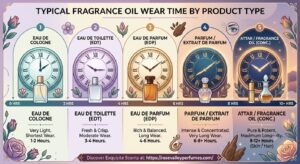
Most articles on this topic quote a single flat number, six to twelve hours, for every kind of fragrance oil. That number is not especially useful once you are comparing something as light as a floral attar to something as concentrated as pure Dehnal Oud.
A more realistic breakdown, based on typical wear patterns:
| Product Type | Typical Wear Time | Notes |
| Light floral attar (rose, jasmine) | 6 to 8 hours | Best on wrists and behind ears; reapply for evening wear |
| Woody or musk-based attar | 8 to 10 hours | Holds well on neck and inner elbows |
| Mukhallat (blended attar) | 8 to 12 hours | Longevity varies with blend composition |
| Pure Dehnal Oud | 12 to 24 hours | Extremely concentrated; a single application often carries into the next day on fabric |
| Western-style fragrance oil (synthetic, alcohol-free) | 6 to 8 hours | Comparable to a light attar |
A few things influence where you land within these ranges:
- Skin type. Oilier skin generally holds fragrance longer than very dry skin.
- The specific fixatives used in the blend.
- How the oil was stored before you bought it.
- Climate, and how much time you spend moving between air conditioning and outdoor heat, as covered above.
How to Reapply Fragrance Oil Without Overdoing It
If a fragrance starts to fade by mid-afternoon, the instinct is usually to reapply at full strength. There is a gentler way to refresh a scent that is still faintly present rather than gone entirely.
- Reapply to fabric before skin for a second application later in the day. A light touch to a collar or scarf refreshes the scent trail without adding another full dose directly to your skin, which can build up unevenly if you are stacking application after application in the same spot.
- A light touch to the hairline works well as a subtle midday refresh, since hair holds fragrance differently than skin and often carries a trace of scent long after the original application on skin has faded.
- Keep a small rollerball or a few drops in a travel vial if you know your day involves long stretches in air conditioning followed by outdoor heat, since that back-and-forth is exactly the pattern that fades fragrance oil fastest in a city like Dubai.
Carrying Fragrance Oil Through the Day
A few practical habits make midday touch-ups easier rather than something you have to think hard about:
- Decant a small amount of your everyday attar or Dehnal Oud into a travel-sized rollerball or vial rather than carrying the full bottle. This reduces the risk of spills and makes a discreet touch-up in a car or office far more convenient.
- Keep it away from direct sunlight inside a bag. A side pocket rather than one that sits against a car window is usually enough.
- If you are heading into a long meeting, a flight, or a gathering where you want the scent to hold particularly well, apply your usual routine about thirty minutes beforehand rather than right as you are walking in. This gives the oil time to settle into skin and fabric properly before anyone is close enough to notice it.
None of this needs to turn into a complicated ritual. Most people who get consistently long wear out of their attar or Dehnal Oud are not doing anything elaborate. They have simply built the small habits above into muscle memory, the same way checking a mirror before leaving the house becomes automatic after enough repetition.
Frequently Asked Questions
How do you apply fragrance oil to your skin?
Moisturize first, then dab a small amount onto pulse points such as the wrists, neck, and behind the ears. Let it settle for a few seconds without rubbing.
Where should you apply fragrance oil for the best results?
Pulse points work best because body heat helps release the scent gradually. Wrists, neck, behind the ears, and inner elbows are the most effective spots.
How much fragrance oil should you use?
Less than most people assume. One or two drops per pulse point is usually enough, and pure Dehnal Oud often needs just a single drop.
Does fragrance oil last longer than perfume?
Generally, yes. Fragrance oil has no alcohol to evaporate, so it releases scent slowly instead of fading in one quick burst.
Can you apply fragrance oil to your clothes?
Yes. A light touch on the collar, cuff, or hem holds scent well, since fabric does not absorb oil the way skin does. Test on an inner seam first with darker or highly concentrated oils.
Does fragrance oil stain clothing?
Most attars and Dehnal Oud do not stain when used in small amounts and given time to settle before dressing. Very concentrated, dark oud oils carry a small risk with light-colored fabric.
Can you mix fragrance oil with lotion?
Yes. Applying an unscented lotion first is actually recommended, since it helps the fragrance oil sit on the skin longer instead of absorbing too quickly.
How long does fragrance oil last on skin?
It depends on the type. Light attars typically last 6 to 8 hours, while concentrated Dehnal Oud can last 12 to 24 hours with proper application.
Building Your Routine
None of this needs to be complicated once it is broken into steps.
- Moisturize before you apply anything.
- Choose two or three pulse points rather than scattering fragrance everywhere.
- Dab, do not rub.
- Use Fabric Anchoring on your collar, hem, or hair if you want the scent to genuinely last into the evening.
- Adjust how much you use based on Dubai’s heat, rather than assuming the same routine that works in a cooler climate will work here unchanged.
- When it starts to fade, refresh it gently rather than reapplying at full strength.
Get those pieces right, and the difference between a fragrance oil that disappears by lunch and one that is still noticeable when you get home is almost entirely in the application, not the product itself.
If you are still building out your collection, it helps to see how different attars, oud oils, and bukhoor actually smell and perform side by side rather than guessing from photos online. Rose Valley’s two branches in Deira’s Murshid Bazar have been doing exactly this kind of hands-on guidance since 1990. If a visit is not practical, the same ranges are available to browse online:
Either way, the technique above works the same regardless of where the bottle comes from. It is simply easier to get right with a fragrance built for this kind of wear in the first place.