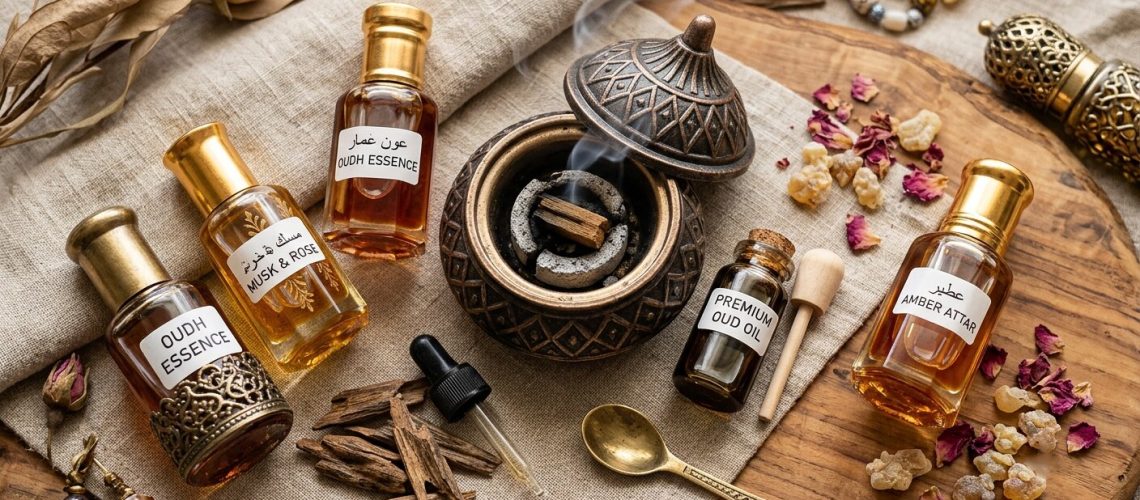
Alcohol-free perfumes are fragrances made with an oil base, such as sandalwood, jojoba, or coconut oil, instead of ethanol. They have been the standard method of scenting the body across Arabia for over a thousand years. Alcohol-free perfumes survive on the skin far longer than a spray because oil binds to the skin’s natural lipids and releases scent slowly through body heat, while alcohol evaporates within minutes and takes the fragrance with it.
What used to be a regional preference tied to religious practice and desert climate is now one of the fastest-growing categories in global perfumery. It is being pulled forward by rising skin-sensitivity concerns, the clean beauty movement, and a new generation discovering attars and oud oils through social media.
At Rose Valley Perfumes, we work with oud, attar, and bakhoor as a daily craft rather than as a novelty category. That hands-on relationship with the raw materials is really what this article is built on. If you’re completely new to the category, our beginner’s guide to oud perfume is a good companion read alongside this one. Everything below comes from that working knowledge combined with current market research, so you’re getting both the tradition and the numbers behind why alcohol-free perfumes are spreading well beyond the Gulf.
What Makes Alcohol-Free Perfumes Different From Regular Perfume?
Alcohol-free perfume is any fragrance concentrate suspended in a carrier oil rather than ethanol. It contains no drying agent and releases scent through slow evaporation instead of a fast alcohol “flash.”
That single distinction changes almost everything about how a fragrance behaves on skin:
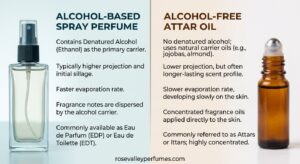
- In a standard alcohol-based Eau de Parfum or Eau de Toilette, ethanol usually makes up somewhere between 70% and 90% of the bottle’s contents, acting as the solvent that carries and quickly disperses the aromatic compounds.
- In an alcohol-free attar or perfume oil, that same aromatic concentrate is dissolved instead in a neutral or semi-neutral oil, most commonly sandalwood, jojoba, coconut, or a light synthetic carrier oil used in mass-market versions.
Here’s a side-by-side look at how the two formats actually compare:
| Feature | Alcohol-Based Perfume | Alcohol-Free Perfume (Attar/Oil) |
| Carrier | Ethanol (denatured alcohol) | Sandalwood, jojoba, or coconut oil |
| Typical concentration | 15–30% fragrance oil | 20–40% fragrance oil |
| Initial sillage (throw) | Strong and immediate | Softer, intimate, builds gradually |
| Longevity on skin | 4–6 hours on average | 8–12 hours or longer |
| Skin effect | Can dry out or irritate sensitive skin | Generally moisturizing and gentle |
| Application method | Sprayed | Dabbed or rolled onto pulse points |
| Halal status | Contested among some Islamic scholars | Considered halal-compliant by most Islamic authorities |
A quick note on why alcohol ended up in Western perfumery in the first place:
- Ethanol is cheap, which keeps mass production costs low.
- It evaporates fast, which gives a spray perfume its immediate, wide-radius “throw” the moment it’s applied.
- Arabian perfumery took the opposite engineering path entirely, prioritizing depth and duration over instant projection, which is the whole reason alcohol-free perfumes behave so differently on the skin.
It’s also worth clearing up a common mix-up before going further:
- “Alcohol-free” and “unscented” are not the same thing. An alcohol-free perfume is still, by definition, a scented product.
- “Alcohol-free” is not the same as “natural.” A perfume can be entirely alcohol-free and still contain synthetic aromatic molecules, and a perfume can contain alcohol while using naturally sourced essential oils.
Understanding that distinction early makes the rest of this article, and honestly, most fragrance shopping in general, a lot easier to navigate.
Attar, Perfume Oil, or Roll-On: Which Alcohol-Free Perfume Is Which?
Shopping for alcohol-free perfumes online can get confusing fast, because “attar,” “perfume oil,” “concentrated perfume oil,” and “roll-on fragrance” are often used almost interchangeably by different sellers, even though they don’t always mean the exact same thing. Here’s how the three most common terms actually break down:
- Attar, in the strictest traditional sense, refers to a fragrance produced through distillation directly into an oil base, following something close to the deg-bhapka method described later in this article.
- Perfume oil is a broader, less regulated term. It can describe an attar, or it can simply describe a modern fragrance concentrate blended into a carrier oil afterward rather than distilled into it. This second method is faster and cheaper, and it doesn’t carry the same centuries-old process behind it. We’ve actually broken down fragrance oil versus spray perfume in more depth if this specific distinction is what brought you here.
- Roll-on fragrance usually refers to a lower-concentration perfume oil packaged for convenience rather than a specific production method at all.
Both attars and modern perfume oils can be genuinely excellent alcohol-free perfumes. If the specific traditional production method matters to you as a buyer, particularly for oud, it’s worth asking the seller directly rather than assuming the word “attar” on a label guarantees deg-bhapka distillation, since the term has become fairly loosely applied across the wider market.
The Arabian Tradition Behind Alcohol-Free Perfumes
Long before “clean beauty” became a marketing category, Arabian perfumers had already built an entire scent culture around alcohol-free formulation. It wasn’t a workaround. It was the intended method from the start.
Attars (Ittars): The Original Alcohol-Free Perfume

An attar, sometimes spelled ittar, is a concentrated botanical fragrance oil produced through steam or hydro-distillation directly into a carrier oil base, most classically sandalwood oil. The result is a perfume that contains no alcohol at any stage of production.
The traditional production method is called deg-bhapka distillation, and it’s worth naming specifically because most articles covering this topic skip straight past it. Here’s how it actually works, step by step:
- Flowers, wood, resins, or other aromatic raw materials are packed into a large copper still, called the deg, along with water.
- The still is heated over a wood or dung fire, allowing the aromatic vapor to rise.
- That vapor travels through a bamboo pipe, called the chonga, into a receiving vessel called the bhapka, which already holds a base oil, usually sandalwood.
- As the vapor condenses, the aromatic compounds bond directly with that oil rather than with water or alcohol.
- The bhapka sits partially submerged in a cool water trough throughout the process, which controls the condensation temperature and keeps the resulting oil stable rather than degraded by heat.
The whole process is slow, sometimes taking several days per batch depending on the raw material. It is still practiced by hand in centers like Kannauj in northern India, and in parts of the wider Gulf region, for high-grade attars today, largely unchanged from how it was done centuries ago.
This matters for a simple reason. It’s the mechanical opposite of how a modern alcohol-based perfume is built:
- A contemporary perfumer typically starts with a concentrated aromatic compound, often called the “juice,” and then dilutes it into an ethanol-water solution at the end of the process.
- In deg-bhapka attar-making, the oil isn’t a diluent added afterward. It’s present from the very first moment of distillation, actively capturing the aromatic vapor as it forms.
- That difference in sequencing is part of why attars tend to carry a rounder, more blended character rather than the sharper, more linear structure typical of alcohol-diluted perfumes.
Some of the most recognizable attar bases and their scent character:
- Sandalwood attar carries a warm, creamy, slightly milky woodiness that also serves as the traditional base oil for other attars.
- Oud attar is deep, smoky, and resinous, drawn from the resin-infused heartwood of the Aquilaria tree. It is generally the most expensive material in Arabian perfumery.
- Amber attar leans sweet, warm, and slightly resinous. It is often blended as a base note to extend other attars.
- Musk attar, in its modern, plant-derived or synthetic form, since natural deer musk is banned under CITES, gives a soft, skin-like, animalic warmth that anchors a blend’s longevity.
- Rose attar (Attar-e-Gulab) is bright, honeyed, and unmistakably floral. It is historically one of the most widely traded attars across both the Gulf and South Asia.
- Jasmine attar (Attar Motia) is another Kannauj classic, steam-distilled from Jasminum Sambac into sandalwood oil. We’ve reviewed it in detail in our Attar Motia guide if you want to see how one specific attar actually performs day to day.
- Mitti attar, distilled from baked earth itself, produces the distinctive scent of the first rain hitting dry ground. It is a fragrance with no true Western equivalent, and one that only makes sense as a concept once you’ve actually smelled it.
Two attars can share the exact same name, “oud attar,” for instance, and still smell meaningfully different depending on which region the agarwood came from, how it was harvested, and how long the batch was aged before bottling:
- Cambodian and Hindi (Indian) oud tend to run darker, muskier, and more animalic.
- Malaysian and Indonesian oud profiles skew slightly sweeter and softer.
We’ve laid out this comparison in more detail in our guide to Hindi Oud versus Cambodian Oud, since the difference genuinely changes which blend suits which occasion. None of this is marketing language. It’s a genuine reflection of how climate, soil, and the specific fungal infection process that creates agarwood resin in the first place all affect the final aromatic profile, in much the same way terroir affects wine.
Bakhoor: Scent as Atmosphere, Not Just Skin
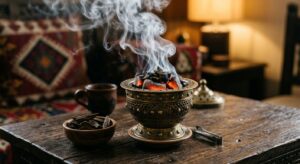
Bakhoor refers to wood chips, most often agarwood, that have been soaked in fragrant oils, resins, or essential oils and then gently burned over charcoal to release fragrant smoke. It is used to scent rooms, clothing, hair, and even skin through smoke exposure rather than direct topical application.
This is a meaningful distinction that a lot of general overviews blur together. An attar is worn directly on the skin, while bakhoor scents the environment and whatever fabric or hair passes through its smoke. In many Gulf households, a small burner called a mabkhara is passed around during gatherings so guests can wave their clothing or hair through the smoke, layering a lingering,
smoky-sweet fragrance that lasts long after the visit ends. If you’d like the full step-by-step, including which charcoal to use and how long to let it ash over, we’ve covered exactly how to burn oud wood at home using the traditional method. It’s common practice to combine both: bakhoor scents the clothing and hair while an attar is worn on the skin, and the two are formulated to complement rather than compete with each other.
Bakhoor itself isn’t a single fixed product either:
- Mu’attar bakhoor refers to wood chips soaked in a liquid fragrance oil blend, often oud, rose, or amber-based. It tends to burn slower with a sweeter, rounder smoke.
- Mabthoothi bakhoor is compressed from a paste of ground agarwood powder mixed with resins and natural binders, pressed into small tablets or cones. It generally burns faster with a sharper, more concentrated aroma.
You can browse both styles in our Bukhoor and Oud Muatter collection if you’d like to compare scents side by side. Outside the home, bakhoor shows up in retail spaces, hotel lobbies, and mosques across the Gulf as a form of ambient branding, long before “scent marketing” became a term used in Western retail design. That same idea, using fragrance to shape how a physical space feels, is now something international hospitality and retail brands are actively studying and adopting.
Cultural and Spiritual Significance
Scent in Arabian culture represents hospitality, personal preparation, and readiness for prayer. This is arguably the single biggest reason alcohol-free formulation became the regional standard rather than a stylistic preference.
A few specific threads worth understanding here:
- Hospitality ritual. Offering bakhoor to a guest, often alongside coffee and dates, is a long-standing gesture of welcome across Gulf households. Refusing it is generally considered impolite.
- Pre-prayer preparation. Many Muslims scent themselves before the five daily prayers as part of personal cleanliness and readiness, a practice with roots in hadith literature encouraging fragrance use, particularly before Friday congregational prayer. Because there is scholarly debate over whether alcohol derived from grain fermentation is permissible to wear on the body during worship, alcohol-free attars sidestep the question entirely.
- Gifting and status. Oud, in particular, has long functioned as a gesture of respect and relationship-building, given as a gift between families, business partners, and dignitaries. The quality and rarity of the oud itself signals the weight of the gesture.
None of this is incidental to why alcohol-free perfumes persisted for centuries in the region while alcohol-based perfumery became the global default elsewhere. It wasn’t that Arabian perfumers lacked access to distillation technology capable of using alcohol. It’s that alcohol-free oil perfumery was already meeting the cultural, religious, and climate-driven needs of the region better than an alcohol-based alternative could.
A Tradition That Traveled Long Before Social Media Did
It’s worth pointing out that alcohol-free perfumes going global isn’t actually a new phenomenon. It’s just moving through a new channel now. The timeline is worth laying out plainly:
- Ancient trade era. Frankincense and myrrh, both resin-based aromatics burned similarly to bakhoor, were among the most valuable traded commodities in the ancient world, moving along what historians often call the Incense Road, connecting southern Arabia to the Mediterranean.
- Cross-continental exchange. Oud and attar traded along the same historic routes that carried spices and silk between the Arabian Peninsula, the Indian subcontinent, and East Africa for well over a thousand years, long before any of it reached Europe or the Americas.
- Mughal refinement. Attar-making is generally credited with reaching a technical peak in the Mughal courts of South Asia, where perfumers refined the deg-bhapka method still used today, before circulating back into Gulf trade networks.
- The digital era. Instead of camel caravans and merchant ships taking generations to build familiarity in a new region, a single short-form video can now introduce a Western teenager to oud attar in under thirty seconds.
What’s actually different today isn’t that alcohol-free perfumes are reaching new markets. It’s the speed and the channel.
Regional Variation Across the Islamic World
Alcohol-free perfumes aren’t culturally uniform even within their own tradition. Treating “Arabian perfume” as one single monolithic style undersells how much regional variation actually exists:
- Saudi Arabia and the UAE – attar houses here tend to favor deep, resinous, oud-forward blends with heavy amber and musk undertones.
- Oman – perfumers lean on frankincense, given the country’s long history as a major producer of the resin.
- South Asia, particularly Kannauj – attar traditions favor rose, jasmine, and earthy mitti attars alongside sandalwood and oud.
Even within a single country, older generations and younger buyers often gravitate toward noticeably different profiles. Younger Gulf consumers are increasingly requesting lighter, more Western-leaning oud blends that still remain fully alcohol-free.
The Science Behind Alcohol-Free Perfumes: Why Oil-Based Scent Lasts Longer
Alcohol-free perfume lasts longer on skin because oil molecules bind to the skin’s natural lipids and release fragrance gradually through body heat. Alcohol, by contrast, evaporates within minutes, carrying the more volatile top notes away with it almost immediately.
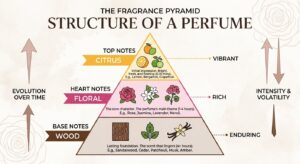
To understand why that matters, it helps to think about how a fragrance is actually built. Perfumers describe scent in three layers, commonly called the fragrance pyramid:
- Top notes – the first, lightest impression, often citrus or aromatic.
- Heart notes – the body of the scent, often floral or spicy.
- Base notes – the heaviest, longest-lasting layer, typically wood, musk, amber, or resin.
In an alcohol-based spray, the ethanol’s rapid evaporation pulls those top notes forward fast and loud, giving that classic “first spray” impact. It also means those same top notes burn off quickly, sometimes within 20 to 30 minutes.
In an alcohol-free attar, there’s no fast-evaporating solvent doing that work. The oil carrier sits on the skin and warms gradually with body heat, releasing the aromatic molecules slowly and steadily rather than in one quick burst. This has two direct consequences:
- The scent projects less dramatically at first application, since there’s no alcohol flash to push it outward. This is why alcohol-free perfumes can feel deceptively subtle in the first few minutes.
- The base notes dominate for much longer, because oil-bound molecules simply take more time to fully evaporate off the skin, often stretching total wear time to 8–12 hours or beyond, well past what most alcohol-based sprays achieve.
There’s also a real dermatological angle here, and this is where the skin-health argument moves from marketing language into something you can actually verify. Alcohol-based perfume has been linked to a few specific skin concerns:
- Barrier breakdown. Dermatology research on alcohol-based cosmetic products has consistently linked ethanol to a breakdown of the skin’s lipid barrier, resulting in dryness, redness, and irritation, particularly with repeated daily application to the same spot on the wrist or neck.
- Photosensitivity. Alcohol can increase skin’s reaction to UV light, occasionally contributing to a pigmentation condition called Poikiloderma of Civatte along the sides of the neck in people who apply spray perfume there for years.
Alcohol-free perfumes simply don’t introduce that variable, since there’s no fast-evaporating solvent stripping lipids from the stratum corneum in the first place. None of this means alcohol-based perfume is “wrong.” It has real advantages in cost, initial projection, and blending versatility that professional perfumers still value. But the mechanism explains, in plain terms, why an attar worn at 7am can still be noticeable at 7pm, while a spray from the same morning has usually faded into nothing by lunch.
There’s one more piece worth understanding, since it explains why alcohol-free perfumes feel so different in how they’re perceived by other people, not just by the wearer. Perfumers use the word sillage to describe the trail a fragrance leaves in the air as someone moves through a room.
Oil-based attars, lacking the alcohol “lift” that carries molecules into the air, tend to produce what perfumers call “skin scent,” or close sillage, meaning the fragrance is more noticeable up close, on a hug or a handshake, than it is from across a room. This isn’t a flaw. It’s simply a different design goal, one that many wearers today, particularly those layering scents or working in shared professional spaces, actually prefer over a fragrance that fills an entire room the moment they walk in.
Why Alcohol-Free Perfumes Are Going Global
Alcohol-free perfumes are expanding well beyond the Gulf because they intersect with several unrelated global consumer movements at once: skin health, ethical sourcing, religious demand, and social-media-driven fragrance culture. Each one is pulling a different audience toward the same category for a different reason.
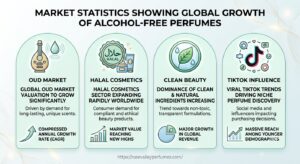
A quick snapshot of the numbers behind this shift, pulled together in one place since they’re usually scattered across separate industry reports:
- The global oud perfume market alone is valued at roughly $4.6 billion, and it is projected to nearly double within the next decade.
- The halal cosmetics market, where alcohol-free formulation is a core requirement, sits well above $47 billion globally and is projected to more than double by the early 2030s.
- The clean beauty market has moved past $10 billion and is climbing toward $35 billion by 2033.
- Nearly half of all social-media-influenced fragrance purchases in the US now trace back to TikTok, a platform where 6 in 10 users belong to Gen Z.
No single one of these numbers explains why alcohol-free perfumes are going global on its own. Taken together, they show four genuinely different consumer motivations, sensory preference, religious compliance, ingredient ethics, and social discovery, all converging on the same category at the same time. That is a far more durable growth pattern than any single trend could produce alone.
Skin Health and Sensitivity Demand
Consumers with sensitive, eczema-prone, or reactive skin are increasingly avoiding alcohol-based fragrance altogether. A few reasons this shift keeps gaining ground:
- Barrier disruption. Dermatological sources are fairly consistent that ethanol dehydrates skin by breaking down its surface lipids and disrupting the epidermal barrier, which increases overall skin sensitivity over repeated use.
- A new formulation niche. A growing category within perfumery, sometimes referred to as dermo-perfumery, is now built specifically around formulating fragrance for compromised or reactive skin, including post-laser treatment, eczema, and general barrier sensitivity.
- An old solution to a new problem. Alcohol-free perfumes were never designed with this modern dermatological framing in mind, but they happen to solve the exact problem this newer niche is now trying to engineer from scratch.
Longevity as a Practical Value Proposition
Longer wear time isn’t just a sensory nicety. It’s a cost-per-wear argument that becomes obvious the moment you actually compare bottles:
- An alcohol-based spray typically needs reapplication every four to six hours to stay noticeable.
- An oil-based attar comfortably carries eight to twelve hours or more on a single application, meaning the attar is doing more work per drop.
- This matters even more in hot, dry climates, where fragrance tends to burn off faster.
We go into this in more detail in our guide to choosing long-lasting perfumes for hot weather, if you’re shopping with heat and humidity in mind.
The Clean Beauty and Vegan Movement
Alcohol-free, oil-based perfumes line up naturally with the global clean beauty shift, which has moved from a niche interest into a serious commercial category. The clean beauty market was valued at roughly $10.5 billion in 2025 and is projected to climb toward $35.3 billion by 2033, driven largely by consumers, especially Gen Z and millennials, actively avoiding synthetic irritants and seeking dermatologist-friendly, naturally derived formulations. The cruelty-free cosmetics segment has followed a similar trajectory, with estimates placing the global cruelty-free cosmetics market between roughly $18 billion and $25 billion, depending on the reporting methodology. Traditional attar and oud production, when sourced responsibly, already checks several of these boxes:
- No animal-derived musk in modern formulations.
- No alcohol-based irritants.
- Increasingly transparent sourcing from agarwood plantations rather than wild-harvested trees, which matters given how heavily wild Aquilaria populations have been pressured historically.
Sustainability and the Oud Sourcing Question
This deserves its own explanation, because it’s genuinely one of the more complicated parts of this industry, and glossing over it would be dishonest. Here’s the chain of cause and effect, laid out step by step:
- Oud comes from Aquilaria trees that only produce the fragrant resin after being infected, naturally or artificially, by a specific mold.
- Wild agarwood harvesting historically meant cutting down infected trees in the forests of Southeast Asia.
- Because only a small percentage of wild trees are naturally infected, this led to significant overharvesting pressure, enough that several Aquilaria species are now listed under CITES, the international convention regulating trade in endangered species.
- That pressure pushed the industry toward agarwood plantation farming, where trees are deliberately inoculated with the resin-producing mold under controlled conditions, allowing oud to be harvested without stripping wild forest populations.
A genuinely sustainable oud house today should be able to tell you, plainly, whether their oud comes from plantation-grown, inoculated trees or wild-harvested sources. That transparency is becoming a real differentiator for buyers who care about where their fragrance materials actually come from, not just how the finished product smells. Our own agarwood explainer goes further into how this resin actually forms inside the tree, and our agarwood and oud collection shows the range of grades this sourcing question actually produces.
Halal-Conscious Consumer Growth
This is one of the biggest drivers behind the global expansion of alcohol-free perfumes, and it’s one almost no competing article on this topic actually names. The numbers behind it are worth stating plainly:
- The global halal cosmetics market was valued at roughly $47–53 billion in 2025–2026, and it is projected by multiple market research firms to roughly double by the early 2030s, with several forecasts placing it above $130 billion by 2034.
- Fragrance specifically within that category is projected to grow at close to a 12% compound annual rate through 2031.
- Demand isn’t limited to Muslim consumers alone. A meaningful share of non-Muslim buyers are choosing halal-certified products specifically because the certification signals purity, ingredient transparency, and cruelty-free formulation.
- Asia-Pacific, not the Gulf, currently accounts for the largest single share of halal cosmetics spending globally, a reminder that halal-conscious demand is a genuinely worldwide consumer force rather than a regional one.
Fragrance Layering and the TikTok Effect
Perhaps the least expected driver of all is this: a Western, largely non-Muslim, Gen Z audience is discovering alcohol-free perfumes through social media, not through religious or cultural tradition, but through the layering trend. A few things worth knowing about this shift:
- On TikTok specifically, social media now influences roughly 45% of fragrance purchases in the US, with Gen Z making up around 60% of TikTok’s user base.
- One of the platform’s defining fragrance behaviors is “scent wardrobing,” where users mix multiple fragrances, often an oil base layered under a lighter spray, to build a signature combination unlike anyone else’s.
- Oil-based fragrances layer particularly well precisely because they don’t evaporate quickly, giving a stable base note foundation that a lighter top-note spray can sit on top of throughout the day.
What started as a purely functional and religious format in the Gulf has, almost by accident, become one of the more sought-after building blocks in a completely unrelated youth fragrance culture on the other side of the world.
How to Choose and Wear Alcohol-Free Perfumes
Getting the most out of an attar or perfume oil comes down to application technique, layering method, and knowing what to actually check on the label before buying.
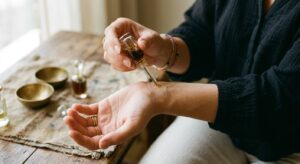
Application technique differs from spraying, and it matters more than people expect. Because there’s no propellant or alcohol pushing the scent outward, alcohol-free perfumes are traditionally applied by dabbing rather than spraying:
- Warm a small amount of oil between your fingertips before applying, which helps the scent open up faster.
- Apply to pulse points where body heat is strongest: inner wrists, the base of the neck, and behind the ears. These areas diffuse the oil most effectively throughout the day.
- Avoid rubbing wrists together after application, a common instinct carried over from spray perfume habits. Friction can break down some of the more delicate aromatic molecules and shorten wear time.
- Reapply only if needed after 8–10 hours, rather than the 4–6 hour habit built by alcohol-based sprays.
Layering bakhoor and attar together follows the traditional Gulf approach. Bakhoor scents clothing and hair through smoke exposure, while attar is worn directly on the skin, so the two fragrances build on each other rather than compete. A simple approach for anyone trying this for the first time:
- Burn a light bakhoor blend to scent an outfit before dressing.
- Apply a complementary attar or Dehnal Oud, ideally from the same base family such as sandalwood or oud, directly to pulse points afterward.
What to actually check when buying alcohol-free perfumes:
- Oil purity – look for clarity on whether the base is a natural carrier oil, such as sandalwood or jojoba, versus a synthetic diluent, since this affects both scent depth and skin feel.
- Concentration percentage – higher fragrance oil concentration generally means stronger, longer-lasting scent, though this varies by brand and isn’t always listed transparently.
- Sourcing transparency – particularly for oud, since sustainably farmed agarwood and wild-harvested agarwood carry very different environmental footprints. Reputable sellers should be able to speak to which one you’re buying. Our guide on avoiding scams when buying perfume in Dubai covers this in more detail, including how to check batch codes.
- Patch testing before full use – apply a small amount to the inner forearm and wait 24 hours, especially with deeper oud or musk blends, since even natural ingredients can trigger sensitivity in some people.
Storage matters more with oils than most people assume. Keep attars and perfume oils away from direct sunlight and heat, ideally in a cool, dark drawer rather than a bathroom shelf exposed to steam and temperature swings, since heat and UV exposure can gradually degrade the more delicate aromatic compounds over time. If you’d rather see and smell the options before buying, both of our Deira branches, listed on our contact page, carry the full attar, bakhoor, and Dehnal Oud range in person.
Who Alcohol-Free Perfumes Actually Suit Best
While attars and oil-based perfumes work well for most people, a few specific groups tend to get the most noticeable benefit from switching. It’s worth being specific about who they are rather than framing this as a universal upgrade for everyone.
- People with sensitive, eczema-prone, or easily irritated skin. They often notice a real, tangible difference within the first few uses simply from removing a drying solvent from their daily routine.
- Anyone observing Islamic prayer practice. Alcohol-free attars remove the ambiguity around wearing alcohol-based fragrance before worship entirely.
- People who reapply fragrance constantly throughout the day. The longer wear time of an oil-based attar often means one application genuinely covers a full day rather than three or four touch-ups.
- Fragrance layering enthusiasts. They benefit from an oil base’s ability to hold steady underneath lighter top-note sprays without competing or fading early.
- Anyone who finds spray perfume’s initial blast overwhelming, whether due to sensitivity to strong smells, shared office environments, or simply a personal preference for a subtler, more intimate scent presence.
That said, someone who specifically wants a fragrance to fill a room the moment they walk in, at a formal event, for instance, may still prefer the stronger initial sillage of a traditional alcohol-based spray, and there’s nothing wrong with reaching for either format depending on the occasion. The two aren’t in competition so much as they’re built for different goals.
Frequently Asked Questions
What is alcohol-free perfume?
Alcohol-free perfume is fragrance dissolved in a carrier oil, such as sandalwood or jojoba, instead of ethanol. It includes traditional attars as well as modern perfume oils.
Do alcohol-free perfumes last longer than alcohol-based ones?
Often, yes. Oil-based attars typically last 8–12 hours because oil releases scent slowly through body heat, while alcohol-based sprays usually fade within 4–6 hours as the ethanol evaporates.
Are alcohol-free perfumes better for sensitive skin?
Generally, yes. Ethanol can strip the skin’s natural lipid barrier and cause dryness or irritation. Oil-based alcohol-free perfumes skip that solvent entirely, which makes them gentler for eczema-prone or reactive skin.
Is oud perfume halal?
Oud itself is halal. Whether a specific oud perfume is halal-compliant depends on the carrier. An oud attar in an oil base is generally accepted as halal, while an oud fragrance in a grain-derived alcohol base is subject to ongoing scholarly debate.
Are alcohol-free perfumes more expensive?
Sometimes, yes, though not always. Attars often carry a higher fragrance oil concentration and require slower, more labor-intensive production, which can push the price up compared to a mass-produced alcohol-based spray of similar volume.
Can alcohol-free perfume stain clothing?
Yes, more so than alcohol-based perfume. Because attars are oil-based, they can leave faint marks on light-colored or delicate fabrics if applied directly to fabric rather than skin.
How do you apply alcohol-free perfume correctly?
Dab, don’t spray. Warm a small amount between your fingertips and apply to pulse points, such as the wrists and neck, where body heat helps the scent develop throughout the day.
Is alcohol-free perfume the same as natural perfume?
No. Alcohol-free describes the carrier, while natural describes the aromatic ingredients. A perfume can be alcohol-free and still contain synthetic fragrance compounds, and vice versa.
Why is alcohol used in perfume in the first place?
Alcohol is cheap, evaporates quickly, and disperses scent widely the moment it’s applied, which gives spray perfume its strong initial projection. That same speed is what causes it to fade faster than an oil-based alternative.
Do alcohol-free perfumes expire faster than alcohol-based ones?
It depends on the format. Alcohol acts as a natural preservative, so some very light, water-based alcohol-free fragrances can lose intensity sooner. Resin-heavy oud and sandalwood attars, however, are the exception, and are widely known to deepen and mellow with age when stored away from heat and light.
Whether you’re drawn to alcohol-free perfumes because of skin sensitivity, halal compliance, sustainability values, or simply because a layering video on your feed introduced you to oud for the first time, the underlying craft is the same one perfumers in the region have been refining for over a thousand years. If you’re ever passing through Deira, our Murshid Bazar location is worth a visit for exactly that reason, and our full attar and oud collection is also there to browse online if you’d rather start exploring from home.