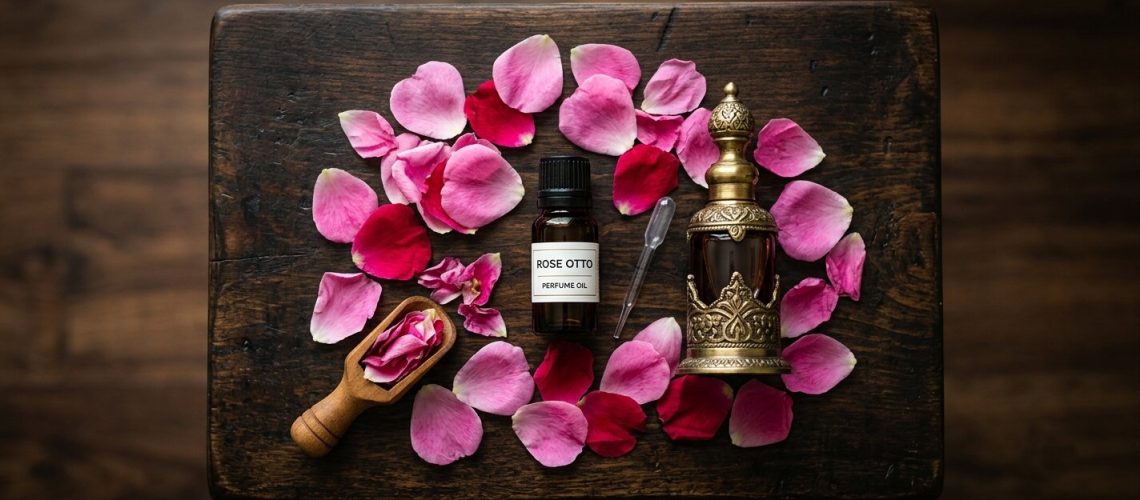
Walk into any traditional fragrance souk in Deira or a modern niche perfumery in Dubai Mall, and one scent will keep finding you: rose. Not the thin, soapy rose of a drugstore body spray, but something denser, warmer, almost edible – a rose that smells like it was grown in punishing heat and harvested by hand before sunrise.
That is Taif rose oil, and it sits at the very heart of Arabian perfumery.
We source and test rose-based attars regularly at Rose Valley Perfumes, and much of what follows reflects that hands-on experience: what genuine Taif rose oil actually smells like, how it behaves on skin in Gulf heat and humidity, and how to tell real Taif damascena rose oil apart from diluted or synthetic imitations flooding the market.
Why Rose Oil Matters So Much in Arabian Perfumery
Rose holds a privileged position in this fragrance tradition for several reasons:
- Cultural weight: Rose is tied to hospitality, religious ritual, and celebration across the Arabian Peninsula, not just to romance.
- Structural role: In attar-making, rose oil is one of the few naturals rich enough to act as both a heart note and a near-complete fragrance on its own.
- Economic value: Genuine Taif rose oil is one of the most expensive raw materials in the perfume industry, often compared to oud and saffron in price per gram.
- Sensory contrast: Its jammy, slightly spicy, honeyed profile pairs unusually well with heavier Arabian materials like oud, amber, and musk – a pairing rarely used in Western perfumery.
- Rarity among florals: It is one of the only floral oils with enough natural intensity and longevity to be worn essentially undiluted.
- Cross-generational appeal: The same rose attar style appeals to older customers who grew up with traditional oil perfumes and to younger buyers rediscovering natural fragrance.
- Regional specificity: “Rose oil” in a Dubai perfume shop almost always implicitly means Taif or, less commonly, Bulgarian or Turkish damask rose, not the lighter, commercial rose varieties used in many Western perfumes.
The History of Rose Oil in Arabian Perfumery
Taif’s Legendary Rose Fields
Key facts about Taif and its role in rose cultivation:
- Location: Perched roughly 1,800 meters above sea level in Saudi Arabia’s Sarawat Mountains.
- Climate advantage: Cool nights, warm days, and mineral-rich mountain soil, close to ideal conditions for Rosa damascena, the damask rose species prized worldwide for perfumery.
- Historical roots: Rose cultivation in Taif is believed to date back centuries, likely introduced along old trade and pilgrimage routes connecting the region to Persia and the wider Islamic world.
- Cultivation method: Roses are grown on stone-terraced hillsides that retain moisture and moderate temperature swings.
- Pruning style: Bushes are pruned to encourage dense, low growth rather than tall stems, maximizing flower yield per plant.
- Harvest window: Roughly six weeks, typically from late March through early May, depending on rainfall and elevation.
- Scale today: Hundreds of family-run rose farms, many passed down for four or five generations, producing an estimated 300–500 million rose blooms each harvest season, still picked almost entirely by hand at dawn.

The Rose in Islamic and Bedouin Culture
Rose water and rose oil hold a status in Arabian and Islamic tradition that goes well beyond fragrance:
- Religious use: Rose water has historically been used to cleanse the Kaaba in Mecca, a practice that continues in modified form today.
- Hospitality ritual: Offering rose water to guests, sprinkled on hands or clothing, remains a gesture of welcome across the Gulf.
- Bridal and celebratory tradition: Rose oil and rose-based attars are central to wedding preparations, particularly in Saudi Arabia, the UAE, and Oman.
- Bedouin practicality: In a desert environment where bathing water was historically scarce, concentrated oil-based perfumes like attars – rose prominent among them – served both scent and hygienic functions, since alcohol-based perfumes were also religiously discouraged for prayer.
- Gift-giving tradition: Rose oil and rose attars remain a common gift across the Gulf for weddings, Eid celebrations, and homecomings, often presented in ornate glass or crystal bottles.
Why this matters for buyers today: this layered cultural role is why rose oil never became a “seasonal” ingredient in Arabian perfumery. It has remained a constant for generations, which is also why counterfeit and heavily diluted “rose oil” products are such a persistent problem in the market.
How Rose Oil Is Made for Arabian Perfumery
The Harvest Ritual
Rose harvesting in Taif follows a strict, time-sensitive sequence:
- Pre-dawn picking captures the flowers before heat causes their volatile aromatic compounds to begin evaporating.
- Each rose is harvested by hand, bloom by bloom, because mechanical harvesting damages the delicate petals and reduces oil yield.
- Pickers can gather roughly 7,000–10,000 blooms per day, an extraordinary pace given the care required.
- Flowers must reach the distillation site within hours of picking, since delays measurably degrade extractable oil quality.
Why it’s so expensive:
- It typically takes 3,500–4,000 kilograms of fresh rose petals to produce just one kilogram of pure rose oil.
- This ratio is repeated by distillers across Taif, Bulgaria’s Rose Valley, and Turkey’s Isparta region.
- It is the single most important fact behind why authentic rose oil is never cheap.
The Economics of Rose Farming in Taif
Beyond the yield ratio itself, several other factors compound rose oil’s cost:
- Labor intensity: Every bloom is picked, sorted, and transported by hand – there is no viable mechanized equivalent for perfumery-grade petals.
- Narrow harvest window: With only about six weeks of usable harvest per year, farms cannot simply “produce more” on demand.
- Weather sensitivity: A poor rainfall year, an early heatwave, or an unexpected cold snap can significantly reduce both petal volume and oil concentration.
- Multi-generational land ownership: Many Taif rose farms are small, family-held plots rather than large industrial operations, limiting economies of scale but preserving traditional growing methods.
- Growing international demand: Rising global interest in natural, traceable perfumery ingredients has pushed prices further upward.
Practical takeaway for buyers:
- Year-to-year price fluctuations in genuine rose oil are normal and expected.
- A seller whose rose oil pricing never changes, regardless of harvest conditions, may be selling a standardized synthetic product rather than a true agricultural commodity.
Extraction Methods: How Rose Oil Becomes Perfume Material
Not all “rose oil” on the market is produced the same way, and the method genuinely changes the final scent and price point.
- Steam distillation
- The traditional and most common method for producing rose otto (the pure essential oil).
- Petals are steamed in copper stills; the aromatic compounds evaporate with the steam, then condense and separate from the water.
- Produces a thick, intensely concentrated oil that solidifies slightly in cool temperatures, a genuine authenticity marker.
- The method most associated with classical Taif rose oil production.
- Solvent extraction (absolute)
- Petals are treated with a solvent (traditionally hexane) to pull out aromatic molecules, later refined into a “rose absolute.”
- Yields a fuller, more true-to-flower scent profile than steam distillation, since it captures compounds that heat can destroy.
- Used more in Western and French perfumery (notably Grasse) than in traditional Taif attar production.
- Enfleurage (largely historical)
- An older, labor-intensive method using fat to absorb fragrance from petals.
- Rarely used commercially today due to cost, though some artisanal producers still experiment with it.
- Rose concrete and rose absolute
- A two-step solvent process: petals first produce a waxy “concrete,” which is then further refined into a more liquid “absolute.”
- Smells noticeably closer to a fresh, living rose than rose otto, since less heat is involved in extraction.
- Not typically used in traditional Taif attar-making, but increasingly available in Dubai’s more contemporary, niche-style perfumeries.
Standard for most Arabian attars: steam-distilled rose otto, either used directly or blended with a carrier oil (commonly sandalwood or a synthetic base) to extend it, since pure rose otto is extremely potent and expensive undiluted.
Chemical Composition and Scent Profile
Rose otto’s complexity comes from over 300 identifiable aromatic compounds, though a handful dominate the character:
- Citronellol and geraniol – bright, slightly citrusy floral top notes
- Nerol and phenylethanol – the classic “true rose” honeyed sweetness
- Rose oxide – a small but powerful component responsible for rose oil’s distinctive green, slightly metallic edge
- Farnesol – contributes to the soft, waxy depth in the base
What this means practically:
- Genuine Taif rose oil rarely smells like a simple, one-note flower.
- Expect a scent that opens bright and slightly sharp, settles into a deep honeyed floral heart, and dries down with a faint waxy, almost fruity warmth.
- A “rose oil” that smells flat, syrupy-sweet, and identical from first spray to last is usually synthetic rather than genuine rose otto.
Rose Oil Grading and Purity Terms You’ll Encounter
Shopping for rose oil in Arabian perfumery means running into a handful of specialist terms. Here’s what they actually mean:
- Rose Otto: The pure essential oil produced by steam distillation, the gold standard for perfumery-grade rose oil.
- Ruh Gulab: A South Asian and Gulf term for pure rose otto, commonly used interchangeably with “rose otto” in attar shops.
- Rose Absolute: A solvent-extracted rose oil with a fuller, more “living flower” scent profile than otto, less common in traditional Taif attars.
- Mitti Attar: Not rose-specific, but frequently sold alongside rose attars; a traditional “earthy” attar sometimes blended with rose for depth.
- Gulab Attar: A general term for rose attar, often used for rose oil pre-blended into a sandalwood or synthetic carrier base.
- Mukhallat: An Arabic term for a custom-blended perfume oil, frequently built around a rose oil or rose-oud foundation.
- Percentage dilution (e.g., “10% rose otto”): Indicates how much pure rose oil is present in the final blend, the single most useful number for comparing value across products.
Knowing these terms before you shop makes it far easier to ask precise questions and avoid paying premium prices for heavily diluted products.
Common purity mistakes to watch for:
- Assuming “Ruh Gulab” and “rose fragrance oil” are the same thing (they are not, the second is usually synthetic).
- Skipping the dilution percentage question because a seller uses confident, technical-sounding language.
- Confusing rose absolute (often deeper amber-red in color) with rose otto (typically pale yellow to olive-green).
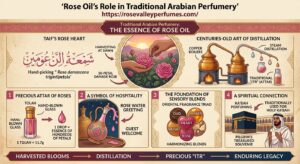
Rose Oil’s Role in Traditional Arabian Perfumery
Attars and Ittars: Oil-Based Perfumery’s Backbone
Attar (also spelled ittar) refers to natural, oil-based perfumes traditionally produced without alcohol, a format especially significant across the Gulf, South Asia, and the wider Islamic world. For a deeper look at how this tradition works, our earlier piece on alcohol-free perfumes and the Arabian tradition covers that history in more detail.
Rose sits among a small handful of “mother” attars, foundational scents that perfumers build entire compositions around, alongside oud, musk, and saffron. In classical attar-making:
- Rose oil is often used as the base extraction medium itself, meaning other materials (like saffron or sandalwood) are distilled directly into rose oil rather than a neutral carrier.
- This produces layered, complex attars where rose is present but not necessarily the dominant note, a technique unfamiliar to most Western perfume buyers.
- Pure Taif rose attar, sold without blending, remains one of the most requested single-note attars in Gulf fragrance markets.
- Attar-makers distinguish between “single note” rose attars, meant to showcase rose on its own, and “compound” attars, where rose is deliberately layered with other materials.
Oud and Rose: The Signature Arabian Pairing
If there is one combination that defines contemporary Arabian perfumery for international audiences, it is oud and rose:
- Oud brings deep, smoky, animalic, woody weight.
- Rose brings brightness, sweetness, and lift.
- Together, they create a contrast that neither note achieves alone, heavy but not suffocating, sweet but not saccharine.
This pairing shows up constantly in Dubai’s fragrance market, from mass-market mall perfumes to ultra-premium boutique attars.
- Shoppers exploring this combination often start by browsing a dedicated Dehnal Oud collection to compare how different oud grades and origins change the way a rose-oud blend wears.
- It has also become the signature scent profile most associated internationally with Middle Eastern perfumery, to the point that many Western niche fragrance houses now market their own “oud rose” lines specifically to evoke this tradition.
Bakhoor and Rose
Beyond liquid perfume, rose oil is frequently used to scent bakhoor, wood chips soaked in fragrant oils and burned as incense, a practice deeply embedded in Gulf hospitality culture. Rose-soaked bakhoor is commonly burned:
- When welcoming guests into a home
- During weddings and engagement ceremonies
- In retail spaces, including many Dubai perfume shops, as ambient scenting
Worth knowing:
- Shops that specialize in bukhoor and oud muatter often carry rose-infused blends specifically for this purpose, alongside more traditional oud-forward options.
- This dual use – worn on skin and burned as incense – is part of what makes rose oil so pervasive across Arabian fragrance culture. It is rarely just a “perfume ingredient”; it is a household and social ritual material.
Signature Rose-Based Attar Styles Popular in Dubai
Beyond generic “rose oil,” Dubai’s fragrance shops typically stock a few recognizable rose-based attar styles. Knowing these makes browsing far easier:
- Pure Gulab Attar – single-note rose, showcasing Taif rose oil with little to no blending, favored by traditionalists.
- Rose Oud Mukhallat – the classic contrast blend, rose brightness layered over smoky, woody oud.
- Rose Musk – a softer, skin-close composition where musk extends rose’s wear time and rounds off its edges.
- Rose Saffron – a warmer, spiced variation often positioned as a premium gifting option.
- Rose Amber – a deeper, more resinous blend, generally favored for cooler-weather or evening wear.
- Rose Sandal – rose oil paired with sandalwood, a milder, creamier profile popular for daily office wear.
- White Rose blends – lighter, greener rose compositions, often marketed toward those who find pure Taif rose otto too intense for everyday use.
Each style pulls from the same core material but delivers a noticeably different wearing experience, which is why testing more than one is worthwhile before settling on a signature scent.
How Dubai’s Climate Affects Rose Oil Wear
Buyers shopping for rose oil in Arabian perfumery while living in or visiting Dubai should factor in one variable that rarely comes up in generic fragrance guides: heat.
- Higher temperatures increase projection. Oil-based fragrances rely on body heat to release their aromatic molecules, so a rose attar that feels moderate in a cooler climate can project noticeably stronger in Dubai’s average daytime heat.
- Sweat and humidity change how rose reads on skin. Rose’s honeyed sweetness can intensify in humid conditions, while its lighter top notes fade faster, so the floral character often feels warmer and heavier by midday.
- Application quantity should be adjusted seasonally. Many long-time attar wearers in the Gulf apply noticeably less rose oil in summer months than in cooler winter evenings.
- Storage matters even more locally. Cars, handbags left in direct sun, and un-air-conditioned storage rooms can degrade rose oil far faster in Dubai than in temperate climates.
- Layering choices shift with the seasons. Rose paired with lighter musk tends to suit Dubai’s hotter months, while rose layered with oud or amber is more commonly favored during the cooler winter season, particularly for evening wear.
Practical impact: this climate relationship directly affects how much rose oil to apply, which pairing to choose, and how a bottle should be stored between uses.
Rose Oil for Different Occasions in Dubai
Choosing between rose oil formats often comes down to the occasion. A quick reference:
- Daily office wear: A lighter rose-sandal or rose-musk blend, applied sparingly to avoid overwhelming shared spaces.
- Evening events and dinners: Rose paired with oud or amber for a richer, longer-lasting projection.
- Weddings and celebrations: Pure rose attar or rose-saffron blends, in keeping with regional gifting and celebratory tradition.
- Travel and daytime errands: A diluted rose oil blend, since Dubai’s heat naturally amplifies projection outdoors.
- Gifting: Ornately bottled rose-oud mukhallats, which combine visual presentation with the region’s most recognizable scent pairing.
Rose Oil Compared to Other Signature Arabian Perfumery Materials
Rose oil is best understood in context. It is one of several “pillar” materials in Arabian perfumery, each playing a distinct role.
| Material | Scent Character | How It Pairs With Rose | Typical Role in a Blend |
| Rose | Bright, honeyed, floral | Foundation note | Heart note, or the base medium itself |
| Oud | Smoky, woody, animalic | Contrast and depth | Base note, adds weight and longevity |
| Musk | Soft, skin-like, warm | Softens and extends | Base note, boosts wear time |
| Saffron | Warm, leathery, spiced | Adds richness | Heart-to-base transition |
| Amber | Resinous, balsamic | Deepens and warms | Base note for cooler-weather blends |
Why this matters: product names like “Rose Oud,” “Rose Musk,” and “Saffron Rose” seen in Dubai fragrance shops are not arbitrary marketing labels. They describe genuinely distinct scent experiences built on rose oil as a common foundation.
From Taif to Dubai: The Journey of Rose Oil
Historic Trade Routes
- Rose oil and rose water moved across the Arabian Peninsula via pilgrimage and trade routes connecting Mecca, Medina, and Taif to broader Gulf trading ports.
- Merchants carried rose products alongside frankincense, myrrh, and later oud, as pilgrims and traders moved between the Hejaz region and coastal trading cities.
- Dubai’s own rise as a trading port in the 19th and 20th centuries, well before oil wealth transformed the emirate, was built partly on this same goods exchange: pearls, spices, textiles, and fragrance materials moving through its creek-side souks.
Dubai as a Modern Global Fragrance Hub
Today, Dubai functions as one of the world’s most important re-export and retail hubs for luxury fragrance materials, including rose oil, oud, and attars sourced from Saudi Arabia, India, Cambodia, and beyond. Reasons Dubai holds this position:
- Geographic centrality between South Asia, the Gulf, and international shipping lanes
- Free-zone trading infrastructure that simplifies import and re-export of raw perfume materials
- A deeply fragrance-literate consumer base, where attars and oud are everyday purchases rather than niche luxury
- Tourism volume, drawing international buyers specifically seeking authentic Arabian perfumery
Two things worth knowing as a buyer:
- Dubai’s fragrance shops, from the historic Perfume Souk in Deira to contemporary boutiques across the city, carry some of the most extensive and highest-quality rose oil and rose-attar selections available anywhere in the world.
- Dubai is largely a distribution and retail hub rather than a rose-growing region itself. Nearly all rose oil sold in Dubai is imported, primarily from Saudi Arabia, Bulgaria, and Turkey, then blended, bottled, or incorporated into finished attars locally. A perfume “made in Dubai” refers to blending and finishing, not to the rose being grown there.
Quality Control on the Journey
Not every drop of “Taif rose oil” sold internationally is genuine. Reputable Dubai-based perfumers and suppliers typically address this through:
- Direct sourcing relationships with named Taif farms or cooperatives, rather than anonymous bulk suppliers
- Batch testing, since natural rose oil composition shifts slightly year to year based on harvest conditions
- Transparent labeling distinguishing pure rose otto from rose-oil blends or rose-scented synthetic alternatives
If you are buying rose oil with the intention of blending it yourself, sourcing transparency should be a non-negotiable factor.
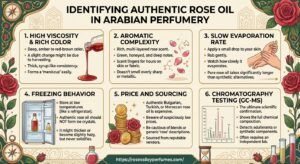
How to Identify Authentic Rose Oil in Arabian Perfumery
Given how much counterfeit and heavily diluted “rose oil” circulates in fragrance markets, here is what to check:
- Price consistency: Pure Taif rose otto is genuinely expensive; if a “pure rose oil” is priced dramatically below market averages, it is very likely diluted or synthetic.
- Texture at cool temperatures: Genuine rose otto tends to thicken or partially solidify when chilled, then re-liquefy at room or skin temperature. Pure synthetic oils typically stay liquid regardless of temperature.
- Scent evolution: Authentic rose oil changes character over the first 20–30 minutes on skin, moving from a brighter opening to a deeper, honeyed drydown. Flat, unchanging scent is a red flag.
- Absence of harsh sweetness: Genuine rose otto has a slightly green, almost peppery undertone alongside its sweetness. Purely sugary, one-dimensional “rose” smells are usually synthetic.
- Country and farm sourcing information: Trustworthy sellers can tell you, at minimum, the country of origin (Saudi Arabia, Bulgaria, Turkey, or occasionally Morocco), and reputable specialists can often name the specific growing region or season.
- Small-batch variation: Because rose oil is agricultural, tiny scent differences between harvest years are normal and actually a good sign; perfect uniformity across years often points to standardized synthetic production instead.
Common Mistakes to Avoid When Buying Rose Oil in Arabian Perfumery
Even experienced fragrance shoppers make avoidable mistakes:
- Assuming “natural” means “pure.” Many products labeled “natural rose fragrance oil” are natural-sourced aroma chemicals rather than genuine rose otto.
- Judging purely by scent strength. Diluted or synthetic rose oils are sometimes formulated to smell more intensely “rosy” on first impression than genuine otto, which can be deceptively subtle at first.
- Buying based on bottle presentation alone. Elaborate crystal bottles and elegant packaging are common across all quality tiers and are not, by themselves, an indicator of what is inside.
- Not asking about dilution ratio. A “rose oil” blended at 3% rose otto in a carrier oil is a completely different product from one blended at 20%, even though both may be marketed simply as “rose oil.”
- Overpaying for brand name alone. Some premium-branded attars charge significantly more for packaging and marketing than for the rose oil content itself.
- Storing oil incorrectly after purchase. Even genuine, high-quality rose oil will degrade quickly if left in direct sunlight or a hot car.
- Skipping the skin test. Paper blotter tests alone do not reveal how rose oil will actually smell and evolve on your own skin chemistry.
Rose Oil in Dubai’s Fragrance Shops Today
The Souk Experience
Dubai’s Perfume Souk in Deira remains the most atmospheric place to encounter rose oil in its most traditional retail form:
- Shops are often family-run, sometimes for two or three generations, with staff who can speak knowledgeably about origin and blending.
- Rose oil is frequently sold both pure and as part of custom-blended attars, mixed on request while you wait.
- Bargaining is expected and part of the shopping culture; quoted prices are rarely final, especially for larger quantities.
- Quality varies significantly shop to shop, which is why reputation and repeat local customers matter more than shopfront appearance.
Modern Niche and Luxury Perfumeries
Alongside the traditional souk experience, Dubai has developed a thriving contemporary perfumery scene:
- Local heritage houses producing modernized attars and oud-rose blends for both regional and international buyers, including a full perfumes collection spanning traditional and contemporary styles.
- Mall-based boutiques offering climate-controlled retail experiences with wider international shipping options.
- International niche perfume brands with Dubai flagship stores, many of which now feature Arabian-inspired rose and oud compositions designed for this market.
For a closer look at how these styles show up in menswear fragrance specifically, our guide to Arabic perfumes for men in Dubai walks through some current favorites.
First-Hand Notes: What to Expect When Testing Rose Oil in a Dubai Shop
Testing rose oil in person is genuinely different from testing alcohol-based perfume:
- The first impression is deceptive. On initial application, pure rose otto can smell almost sharp or slightly medicinal rather than immediately “pretty”; this fades within minutes as the oil warms on skin.
- Application quantity matters more than with sprays. Attars are applied by hand or with a small wand, so it’s easy to apply too little or too much on a first test. Our guide on how to apply fragrance oil for maximum longevity covers pulse-point placement and layering technique.
- Give it time before deciding. Oil-based rose attars often need 30 to 60 minutes to fully settle into their true scent profile, unlike alcohol-based perfume, which reveals most of its character within 15 minutes.
- Body heat changes everything. The same rose oil can smell noticeably different on two people, or on the same person on a hot versus cooler day.
- Ask to smell it on a blotter and on skin. Comparing both gives a more complete picture.
- Do not rush the decision. Reputable shops generally expect customers to spend real time testing before purchasing, especially for higher-value pure rose oils.
What to Expect Price-Wise
Pricing for rose oil and rose-based attars in Dubai varies enormously depending on purity and format:
- Pure Taif rose otto (undiluted): often among the most expensive fragrance materials by weight, reflecting the petal-to-oil ratio discussed earlier.
- Rose oil blended in a carrier (sandalwood, jojoba, or synthetic base): significantly more affordable, with wide quality variation.
- Branded oud-rose attars: pricing driven as much by oud grade and brand positioning as by the rose content itself.
- Mass-market rose-scented oils: inexpensive, but usually contain little to no genuine rose otto.
Rule of thumb: if a small vial of “pure rose oil” is priced similarly to a supermarket body spray, it almost certainly is not pure rose oil.
How Rose Oil Is Used in Perfume Composition
As a heart note
- In classical perfume structure (top, heart, base), rose typically occupies the heart, emerging after initial top notes fade and lasting well into the fragrance’s development.
- Its relatively slow evaporation rate compared to citrus or light florals gives it staying power beyond the first hour.
As a modifier and blender
- Perfumers use rose oil to soften harsher materials, oud in particular, smoothing sharp, smoky, or animalic edges into something more wearable.
- It also amplifies other florals in a blend, often used in small quantities even in compositions not explicitly marketed as “rose” fragrances.
As a base medium in attar-making
- Rose oil is sometimes used as the extraction medium itself in traditional attar production, meaning saffron, agarwood, or other materials are infused directly into it rather than a neutral carrier oil.
- This produces attars where rose is structurally present throughout the scent, even when it is not the dominant note on first smell.
Common pairings in Arabian perfumery
- Rose + oud – the signature contrast pairing
- Rose + saffron – adds warmth and a subtle leathery spice
- Rose + musk – softens rose’s brightness into something skin-like and sensual
- Rose + amber – deepens rose into a warmer, more resinous composition
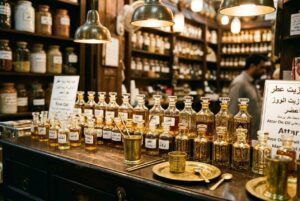
Buying Guide: Choosing Rose Oil in Arabian Perfumery for Dubai Shoppers
- Decide your purpose first. Are you buying pure rose oil for personal blending, or a finished attar or perfume for daily wear? Pure oil is more versatile but far more concentrated and expensive.
- Ask about origin explicitly. A trustworthy seller should be able to tell you whether the rose oil is from Taif, Bulgaria, or Turkey, and roughly what harvest season it is from.
- Request a skin test, not just a paper strip test. Rose oil develops differently on skin than on blotting paper; genuine oil should evolve noticeably over 30–60 minutes.
- Compare concentration levels. Ask whether you are buying pure rose otto, a rose oil blend, or a rose-scented synthetic. Browsing a dedicated fragrance oil collection is often the fastest way to compare concentration and pricing across several options at once.
- Check for consistent labeling. Reputable sellers will clearly state dilution ratios (for example, “10% rose otto in sandalwood oil”) rather than vague marketing language alone.
- Buy a small quantity first. Especially for pure rose otto, start with a small vial before committing to a larger purchase.
- Consider storage conditions at the shop. Oils stored in clear bottles under direct display lighting are a minor quality red flag.
- Ask about return or exchange policy. Reputable perfumeries typically allow exchanges if a scent does not develop as expected on your skin within a short window.
- Factor in climate when choosing concentration. In Dubai’s heat, more concentrated rose oils project more noticeably throughout the day; those preferring a subtler scent may want a lighter dilution.
Rose Oil Products at a Glance
| Product Type | Typical Concentration | Best For | Notes |
| Pure rose otto | Undiluted, 100% | Personal blending, layering | Most expensive, needs careful storage |
| Rose attar (single note) | Rose oil in a carrier oil | Daily wear, traditional style | Longevity depends on dilution ratio |
| Rose-oud attar | Blended composition | Evening wear, gifting | Balances rose brightness with oud depth |
| Rose-scented fragrance oil | Often partly or fully synthetic | Budget-friendly everyday scent | Verify labeling before buying as “pure” |
Rose Oil Beyond Perfume: Skincare and Wellness Uses in the Gulf
Many perfume shoppers encounter rose oil’s broader presence in Gulf beauty and wellness routines too:
- Facial oils and serums: Diluted rose oil is a common ingredient in regional skincare products, valued for its scent and traditional association with skin softness.
- Hair care: Rose oil is sometimes added to hair oils and treatments, both for fragrance and its traditional reputation for promoting shine.
- Massage and relaxation use: Rose oil blended into carrier oils is used in some regional spa and wellness settings.
- Rose water skincare: More common than pure rose oil in skincare, rose water is widely used across the Gulf as a gentle toner and refreshing facial mist.
A note of caution:
- Cosmetic and wellness claims about rose oil vary widely in scientific support.
- Concentrated rose otto should always be patch-tested and properly diluted before any skin application beyond standard perfume use.
- Products specifically formulated and labeled for skincare should be used for skincare purposes, rather than perfume-grade rose oil intended primarily for fragrance application.
Caring for and Storing Rose Oil Perfumes
Because genuine rose oil is a natural, chemically complex material, it requires more careful handling than typical alcohol-based perfumes:
- Store away from direct sunlight and heat; a drawer or cabinet is far better than a sunny windowsill or car interior, both common risks in Dubai’s climate.
- Keep the cap tightly sealed between uses to limit oxidation, which can dull rose oil’s brighter top notes over time.
- Use dark glass bottles for any oil you decant or blend yourself; clear glass accelerates degradation from light exposure.
- Avoid extreme temperature swings; repeated warming and cooling can shorten the usable life of the oil.
- Expect a shelf life of roughly 1–3 years for pure rose otto stored properly, though many rose-based attars age gracefully well beyond that window.
The Future of Rose Oil in Arabian Perfumery
- Sustainability pressure on Taif farms: Water scarcity and rising land values have prompted growing interest in more sustainable, water-efficient cultivation methods.
- The Taif Rose Festival: Saudi Arabia’s annual rose festival has grown into both a cultural celebration and a tourism draw, raising international awareness of Taif’s role in global perfumery.
- Synthetic and bio-identical alternatives: Some perfumers are turning to lab-created rose molecules to supplement, rarely fully replace, natural rose otto in more affordable product lines.
- Younger consumer interest in provenance: Gulf and international buyers are asking more detailed sourcing questions, rewarding retailers willing to be transparent about origin.
- Dubai’s continued role as a gateway: As global interest in Arabian perfumery grows, Dubai’s position as both a trading hub and a retail showcase for rose oil and oud is likely to strengthen further.
- Traceability technology: Some suppliers are exploring batch tracking and origin certification for high-value naturals like rose oil.
In short: rose oil’s role in Arabian perfumery is evolving in presentation and technology, even as its cultural and sensory core remains rooted in the same Taif hillsides that have supplied it for generations.
Frequently Asked Questions
What is Taif rose oil used for?
Taif rose oil is used primarily in perfumery, especially in attars and oud-based fragrances, and also in rose water production, skincare, and aromatherapy.
Is rose oil the same as rose water?
No. Rose water is a byproduct of steam distillation with only trace aromatic oil, while rose oil (rose otto) is the concentrated essential oil itself.
Why is Taif rose oil so expensive?
It takes roughly 3,500 to 4,000 kilograms of hand-picked petals to produce one kilogram of pure oil, making the yield extremely low relative to labor.
What does Taif rose oil smell like?
Genuine Taif rose oil opens bright and slightly green, then settles into a deep, honeyed floral heart with a soft, waxy drydown.
Why is oud paired with rose in Arabian perfumery?
Oud’s smoky, woody depth balances rose’s brightness and sweetness, creating a contrast that has become the signature profile of Arabian perfumery.
How can I tell if rose oil is pure or diluted?
Pure rose otto often thickens slightly when chilled, evolves noticeably on skin over 30–60 minutes, and carries a subtle green, peppery edge alongside its sweetness.
How long does rose oil perfume last on the skin?
Rose attars and rose oil blends typically last 6 to 10 hours or longer, since oil evaporates more slowly than alcohol-based fragrance.
Where can I buy authentic rose oil in Dubai?
Dubai’s Perfume Souk in Deira and established local perfumeries are the most reliable sources, particularly sellers who disclose origin and dilution ratio.
Final Thoughts
- Rose oil’s place in Arabian perfumery reflects a centuries-deep relationship between a specific mountain climate in Taif, a labor-intensive harvest tradition, and a fragrance culture built around oil-based, alcohol-free perfumery.
- From the pre-dawn petal harvests in Saudi Arabia’s terraced hillsides to the perfume counters and souks of Dubai, that thread has remained remarkably intact.
- Authenticity is knowable. Origin, texture, scent evolution, and pricing all offer real signals for telling genuine Taif rose oil apart from diluted or synthetic imitations.
If you would like to see and test rose oil and rose-oud attars in person, our team at Rose Valley Perfumes‘ Deira stores is always happy to walk through origin, concentration, and blending options with you.