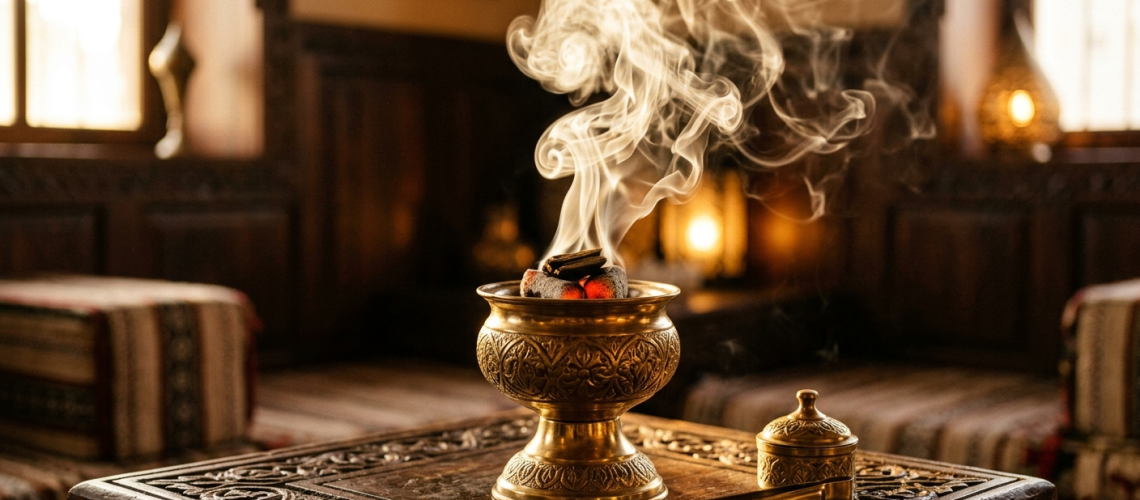
Bukhoor (also spelled bakhoor, Arabic: بخور, pronounced boo-KHOOR) is traditional Arabian incense made from natural agarwood (oud) wood chips soaked in fragrant oils, resins, and spices – heated on charcoal or an electric burner to release rich, long-lasting aromatic smoke used to perfume homes, clothing, hair, and gathering spaces across Dubai, the UAE, and the wider Arab world.
That is the complete answer in one sentence. But if you want to understand why bukhoor has shaped social life in Dubai for centuries, what separates a AED 30 piece from a AED 500 one, and how to buy an authentic blend without being misled – this guide covers all of it.
From the ancient Incense Road to your Dubai apartment, here is everything you need to know about bukhoor in Dubai
What Is Bukhoor in Dubai? – Definition, Pronunciation, and Spelling
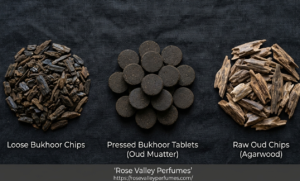
Bukhoor is the finished, blended form of Arabian incense. It begins with agarwood chips – the resinous heartwood of the Aquilaria tree, known in Arabic as oud (عود) – soaked in fragrant oils, combined with resins and spices, then shaped into tablets or left as natural loose pieces.
When a small amount is placed on a glowing charcoal disc or an electric burner, the heat slowly draws the oils and aromatic compounds out of the wood. The result is a thick, layered, intensely fragrant smoke that lingers in a room, on fabric, or in hair for hours – and sometimes into the following day.
The word comes from the Arabic root bakhur (بخور), meaning “smoke” or “fumigation.” In everyday Dubai speech, you will hear both bukhoor and bakhoor interchangeably. Both spellings are correct, both widely used, and both describe exactly the same product. The variant bakhur is also common. Throughout this guide we use bukhoor, but everything here applies equally to every spelling.
How Bukhoor Differs from What You Might Confuse It With
This is where most guides fail the reader. Here is a clear breakdown of how bukhoor in Dubai relates to the other aromatic products you will find in shops across Deira and beyond.
Bukhoor vs. Raw Oud Chips Raw oud chips are chunks of agarwood cut directly from the Aquilaria tree with minimal processing. They carry the natural, unblended scent of the wood. Bukhoor is made from oud chips – but only after those chips have been soaked, blended with other ingredients, and properly aged. Think of raw oud as the grape and bukhoor as the finished wine.
Bukhoor vs. Oud Muatter Oud muatter (also spelled muattar) sits between raw chips and fully blended bukhoor. Muatter chips have been soaked in oud oil and perhaps one or two other oils, but they are not as fully blended or spiced as traditional bukhoor. Muatter burns cleaner and delivers a more direct, single-wood aroma. Both are widely available across Dubai – sometimes labelled together, sometimes separately. Explore Rose Valley’s Bukhoor & Oud Muatter range to compare them side by side.
Bukhoor vs. Incense Sticks Western or Indian incense sticks (agarbatti) are made by rolling fragrant paste around a bamboo stick. They burn quickly, produce light smoke, and deliver a thin, single-note scent that disappears fast. A quality bukhoor chip, properly heated, will scent a medium-sized room for 30 to 45 minutes – the depth of fragrance is incomparable.
Bukhoor vs. Frankincense (Luban) Frankincense – called luban (لبان) in Arabic – is the dried resin of the Boswellia tree. It is a completely separate product. Some bukhoor blends contain small amounts of luban as an ingredient and the two are often burned together, but they are not the same thing.
Quick Comparison: Bukhoor vs. Similar Arabian Incense Products
| Product | Base Material | Processing Level | Scent Character | Burn Method | Dubai Price Range |
| Bukhoor | Oud/agarwood chips | Fully soaked, blended, spiced | Rich, layered, complex | Charcoal or electric | AED 20–500+ |
| Raw Oud Chips | Agarwood wood | None or minimal | Raw, woody, resinous | Charcoal | AED 50–1,000+ |
| Oud Muatter | Agarwood chips | Soaked in oud oil only | Clean, direct oud scent | Charcoal or electric | AED 40–400 |
| Incense Sticks | Bamboo + paste | Rolled | Light, single-note | Direct flame | AED 5–30 |
| Frankincense | Boswellia resin | Dried/raw | Sharp, citrusy, spiritual | Charcoal | AED 10–80 |
The History of Bukhoor – From Ancient Arabia to Dubai’s Deira Souks
The Incense Road – Where It All Began
To understand why bukhoor holds such a central place in Dubai culture, you need to understand ancient geography. The Arabian Peninsula was not just a desert – it was the crossroads of the ancient world’s most valuable trade route: the Incense Road.
For thousands of years, fragrant resins, woods, and spices moved in three directions:
- Northward – from Yemen and Oman through the Levant to the Mediterranean world.
- Westward – to Egypt, where pharaohs burned aromatic resins in royal temples and tombs.
- Eastward – to Persia, India, and eventually China.
Frankincense, myrrh, and agarwood were among the most precious commodities in the ancient world – worth more per weight than gold in some historical periods. Agarwood entered the Arabian Peninsula through Indian and Southeast Asian traders who recognised the Peninsula’s strategic position as a global transit hub. Arabian merchants then blended imported woods with local resins and oils, creating the earliest versions of what we today call bukhoor.
Pre-Islamic Arabia – Fragrance as Currency and Status
Long before Islam, incense played both a practical and a ceremonial role in Arabian tribal life. Early Arabian nomads burned aromatic materials for four primary reasons:
- To repel insects during extended camp life in the desert.
- To purify water sources and the immediate living environment.
- To mark tribal territory with a distinctive, recognisable scent that identified the camp to allies and traders.
- To signal wealth and social standing – the more elaborate the aromatic materials, the more powerful the tribe.
A visitor greeted with fine incense understood immediately they were being received with genuine respect. Fragrance was a social signal long before it became a personal luxury.
How Islam Elevated the Practice of Burning Bukhoor
When Islam spread across the Arabian Peninsula in the 7th century CE, it did not displace the tradition of incense – it codified and elevated it. Several hadith (the recorded sayings and actions of the Prophet Muhammad, peace be upon him) speak positively about pleasant fragrance. One well-known narration records that the Prophet considered pleasant scent among the things he loved most in the world.
As a result, burning bukhoor became an established act of both hospitality and spiritual preparation across four settings:
- In the home before prayer, as part of preparing a clean and welcoming environment.
- Before guests arrive, as a deliberate mark of respect, warmth, and welcome.
- At weddings, as a blessing and a purification of the new couple’s space.
- At Eid and Ramadan gatherings, as an inseparable part of celebratory preparation.
To this day, bukhoor is burned in mosques across the UAE before Friday prayers, in homes on Thursday evenings (the traditional start of the Islamic weekend), and at every major celebration across the Gulf.
Why Dubai Became the Global Capital of Bukhoor
Dubai’s relationship with Arabian incense is inseparable from its history as a trading port. Three key historical developments shaped this:
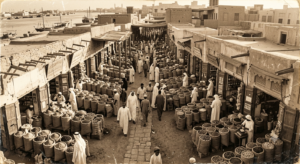
- The Creek in Deira – from the early 1800s, one of the most active natural harbours on the Arabian Gulf, where merchants from India, Persia, and East Africa converged with oud and incense among the most valuable cargo.
- The Deira Spice Souk – established on Baniyas Street near the Al Ras Metro area, growing directly from that trade history. The narrow lanes that today sell saffron, frankincense, and bukhoor were, a century ago, the primary wholesale channels for fragrant goods arriving by dhow from Malabar, Gujarat, and the East African coast.
- The oil wealth era – when Dubai modernised rapidly through oil revenue in the 1970s and 1980s, the fragrance trade did not contract. It expanded dramatically. Luxury Arabian perfume houses emerged, international oud sourcing became more sophisticated, and bukhoor evolved from an everyday household staple into a globally recognised premium product associated with Gulf refinement and cultural identity.
What Is Bukhoor Made Of? – Ingredients, Origins, and What Each One Does
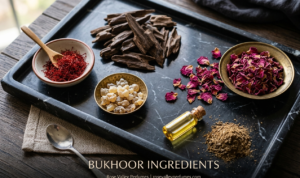
People consistently ask what separates a AED 30 bukhoor from a AED 300 one. The answer lies almost entirely in the quality of the ingredients and the care taken during blending.
1. Agarwood (Oud) – The Heart of Every Authentic Bukhoor
Every genuine bukhoor made in Dubai starts with agarwood. Agarwood is the resinous, dark heartwood of the Aquilaria tree, formed when the tree is infected by a specific mould (Phialophora parasitica). The tree responds by producing a dense, fragrant resin that saturates the wood over time – a process that can take decades in nature. The result is one of the rarest and most expensive raw materials on earth.
Market data: The global agarwood chip market was valued at approximately USD 7 billion in 2024 and is projected to reach USD 16.5 billion by 2034 (Fact.MR, 2024).
Not all oud is the same. The region where the Aquilaria tree grows profoundly shapes the final bukhoor character. Here is how each origin differs:
| Oud Origin | Scent Character | Typical Dubai Buyer |
| Hindi (India) | Deep, earthy, animalic, heavy, complex | Traditional Gulf connoisseurs; preferred for premium bukhoor. |
| Cambodi (Cambodia) | Rich, warm, slightly fruity, clean+-* | Most popular origin for everyday Dubai bukhoor. |
| Vietnamese | Light, sweet, green-floral, clean | Common in beginner-friendly and modern blends. |
| Indonesian | Woody, earthy, slightly green, good resin depth | Widely used in mid-range Dubai bukhoor. |
| Sri Lankan | Soft, slightly milky, less intense | Good entry point for oud-curious first-timers. |
When a product is labelled “Hindi Muatter” or “Cambodi Bukhoor” in a Dubai shop, that label tells you where the base oud was sourced – and this single factor influences scent character and price more than any other variable.
Want to explore the oud origins behind quality bukhoor? Browse Rose Valley’s full Agarwood collection – including Hindi, Vietnamese, Indonesian, and Sri Lankan oud chips, each sourced and labelled clearly by origin and grade.
2. The Muatter Process – The Step Nobody Explains
Before oud chips become bukhoor, they go through a soaking process known as the muatter method. Here is how it works:
- Raw agarwood chips are submerged in a blend of fragrant oils – typically including sandalwood oil, rose water, jasmine absolute, and sometimes oud oil itself.
- The chips are left to absorb those oils for anywhere from a few days to several weeks.
- Once fully saturated, the chips are shaped, pressed into tablets, or left as loose pieces – and the finished product is the bukhoor you buy in a Dubai shop.
The quality of the soaking process determines much of the quality of the finished bukhoor. Here is the practical truth most sellers will not tell you:
- A cheap bukhoor uses low-grade synthetic fragrance oils rushed through soaking in a matter of hours.
- An expensive bukhoor uses high-grade natural oils allowed to properly penetrate the wood over many days or weeks.
Quality tip: When you pick up a piece of genuine bukhoor and it feels slightly oily to the touch – not bone-dry and light – that is a reliable indicator the soaking was done properly.
3. Supporting Resins – The Depth Builders
Beyond the agarwood base, authentic Arabian bukhoor blends include natural resins that deepen and extend the scent. These resins also physically help bind the bukhoor and extend its burn time – which is why high-resin blends tend to burn fragrantly for longer.
The three most commonly used resins in Dubai bukhoor are:
- Frankincense (luban / لبان): Adds a sharp, citrusy, slightly piney quality that lifts the heavier oud and provides contrast. Used in smaller quantities to “clean” and balance the overall blend.
- Myrrh (murr / مر): Earthy, slightly medicinal, and warm. Adds ancient depth and rounds out the spicier notes in the blend.
- Benzoin: Sweet, vanilla-like, and smooth. A common base-note resin that softens darker, oud-heavy blends and makes them more approachable to newcomers.
4. Premium Additions – What Separates Luxury Bukhoor from Everyday Blends
The most expensive bukhoor in Dubai shops contains one or more of these premium ingredients:
- Saffron (za’faran / زعفران): Adds a golden, warm, honeyed spice note. Genuine saffron deepens the sweetness of the blend without adding sharpness. Easy to fake – real saffron builds slowly and warmly; synthetic saffron smells sharp and thin.
- Natural musk: Derived from plant sources such as ambrette seed in ethically produced modern blends. Adds warmth, depth, and exceptional longevity. A bukhoor with genuine musk is one you will still detect on your thobe or abaya the following day.
- Ambergris (anbar / عنبر): The legendary marine-origin fixative. Extraordinarily rare and expensive. Adds smooth, oceanic warmth and acts as a scent anchor, making every other ingredient last significantly longer.
- Patchouli: Earthy, dark, and slightly chocolatey. A familiar note in many modern Dubai bukhoor blends targeting a broader international audience.
- Vanilla and tonka bean: Found in lighter, accessible modern blends. Sweet and approachable – popular with first-time buyers who prefer a gentler introduction to Arabian incense in Dubai.
5. Natural vs. Synthetic Bukhoor – How to Tell the Difference Before You Pay
The Dubai bukhoor market has a well-known quality problem: synthetic fragrance oil-dominant products are regularly marketed as premium oud-based incense, particularly at tourist-facing shops. Knowing how to identify quality protects your purchase.
Signs of a natural, quality bukhoor (cold-sniffed before burning):
- The scent is layered – you detect dry wood first, then something subtly sweet or resinous beneath it.
- There is an oily richness to the cold aroma, with no sharp chemical edge.
- The chip feels slightly soft or oily to the touch – not bone-dry and lightweight.
- The colour is dark and naturally uneven – authentic oud does not look or feel manufactured-uniform.
- No single fragrance oil note dominates and overwhelms everything else.
Signs of a synthetic-heavy or low-quality bukhoor:
- The cold scent is bright, sharp, and one-dimensional – it smells like a bottled fragrance oil, not wood.
- The chip feels completely dry and artificially consistent.
- There is a faint chemical undertone that is neither quite floral nor quite natural.
- It smells nearly identical to a commercial air freshener or synthetic room spray.
Key rule: A trustworthy seller in Deira’s Perfume Souk will always allow you to cold-sniff before you decide. Reluctance to let you smell the product before burning it is meaningful information about the product’s quality.
Section 4: Types of Bukhoor Available in Dubai – A Complete Buyer’s Guide
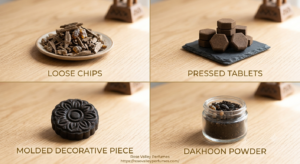
Dubai’s bukhoor market is one of the most diverse in the world. Understanding the categories before you walk into a shop means you spend less time confused and more time finding exactly what suits your home, occasion, and budget.
By Form Factor – Which Physical Type Is Right for You?
- Loose Chips
- The most authentic and traditional form of bukhoor in Dubai.
- Individual soaked agarwood chips of varying natural sizes and shapes.
- They produce more smoke and a more complex, evolving aroma as the chip burns through its layers.
- Best suited to experienced users who want the full traditional burning experience.
- Pressed Tablets or Discs
- Blended and compressed into flat discs or small rectangular pieces.
- They produce a more consistent burn and a more uniform scent session to session.
- Considerably easier for beginners to manage – less variable, more predictable.
- The majority of Dubai’s everyday household bukhoor comes in this form.
- Molded Decorative Pieces
- Shaped into domes, flowers, or small decorative bricks from blended bukhoor paste.
- Primarily for gifting and aesthetic presentation rather than maximum scent performance.
- The compression process can slightly reduce aroma complexity compared to loose chips.
- Powder Blends (Dakhoon)
- A fine aromatic powder burned directly on charcoal.
- Produces a dense cloud of fragrant smoke very quickly – ideal for perfuming a room fast before guests arrive.
- Very potent – a small pinch is sufficient for a large room.
- A little genuinely goes a very long way.
By Scent Character – Finding Your Personal Style
Heavy and Dark Bukhoor
- Dominated by Hindi or Cambodi oud, dark resins, and musk.
- The classic Gulf style – intense, smoky, deeply woody, and long-lasting.
- If you have walked into a traditional Emirati majlis and been enveloped by that unmistakable cloud of rich, complex incense, this is exactly what you experienced.
- Best for: traditional Emirati households, serious fragrance enthusiasts, hosting formal gatherings.
Light and Floral Bukhoor
- Built on a Vietnamese or Indonesian oud base with rose, jasmine, or other floral oils as dominant notes.
- Sweeter, more accessible, and less polarising for people who are new to Arabian incense.
- Popular with younger Dubai residents, first-time buyers, and expat households.
- Best for: daily home use, introductory gifts, modern living spaces.
Modern and Sweet Blends
- Feature vanilla, amber, tonka bean, and sometimes a light oud note.
- Cater to a global audience and are increasingly common in Dubai mall perfumeries.
- A good starting point for complete beginners.
- Best for: people entirely new to bukhoor who want a familiar, non-challenging entry point.
Dubai Price Tiers – What to Expect at Every Level
Understanding Dubai’s pricing landscape before you walk into a shop protects you from both overpaying and being misled about quality.
| Price Tier | What You Get | Best For |
| Entry-level AED 15–60 | Mostly synthetic fragrance oil-dominant, pressed tablet form. | Everyday home freshening. Not a fair representation of authentic bukhoor. |
| Everyday quality AED 60–200 | Genuine oud content, Indonesian or Vietnamese origin, real blending. | Daily home use, introductory purchases, exploring scent styles. |
| Premium AED 200–500 | Hindi or Cambodi oud base, natural resins, genuine saffron or musk. | Special occasions, hosting guests, quality gifting. |
| Luxury / collectible AED 500+ | Rare oud origins, ambergris-fixed, long-aged soaking, small production batches. | Connoisseur collecting, landmark gifting, serious fragrance investment. |
Not sure where to start? Browse Rose Valley’s Bukhoor & Oud Muatter collection – blends available across every price tier, each labelled clearly by scent character and origin.
Section 5: How to Burn Bukhoor at Home – Step-by-Step Guide (Charcoal and Electric Methods)
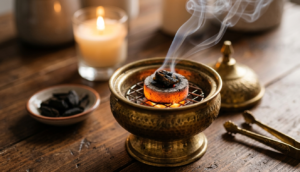
Quick Answer – Burn Bukhoor in 6 Steps
To burn bukhoor in Dubai the correct way:
- Place your mabkhara on a heat-proof surface.
- Light a charcoal disc until it glows red and develops a full white ash coating.
- Set the charcoal in the burner’s bowl.
- Wait 2–3 minutes for the charcoal to catch and glow evenly across the whole disc.
- Place a small piece of bukhoor – no larger than a thumbnail – on the glowing coal.
- Allow the fragrant smoke to rise and direct it toward the room, clothing, or fabric you want to scent.
That is the complete method. What follows is the expanded version with full timing, practical tips, and the modern electric alternative.
Method A – Traditional Charcoal Mabkhara (The Authentic Experience)
What You Will Need:
- A mabkhara (traditional Arabian incense burner) – available in brass, ceramic, or carved wood with a metal bowl insert.
- Self-igniting charcoal discs – available at any Dubai supermarket or Deira souk shop for around AED 5–10 per roll.
- A lighter or long matchstick.
- Metal tongs or tweezers for handling hot charcoal safely.
- Your bukhoor.
Step-by-Step Instructions:
Step 1 – Prepare your space. Place the mabkhara on a heat-proof surface – marble, tile, or a ceramic plate all work well. If you are in a Dubai apartment, open a window or turn on the kitchen extractor fan before you light anything. Closed, air-conditioned spaces concentrate smoke faster than most people expect, and ventilation before you start is the single most practical safety habit you can build.
Step 2 – Light the charcoal. Hold the charcoal disc in tongs and use a lighter to heat one corner until it begins to spark and glow orange. Self-igniting charcoals are coated with a light accelerant that starts the burn. Allow the spark to travel across the disc until approximately half the surface has turned grey-white with ash. This typically takes 2–3 minutes.
Step 3 – Place and wait. Set the glowing charcoal in the bowl of your mabkhara and wait another full 2 minutes. You want the entire disc glowing evenly, not just one side. A half-lit charcoal will not properly vaporise the bukhoor oils and will produce an incomplete, flat aroma with an unpleasant raw coal smell beneath it.
Step 4 – Add the bukhoor. Place a single piece of bukhoor – approximately the size of a large thumbnail – directly on the centre of the glowing coal. Do not add more for a standard room. Overloading the burner is the single most common beginner mistake and creates an overwhelming cloud of smoke rather than a pleasant, layered fragrance that builds naturally.
Step 5 – Direct the smoke. For room diffusion, allow the smoke to rise naturally and circulate freely. For clothing, hold your garment – kandura, abaya, thobe, or jacket – tent-like over the mabkhara and allow the smoke to rise up into the fabric for 15–30 seconds. Move the fabric gently to distribute the scent evenly. This is a normal everyday ritual for many Emiratis before leaving the house, and it produces a depth of fragrance that liquid perfume cannot replicate.
Step 6 – Safe finish. A single piece of quality bukhoor on charcoal burns actively for 20–35 minutes. Residual heat from the charcoal may continue releasing faint aroma for another 10–20 minutes after the chip is fully consumed. Never leave a lit charcoal mabkhara unattended. Always extinguish the charcoal completely in a pot of sand or cold water when you are finished.
Method B – Electric Mabkhara (The Modern Dubai Approach)
Electric bukhoor burners have become the standard in Dubai apartments over the past decade. The practical reasons are clear:
- No open flame to manage.
- No charcoal ash to clean up.
- Easy, adjustable temperature control for precise scent delivery.
- Significantly less visible smoke – far less risk of triggering your building’s fire alarm.
Electric burners have a small ceramic or metal heating plate that warms to a set temperature, controlled by a dial or digital setting. The bukhoor sits on this plate and its oils are gently vaporised rather than combusted.
Step-by-Step Instructions:
- Plug in the burner and set it to a low-to-medium heat setting. On a numbered dial from 1–5, start at setting 2.
- Place a small piece of bukhoor – slightly smaller than you would use for charcoal – on the heating plate. Electric burners extract fragrance more efficiently because the heat is consistent, so you need noticeably less material per session.
- Allow 3–5 minutes for the plate to fully heat and for the fragrance to begin releasing. Electric burning is slower and subtler than charcoal – the scent builds gradually rather than arriving all at once.
- Adjust the temperature based on what you detect. If you smell nothing, increase the heat by one setting. If visible smoke is appearing, reduce it. The goal with electric burning is a gentle, fragrant vapour that fills the room steadily – not a cloud of dense smoke.
Electric vs. Charcoal – Which Is Right for You?
| Factor | Charcoal Method | Electric Method |
| Scent intensity | Higher, denser, more immersive | Lower, more subtle, builds gradually |
| Smoke volume | More | Significantly less |
| Authenticity | Full traditional experience | Modern, practical adaptation |
| Safety in apartments | Requires active ventilation | Much safer – no open flame |
| Ease of use | Moderate – requires some practice | Very easy – suitable for all beginners |
| Running cost | Charcoal discs: AED 5–10 per roll | Electricity only |
| Best for | Special occasions, hosting guests | Daily home use, apartments |
For daily home use in a Dubai high-rise, the electric method wins on safety and practicality every time. For special occasions, hosting guests, or the full traditional cultural experience, charcoal is incomparable.
Important: Dubai Apartment Fire Alarms and Bukhoor
Dubai’s modern residential buildings – particularly in Downtown Dubai, Dubai Marina, Business Bay, and Jumeirah Lake Towers – have sensitive smoke detectors calibrated for fire safety. Burning charcoal bukhoor in a small, sealed apartment without ventilation can and does trigger these alarms.
If you are burning charcoal bukhoor indoors, always follow these five precautions:
- Open at least one window before lighting the charcoal.
- Keep the burning session under 20 minutes in a small room.
- Do not position the mabkhara directly beneath a smoke detector.
- Consider burning in the kitchen with the extractor fan running at full power.
- Use the electric method for regular weekday evenings and reserve charcoal for well-ventilated, special occasions.
The electric method eliminates this concern entirely and is what the majority of Dubai residents use for everyday home burning.
Section 6: Why Bukhoor Is Used in Dubai – Cultural Meaning, Rituals, and UAE Traditions
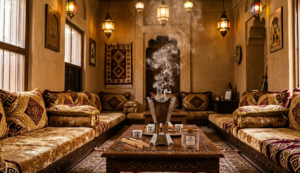
Bukhoor Is a Social Language, Not Just a Fragrance
In the West, burning incense is typically a personal act – a mood-setter, a wellness ritual, or a scent preference. In Dubai and across the Gulf, bukhoor carries a completely different social weight. When a host burns bukhoor before your arrival, it is not because the house needed freshening. It is a deliberate announcement of welcome. It says, without words: you matter enough for me to prepare for your arrival. The richer and more lingering the scent, the deeper the respect being expressed.
This tradition predates the modern UAE by centuries. Travelers who visited Gulf port towns in the 18th and 19th centuries recorded that the first thing they noticed upon entering any home of standing was the heavy, sweet smoke of incense. The tradition has never broken.
The Majlis – Where Bukhoor Plays Its Most Important Role
The majlis (مجلس, meaning “a place of sitting”) is the traditional receiving room in an Emirati or wider Gulf household. It is where guests are formally welcomed, where business is discussed over coffee, where the extended family gathers, and where decisions of significance are made. Every proper majlis burns bukhoor when guests arrive.
The ritual follows a specific, respected sequence:
- The mabkhara is lit and allowed to build a steady, fragrant smoke before guests enter.
- The host passes the burner to the first guest on their right.
- Each guest leans forward and allows the smoke to rise into their thobe, kandura, abaya, or hair for a few moments.
- The guest passes the mabkhara to the next person on their left, moving clockwise around the room.
- The ritual continues until every guest has received the smoke.
This act is simultaneously practical – everyone leaves smelling extraordinary – and deeply ceremonial. Sharing the same fire is an ancient gesture of trust, community, and belonging.
Etiquette note: Refusing the mabkhara when it is offered is considered mildly discourteous in traditional Emirati and Saudi settings. Accepting it, leaning into the smoke, and passing it on with your right hand is the correct etiquette.
Weddings, Ramadan, and Eid – Bukhoor at Every Major Celebration
Bukhoor appears at every major cultural milestone in Emirati life. Here is how it is used across the three most important occasions:
At UAE Weddings:
- The bridal preparation room is traditionally heavily scented before the bride dresses.
- The reception space is filled with fragrant smoke before guests begin to arrive.
- In some traditions, the couple’s new home is fumigated with bukhoor before they enter together for the first time – a combined blessing and purification of the shared space.
During Ramadan in Dubai:
- Burning bukhoor in the evening after iftar is widespread practice across all communities.
- The Ramadan evenings in older Dubai neighbourhoods like Deira and Al Fahidi carry a specific, layered scent that long-term residents describe as one of the most distinctive sensory memories of the holy month.
- Many families burn a specific blend reserved only for Ramadan – a blend they do not use at any other time of year.
At Eid Across the UAE:
- Homes are cleaned, new clothes are prepared, and bukhoor is burned before family visits begin on the morning of Eid.
- The scent of the home on Eid morning is part of the emotional and sensory memory of the celebration for many Emirati families.
- The specific bukhoor used for Eid is often heavier and more formal than everyday blends.
Bukhoor as a Cultural Gift – What It Communicates
A quality bukhoor gift set from Dubai is one of the most culturally appropriate and genuinely valued gifts you can give in UAE culture. It is particularly well-suited to:
- Visiting someone’s home for the first time as a guest.
- Attending a business meeting with a UAE or Gulf counterpart and bringing a thoughtful gift.
- Marking Ramadan or Eid with a culturally resonant gesture for a colleague or client.
- Welcoming new neighbours or celebrating a new home.
- Giving a meaningful souvenir from Dubai to friends and family abroad.
A premium bukhoor gift communicates clearly and unmistakably: I know your culture and I respect it. For expats building professional or social relationships in the UAE, this one piece of cultural intelligence carries more social impact than almost any generic gift.
Section 7: What Are the Benefits of Bukhoor? – Beyond the Fragrance
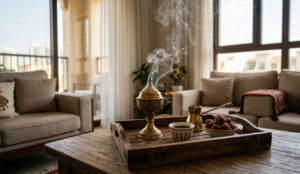
1. Superior Odor Elimination
Bukhoor’s smoke does not simply mask bad odours – it displaces them at a molecular level. Aromatic smoke binds to odour compounds in the air and neutralises them more effectively than spray fresheners, which only layer a pleasant scent on top of existing unpleasant ones.
A home that regularly uses bukhoor simply does not carry the residual smell of cooking, fabric, or stale air the way homes relying solely on spray fresheners do. This is the same scientific principle behind smokehouse preservation and the ceremonial fumigation practices found across multiple independent cultures worldwide for thousands of years. It works because it is chemistry, not folklore.
2. Documented Mood and Psychological Benefits
The connection between scent and mood is one of the most well-established areas of olfactory science. The olfactory system has a more direct anatomical connection to the brain’s limbic system – the area governing emotion and memory – than any other human sense. What you smell can trigger a genuine emotional response before your rational mind has consciously processed it.
Agarwood’s aromatic compounds release sesquiterpenes and volatile organic compounds including agarospirol when heated – a molecule shown in peer-reviewed research to interact with olfactory receptors in ways that produce calming and mood-elevating responses. A study indexed by the National Institutes of Health (NIH/PubMed) found that agarwood aromatherapy significantly improved sleep quality and reduced spontaneous anxiety-related activity, with the mechanism connected to serotonin regulation and GABA balance in the brain.
Supporting ingredients in bukhoor contribute documented benefits too:
- Sandalwood oil – one of the most common soaking oils in bukhoor production – has well-documented calming and anxiety-reducing properties.
- Frankincense has been studied in multiple independent contexts for its potential anxiolytic (anti-anxiety) effects.
- Patchouli is associated with grounding and emotional balance in aromatherapy traditions across multiple continents.
The claim that burning bukhoor lifts mood and reduces stress is not marketing language – it has a genuine scientific basis in the chemistry of its core ingredients.
3. Spiritual Focus and Meditative Clarity
In Islamic tradition, spiritual cleanliness and physical cleanliness are understood as inseparable. The use of pleasant fragrance during prayer is not only permitted but actively encouraged. Many Muslims who burn bukhoor before Fajr (dawn prayer) describe the scent as helping create a settled, focused mental state that supports the quality of their worship.
Across multiple unconnected religious traditions, aromatic smoke has long been used to mark sacred time and sacred space:
- Tibetan Buddhist monks use agarwood in meditation ceremonies to quiet mental agitation and deepen concentration.
- Sufi orders have historically incorporated fragrant wood into dhikr (remembrance) ceremonies.
- Shinto priests in Japan have used agarwood-based incense in temple rituals for over a thousand years.
The universality of this practice across unconnected cultures and centuries is a powerful testament to how deeply fragrance connects to human consciousness and the sense of the sacred.
4. Honest Caveats – Who Should Exercise Caution
It would be irresponsible to close this section without clearly noting that bukhoor produces real combustion smoke. For the following groups, regular indoor smoke exposure is not advisable:
- People with diagnosed asthma or COPD.
- People with significant respiratory sensitivity to smoke.
- Pregnant women, particularly in the first trimester.
- Young children under five years of age.
- Elderly people with existing respiratory or cardiovascular conditions.
For all of the above, the electric burner method – which produces significantly less visible smoke and fewer combustion products – is the practical and responsible alternative. Burn briefly, in a well-ventilated space, and never in a sealed room.
Section 8: How to Choose Quality Bukhoor in Dubai – What to Look For Before You Buy
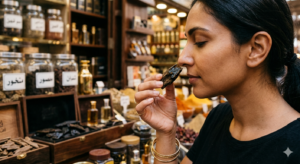
The Cold Sniff Test – Your Single Most Important Tool
The best thing you can do before purchasing bukhoor in Dubai is to cold-sniff it before anyone heats it for you. Pick up the chip or tablet, hold it close to your nose, and evaluate it unburned.
Signs of a natural, quality bukhoor:
- The scent is layered – you detect dry wood first, then something subtly sweet or resinous beneath it.
- There is an oily richness to the cold aroma, with no sharp chemical edge.
- The chip feels slightly soft or oily to the touch – not bone-dry and lightweight.
- The colour is dark and naturally uneven – authentic oud does not look or feel manufactured-uniform.
- No single fragrance oil note dominates or overwhelms everything else.
Signs of a synthetic-heavy or low-quality product:
- The cold scent is bright, sharp, and one-dimensional – like a bottled fragrance oil, not natural wood.
- The chip feels completely dry and artificially consistent.
- There is a faint chemical undertone that is neither quite floral nor quite natural.
- It smells nearly identical to a commercial air freshener or synthetic room spray.
Seller test: A trustworthy seller in Deira’s Perfume Souk will always allow you to cold-sniff before you decide. Reluctance to let you smell the product before burning it is itself meaningful information about the product’s quality.
Reading Dubai Bukhoor Labels – What the Language Actually Means
When buying packaged Arabian incense in Dubai, the label language carries specific meaning. Here is a quick decoder:
| Label Term | What It Actually Means |
| “Hindi Muatter” | Oud chips from India, soaked in fragrant oil. Usually the most intense and expensive. |
| “Cambodi” | Cambodian oud origin. Typically sweeter, more balanced, and widely approachable. |
| “Super” or “Special” | Marketing terms with no regulated meaning. Judge by price and smell, not these words. |
| “Natural ingredients” | Legally undefined in the UAE fragrance market. Use the cold sniff test, not the label. |
| Oud oil percentage (e.g. 15%+) | A genuinely useful quality signal when present. Rare on mass-market packaging. |
Freshness and Shelf Life – What to Know Before You Buy
Good bukhoor stored correctly retains its character for two to five years without significant scent loss. The fragrance oils remain stable as long as the product is not exposed to direct heat, UV light, or humidity.
Correct storage conditions:
- Store in an airtight container – a small glass jar with a secure lid is ideal.
- Keep away from direct sunlight at all times.
- Keep away from humidity – a bathroom cabinet is a poor storage location.
- Store in a cool, dark drawer or cupboard.
Shopping tip: When buying from a stall in Deira’s Spice Souk, check that stock is kept away from direct light and heat. Ask when the batch arrived – most experienced sellers will answer honestly, and freshness of stock is a genuine quality indicator.
Online vs. In-Store in Dubai – The Honest Advice
For your first few bukhoor purchases in Dubai, buy in person. The entire selection process depends on smell, and you cannot evaluate scent from a product photograph. The Perfume Souk in Deira, the specialty shops near the Gold Souk, and dedicated Arabian fragrance retailers exist precisely because bukhoor is a product you must experience before you commit to buying.
Once you know what you like – once you have a preferred oud origin, a preferred scent profile, and a comfortable price point – ordering online from a trusted UAE retailer is entirely practical and the product quality from a verified source will be consistent with what you sampled in person.
Already know your preference? Browse and order from Rose Valley Perfumes online – the same authentic range available in the Deira store, delivered across the UAE.
Section 9: Where to Buy Authentic Bukhoor in Dubai – Souks, Stores, Malls, and Online
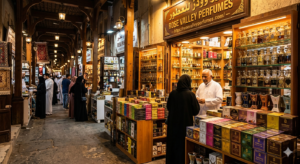
Deira Spice Souk and Perfume Souk – The Best First Stop
For most people who want to understand what authentic bukhoor in Dubai actually is before deciding what to buy, the streets of old Deira are the right starting point. There is no better introduction to Arabian fragrance culture anywhere in the city.
Practical visiting information:
- Location: Baniyas Street, Al Ras quarter, Deira, Dubai.
- Nearest Metro: Al Ras Station, Green Line.
- Opening hours: Saturday to Thursday, 10am–10pm (closed approximately 1pm–4pm).
- Best visiting times: Before noon or after 4pm – fewer crowds, more relaxed vendors, more time for genuine conversation.
Immediately adjacent is the Perfume Souk – a stretch of specialist shops carrying oud oils, bukhoor of all grades, musk blends, and traditional Arabian perfumes. This is where you can compare dozens of options side by side, take your time, and ask questions from vendors with decades of hands-on experience.
What to expect to pay in Deira:
- Entry-level bukhoor: AED 15–25 per box.
- Mid-range quality: AED 60–150 per box.
- Premium pieces: AED 200 and above.
Rose Valley Perfumes, Deira – Authentic Arabian Incense Since 1990
For visitors and Dubai residents who want expert guidance rather than an open browsing experience, Rose Valley Perfumes in Deira has been sourcing and supplying authentic Arabian fragrances in Dubai for over 35 years.
What makes Rose Valley different:
- The team knows the sourcing origin of every product in the collection.
- Every bukhoor blend is verified for natural oud content and cruelty-free sourcing.
- Products are stocked across the full price range – from accessible everyday blends to premium Hindi and Cambodi oud pieces.
- Expert guidance is available in-store and by phone for anyone unsure where to start.
Store details:
- Location: Deira, Dubai.
- Contact: 52 276 7436.
- 🌐 Online: rosevalleyperfumes.com
The Bukhoor & Oud Muatter collection includes both loose oud chips and blended bukhoor tablets across light and floral, medium and balanced, and heavy and dark scent profiles. If you are new to Arabian bukhoor in Dubai and want a trusted starting point with confidence, this is where to begin.
For those who want to explore the raw agarwood foundation behind every quality bukhoor blend, the Agarwood collection covers Hindi, Vietnamese, Indonesian, and Sri Lankan origins – each clearly labelled by source and grade.
Mall-Based Options – Convenience at a Premium
For residents who prefer the comfort of a mall environment, Dubai’s Arabian perfume retail within major shopping centres is extensive. The following locations all carry dedicated bukhoor ranges:
- Dubai Mall – widest overall selection, including international luxury fragrance houses.
- Ibn Battuta Mall – good range within a traditionally themed retail environment.
- Deira City Centre – convenient for Deira residents; solid mid-range and premium options.
- Mall of the Emirates – strong luxury-tier options at correspondingly higher price points.
Price reality check: Mall overheads are reflected in bukhoor pricing. You will typically pay 20–40% more for comparable quality than you would find in Deira. The advantage is air conditioning, transparent fixed pricing, and staff experienced at explaining products to international visitors new to Arabian incense.
Buying Bukhoor Online in Dubai
Noon, Amazon.ae, and the websites of established UAE perfume houses carry bukhoor for home delivery across the UAE. When ordering online, verify the following four things before purchasing:
- Clear labelling of oud origin (Hindi, Cambodi, Vietnamese, Indonesian, etc.).
- A stated return or exchange policy in case the scent profile does not match your expectations.
- Reviews that describe scent character and burn performance – not just packaging appearance.
- An established brand with a verified physical UAE presence – a reliable indicator of product traceability and quality consistency.
For UAE delivery with verified natural sourcing: Shop bukhoor online at Rose Valley Perfumes.
Dubai Buying Location Summary
| Location | Price Range | Best For | Authenticity Level |
| Deira Spice and Perfume Souk | AED 15–500+ | First-timers, connoisseurs, best overall value | Highest |
| Rose Valley Perfumes, Deira | AED 25–500+ | Expert guidance, verified natural sourcing | Highest |
| Dubai Mall / Ibn Battuta / DCC | AED 60–600+ | Convenience, international brand range | High |
| UAE online retailers | AED 20–500+ | Reorders, home delivery convenience | Variable – buy from verified retailers only |
Frequently Asked Questions
Q1: What does bukhoor smell like?
Bukhoor smells like a rich, multi-layered combination of deep woody agarwood, warm resins, and sweet or spiced fragrant oils. It is smoky and dense – not sharp or thin like incense sticks. Heavy traditional blends smell earthy, animalic, and deeply complex. Lighter modern blends lean toward sweet florals with a wood foundation. Walking into a room filled with quality bukhoor is often described as entering a five-star Gulf hotel or an old Arabian spice market – warm, enveloping, and unmistakably distinctive.
Q2: What is the difference between bukhoor and oud?
Oud is the raw material. Bukhoor is the finished, blended product made from it. Oud refers to raw agarwood chips cut from the Aquilaria tree with minimal processing. Bukhoor is made by soaking those chips in fragrant oils, resins, and spices, then ageing the blend. Burning raw oud gives a clean, direct wood scent. Burning bukhoor gives something far more complex and evolved because of the blending process it has undergone.
Q3: How do you burn bukhoor?
Light a charcoal disc until it fully glows, place it in your mabkhara, wait 2–3 minutes, then add a thumbnail-sized piece of bukhoor on the coal. Allow the fragrant smoke to rise and direct it toward the space or clothing you want to scent. For apartments, use an electric mabkhara instead – place the bukhoor on the heated plate at low-medium heat and allow 3–5 minutes for the fragrance to build. The electric method is safer for Dubai high-rises and requires no charcoal at all.
Q4: Is bukhoor safe to burn indoors?
Yes, with proper ventilation. Open a window or run the kitchen extractor fan before burning charcoal bukhoor in any indoor space. Keep sessions under 20 minutes in small rooms. People with asthma, COPD, or significant respiratory sensitivity should use the electric method, which produces considerably less smoke. Never leave a lit charcoal mabkhara unattended.
Q5: Is bukhoor the same as bakhoor?
Yes – bukhoor and bakhoor are two different English spellings of the same Arabic word (بخور) describing the same product. Both spellings are correct and widely used in the UAE and across Gulf countries. You will see both on product packaging, in shop signage, and in online search results in Dubai. The product they describe is completely identical.
Q6: How long does bukhoor last when burning?
On charcoal, a thumbnail-sized piece burns actively for 20–35 minutes, with residual fragrance continuing for another 10–20 minutes from the charcoal heat. On an electric burner at moderate heat, the same piece may last 30–60 minutes. Denser, resin-rich blends last notably longer than lighter modern blends.
Q7: Can you burn bukhoor without charcoal?
Yes. Electric mabkhara burners are widely available across Dubai – in Deira perfume shops, in Carrefour and Lulu hypermarkets, and online – starting from around AED 30 for a functional basic model. They require no charcoal, produce significantly less smoke, and are far more practical for regular apartment use.
Q8: Where can I buy authentic bukhoor in Dubai?
The best places to buy authentic bukhoor in Dubai are the Deira Perfume Souk and specialist Arabian fragrance retailers in Deira. For verified natural sourcing and expert guidance across the full price range, Rose Valley Perfumes in Deira has been a trusted source of authentic Arabian fragrances since 1990. Mall perfumeries at Dubai Mall, Ibn Battuta, and Deira City Centre also carry good ranges at higher price points.
Conclusion – The Smoke, the Story, and Your Next Step
From ancient caravan routes threading across the Arabian desert, across the teak decks of dhows trading through Dubai Creek, into the narrow lanes of Deira’s Perfume Souk, and now into your home – bukhoor has traveled far, but it has never really changed. It is still wood, oil, heat, and smoke. It is still an act of welcome. It is still one of the most direct sensory pathways into the memory and identity of the Gulf.
Now that you understand what bukhoor is in Dubai, where it came from, what goes into it, how to burn it correctly, and how to choose it without being misled – the only thing remaining is the experience itself. No guide, however thorough, can substitute for the sensation of a quality piece of Arabian bukhoor on a glowing charcoal disc: the way the smoke builds slowly, the way the scent evolves as heat draws out each layer of the blend, the way a room transforms completely in five minutes.
Ready to experience authentic Arabian incense in Dubai?
- Browse the Bukhoor & Oud Muatter collection – from light and floral blends for first-timers to premium Hindi and Cambodi oud for serious fragrance enthusiasts.
- Explore the Agarwood collection – the raw oud origins behind every quality bukhoor blend.
- Shop the full Rose Valley Perfumes range – authentic Arabian fragrances sourced and verified in Deira since 1990.